All species › Passerines › Monarchs and allies › Black-faced Monarch
Black-faced Monarch | Monarcha melanopsis
Maskermonarch | Monarca carinegro
The Black-faced Monarch is the best-known monarch of eastern Australia and one of the few songbirds on the continent whose migration is regularly observed: each spring they work south along the east coast, and each autumn back again. It is a blue-grey bird with a rufous-orange belly and a small, crisply cut black face — the mask that gives it its Dutch name. In rainforest it gives itself away above all by its clear, two-note whistle.

Voice
A rich, pure whistle in two syllables, usually rendered why-you or which-you, the second note sliding down; the bird repeats the motif slowly and at long intervals, as though thinking it over. There is also a harsh, rasping scold — a dry rattle that carries well in forest and is often the first sound when a pair is disturbed. On migration they are largely silent, and then slip unnoticed through gardens and copses they avoid the rest of the year.
Recording: Romuald Mikusek — CC BY-NC-SA 4.0 · Marlo, East Gippsland Shire, Victoria, Australia · xeno-canto
Identification
A compact, fairly large monarch with a stout blue-grey bill and blue-grey head, back, wings and tail. From the forehead across the lore onto the chin and upper throat runs a compact black mask that sits against the grey like a small, sharply cut-out patch. Breast, belly and undertail coverts are warm rufous-orange, brightest on the breast. The legs are blue-grey, the eye dark. The sexes are alike; juveniles lack the black entirely and have a dingy grey face with a pale throat, which raises questions every autumn. Wings and tail are plain grey, without black contrast — that is the character that counts.
Confusion species
The only genuinely difficult species is Black-winged Monarch (Monarcha frater), which can overlap with this one on Cape York Peninsula in the austral summer: in frater the flight feathers, greater coverts and tail are black and stand out clearly against the grey of the back, whereas in Black-faced Monarch they stay plain grey; frater is also paler orange below with a whitish belly. Spectacled Monarch (Symposiachrus trivirgatus) is smaller, carries its black as a broad ring around the eye rather than a closed mask with black throat, is white on the belly instead of orange, and shows white tail tips. White-eared Monarch (Carterornis leucotis) is black and white without any orange. The flycatchers of the genus Myiagra, such as Leaden Flycatcher (Myiagra rubecula), are slimmer, quiver the tail constantly and never have a black mask.
Habitat
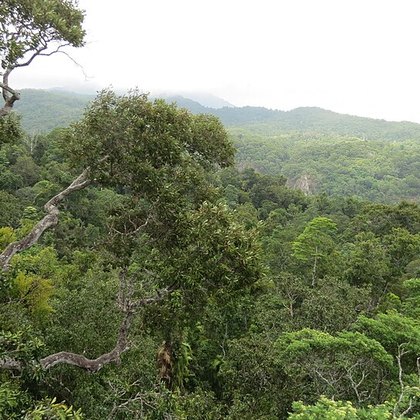
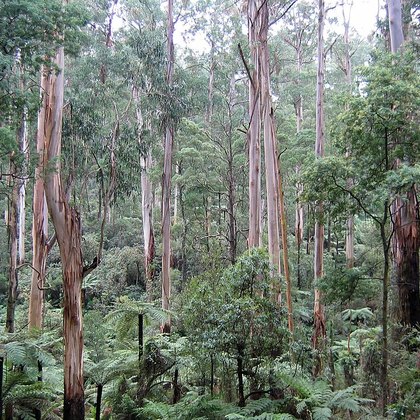
In the breeding season rainforest, wet eucalypt forest and densely vegetated gullies, where the bird works the middle and lower storey, gleaning insects from foliage or taking them in short sallies. The nest is a neat, deep cup of moss and cobweb in a fork, often low over a track or a creek. Outside the breeding season it is far less particular: on migration it turns up in drier woodland, in mangrove and regularly in suburban gardens and parks.
Where the bird is most often found, arranged by main group and formation.

Range and movements
Breeds in eastern Australia, from the Wet Tropics of north Queensland south along the coast and ranges to central Victoria. The southern breeders are true summer visitors: they arrive in September and October and leave northward in March and April, with part of the population crossing Torres Strait to winter in southern New Guinea. At the far north of the range some birds are present year-round. The movement along the east coast is conspicuous enough to be tracked at established count sites.
- Breeding (summer)
- dark = core range, pale = thinly spread
Where and when to look
Look for it in spring in moist gullies with a rainforest edge, and check the wing first: plain grey means Black-faced Monarch, contrasting black means you are looking at Black-winged Monarch on Cape York. The slow, two-note whistle is often the only clue outside the breeding season. In September and October it pays to walk the gardens and parks of coastal towns: migrants then turn up in the oddest places, usually silent and low in the shrubbery.
Conservation
Least Concern (LC). The species is still common throughout its breeding range and benefits from the fact that a substantial share of the eastern rainforest lies in national parks and the World Heritage area. Where the pressure lies is in the fragmentation of lowland forest and of the creekside strips that form the migration route: a migrant needs not only a breeding ground and a winter quarter but also the links between them. No structural decline in numbers has so far been established.
Scientific name
Monarcha melanopsis | (Vieillot, 1818)
Louis Pierre Vieillot described the species in 1818 as Muscicapa melanopsis, from a bird taken in New South Wales; because the species now stands in Monarcha, author and year are in parentheses. The genus Monarcha goes back to Ancient Greek monarkhos, 'sole ruler' — a name Vigors and Horsfield chose in 1826 without explaining it, and which Dutch has simply taken over as 'monarch'. The epithet melanopsis combines melas ('black') and opsis ('face, appearance') into 'black-face'. The English Black-faced Monarch, the Dutch maskermonarch and the Spanish monarca carinegro all name the same character.