All species › Passerines › Monarchs and allies › Shining Flycatcher
Shining Flycatcher | Myiagra alecto
Zwarte monarch | Monarca reluciente
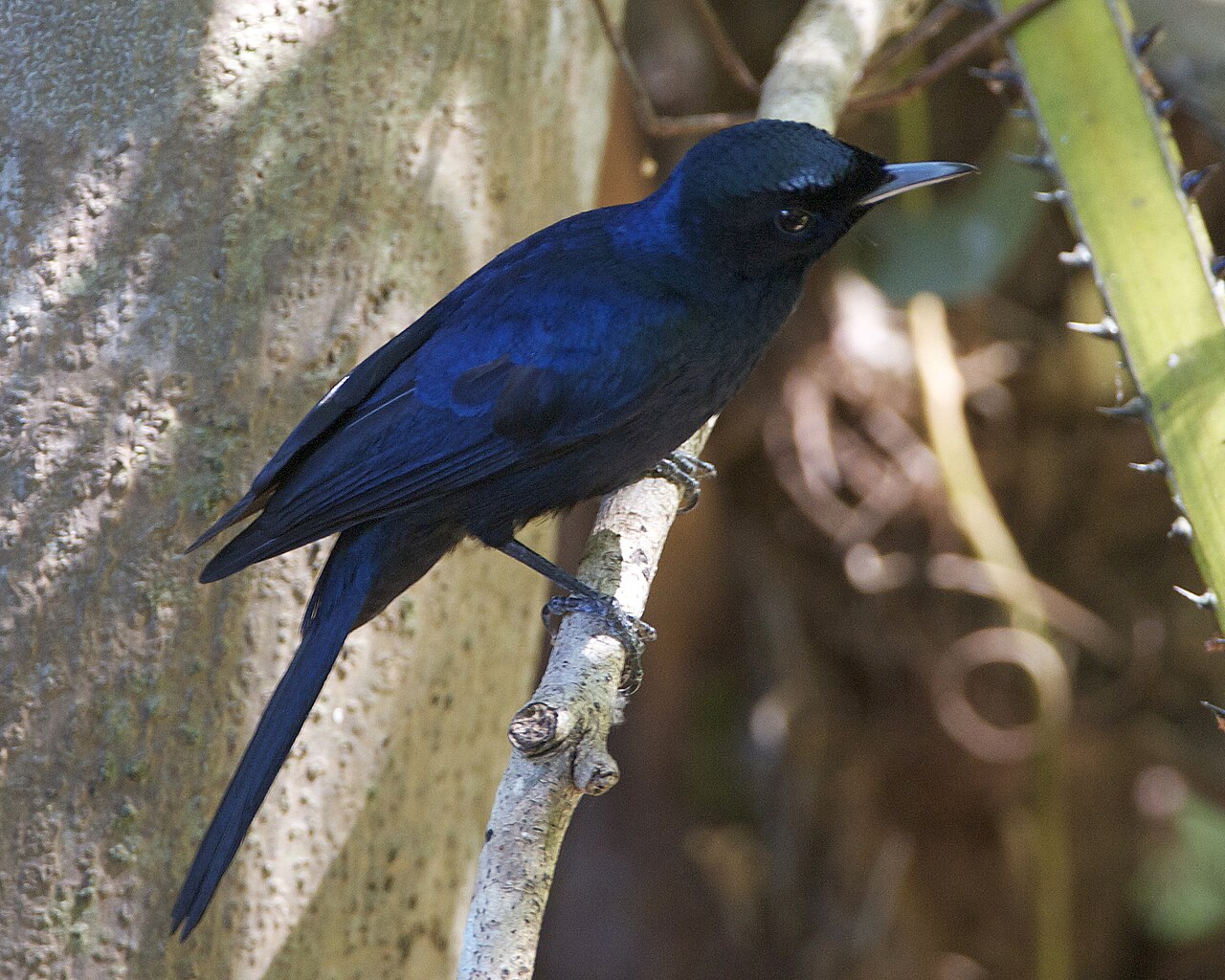
The Shining Flycatcher is the bird of the mangrove and the tropical creek bank, and the only Australian monarch flycatcher whose male is black from bill tip to tail tip — no white throat, no white belly. The female is patterned so differently, with a rufous back and white underside, that anyone seeing the pair for the first time easily takes them for two species. Both keep low over the water, in the shade of the mangrove roots.
Voice
Loud and varied: clear, ringing whistles in short series, a sharp whit-whit, and alongside these a hard rattling scold. Pairs often call in turn, so that it sounds as though two birds are answering each other — which they are. The voice is stronger and fuller than that of the other Myiagra species and carries through dense mangrove; you generally hear the bird long before it shows itself in the gloom beneath the canopy.
No freely licensed recording has been found for this species yet; what to listen for is described below.
Identification
A stout, thickset flycatcher of sixteen to nineteen centimetres with a broad, blue-grey bill. The male is wholly glossy blue-black, chin, throat, breast and belly included, without any white — the only Australian member of the genus of which that is true. The female has a glossy blue-black head, a warm cinnamon-rufous back, wings and tail, and a pure white underside from the throat down. Young birds resemble the female. Both sexes spread and fan the tail when excited and move restlessly through the lowest vegetation layer.
Confusion species
Within the genus confusion is slight in practice, precisely because the male alone carries no white: in Restless and Paperbark Flycatcher (Myiagra inquieta and Myiagra nana) the throat is pure white, and in Satin and Leaden Flycatcher (Myiagra cyanoleuca and Myiagra rubecula) the dark ends in a bib above a white belly. The female, with her rufous back, resembles none of those and is more likely taken for a shrikethrush or another rufous forest bird; the glossy black head and the broad blue-grey bill mark her out. In the mangrove, Broad-billed Flycatcher (Myiagra ruficollis) shares the habitat, but is far smaller and has an orange throat in both sexes. Fantails (Rhipidura rufifrons and relatives) also fan the tail but are smaller and differently marked.
Habitat
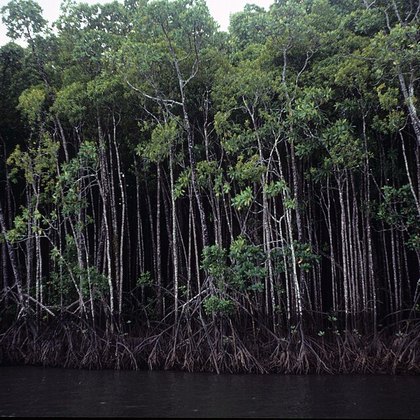
Mangrove first of all, and beyond that everything that resembles it: dense growth along tropical creeks and rivers, paperbark swamp forest, monsoon forest and the humid margins of lowland rainforest. The bird stays almost always low, within a few metres of the water, and hunts among the stilt roots and over the mud for insects and small crustaceans. In doing so it regularly comes to the ground, which the other Myiagra species seldom do.
Where the bird is most often found, arranged by main group and formation.


Range and movements
The coastal zone of tropical northern Australia, from the Kimberley across the Top End and the Gulf of Carpentaria to Cape York Peninsula and the tropical east coast of Queensland. Outside Australia the range extends across New Guinea, the Moluccas and Sulawesi. It is a resident holding its territory year-round; movements are local and follow the tides and water levels more than the season.
- Resident
- dark = core range, pale = thinly spread
Where and when to look
Work a mangrove creek by boat or on foot at low tide and look in the lowest two metres, not in the canopy. An all-black bird fanning its tail is unmistakable here; if a rufous bird with a black head and white belly settles beside it, that is not a second species but its mate. The loud whistling helps locate the bird before you find it in the gloom.
Conservation
Least Concern (LC). The species occupies a very large range from Sulawesi to Queensland and is common in suitable mangrove. Its vulnerability lies in the narrowness of that habitat: where mangrove is cleared, reclaimed, or dies back through sea-level rise and altered freshwater inflow, the bird goes with it. In Australia the mangrove belt is largely intact, so there is no national concern; in parts of South-East Asia the habitat type is under pressure.
Scientific name
Myiagra alecto | (Temminck, 1827)
Coenraad Jacob Temminck described the bird in 1827 as Drymophila alecto; Celebes was given as the locality, but the type proved to come from Ternate in the Moluccas. The genus Myiagra is built from Ancient Greek muia ('fly') and agra ('catching'). The epithet alecto refers to Alecto, one of the Furies of Greek mythology — avenging goddesses depicted in black; the name thus takes the jet-black plumage of the male. The English Shining Flycatcher and the Spanish monarca reluciente take the gloss of that same plumage, the Dutch Zwarte monarch its colour.