All species › Passerines › Monarchs and allies › Satin Flycatcher
Satin Flycatcher | Myiagra cyanoleuca
Satijnmonarch | Monarca satinado
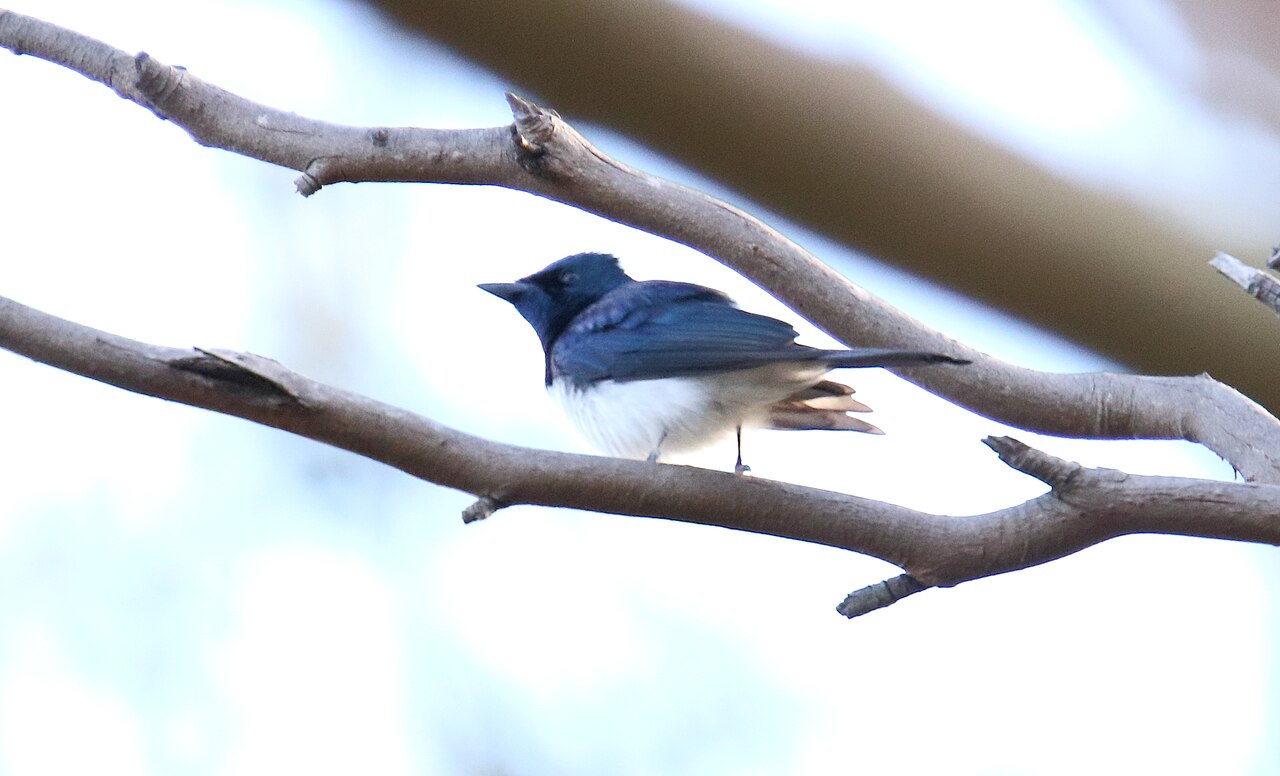
The Satin Flycatcher is the migrant among the Australian monarch flycatchers: it breeds in the tall wet forests of the south-east and Tasmania and spends the winter in New Guinea. The male is deep glossy blue-black with a clean white belly, the female wears a warm orange throat. And together with Leaden Flycatcher it forms the classic Australian identification trap: two species that differ on paper and often do not in the field.
Voice
A loud, harsh, rasping call — a grating tzzherr that cuts through the forest — alternating with clear, clipped whistled notes in short series. Satin Flycatcher sounds stronger, shriller and sharper than Leaden Flycatcher, whose call is buzzier, softer and more nasal. That difference in voice quality is the only character that works across both sexes and all plumages, and it is therefore the best separator between the two species. Anyone hoping to tell them apart should listen to recordings of both beforehand.
No freely licensed recording has been found for this species yet; what to listen for is described below.
Identification
A flycatcher of fifteen to seventeen centimetres that perches upright and quivers its tail constantly. The male is glossy blue-black above, on the head and on the breast, with a clear violet to green-blue sheen in good light; the black breast bib runs well down and ends in a sharp, rounded border against the white belly. The female has blue-grey upperparts with a glossy dark head, and a deep orange throat and breast reaching low onto the chest. Young birds resemble the female but are duller. The species has proportionately long, pointed wings — a migrant's silhouette.
Confusion species
Leaden Flycatcher (Myiagra rubecula) is the great pitfall, and it is more honest to admit the difficulty than to write it away. In males three things help, all of them relative: Satin is deeper blue-black with more gloss, where Leaden looks duller and greyer — leaden, indeed; the black bib reaches further down in Satin and ends more sharply; and the wings are longer and more pointed. In poor light, which in the canopy is the rule, those differences vanish. Females are barely separable: Satin usually shows a deeper and more extensive orange running further onto the breast, but the variation overlaps and on a single view a female is often better left unnamed. The best separator is the call. Beyond that: Restless Flycatcher (Myiagra inquieta) has a pure white throat and no bib, and Shining Flycatcher (Myiagra alecto) has an all-black male, belly included.
Habitat
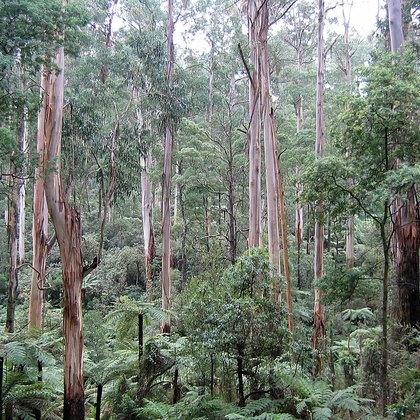
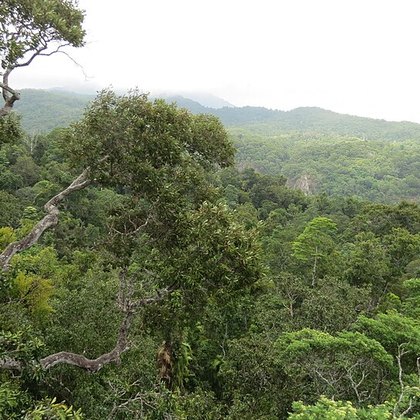
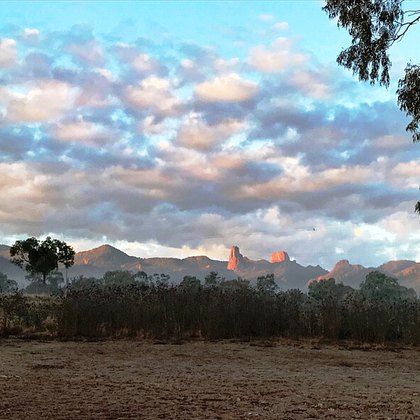
Breeds in tall wet eucalypt forest and wooded gullies with a closed canopy, where the bird hunts in the upper half of the trees and sallies from a branch at passing insects. On passage it turns up in much wider company: drier woodland, rainforest edges, mangrove belts and gardens with tall trees. In the New Guinea winter quarters it occupies lowland forest and forest edge.
Where the bird is most often found, arranged by main group and formation.
Range and movements
A breeding bird of eastern and south-eastern Australia, from the Wet Tropics of northern Queensland to Millicent in south-eastern South Australia, including Tasmania and the Bass Strait islands of King and Flinders. Birds move north in the southern autumn and winter in New Guinea; passage through Queensland is conspicuous in March and April and again in September and October. It is thus the only Australian Myiagra that largely leaves the continent in winter.
- Breeding (summer)
- dark = core range, pale = thinly spread
Where and when to look
Look for it in the southern spring and summer high in wet forest and wooded gullies, and let the quivering tail lead you to the bird. Then go on voice first: a loud, harsh rasp points to this species, a softer buzz to Leaden Flycatcher. If a female sits in the canopy without calling, be prepared to log the record as 'Satin or Leaden Flycatcher' — that is not a defeat but precision.
Conservation
Least Concern (LC). The breeding range is large and the species is still common in suitable tall forest. Because it depends on tall wet forest with a closed canopy, the logging of old forest touches it more directly than it does the more opportunistic Leaden Flycatcher, and as a full migrant it is additionally exposed to change in the breeding range, along the flyway and in the New Guinea winter quarters alike. Firm evidence of a national decline is lacking; attention goes mainly to keeping old, tall forest stands in south-eastern Australia and Tasmania.
Scientific name
Myiagra cyanoleuca | (Vieillot, 1818)
Louis Pierre Vieillot described the bird in 1818 as Platyrhynchos cyanoleucus, giving Timor as the locality, later recognised as an error — the material came from Sydney. The genus Myiagra is built from Ancient Greek muia ('fly') and agra ('catching'). The epithet cyanoleuca combines kuaneos ('dark blue') with leukos ('white') and describes the male exactly. The English Satin Flycatcher, the Dutch Satijnmonarch and the Spanish monarca satinado all three take the satin gloss of that blue-black plumage.