All species › Passerines › Cisticolas and allies › Golden-headed Cisticola
Golden-headed Cisticola | Cisticola exilis
Goudkopgraszanger | Cistícola cabecidorado
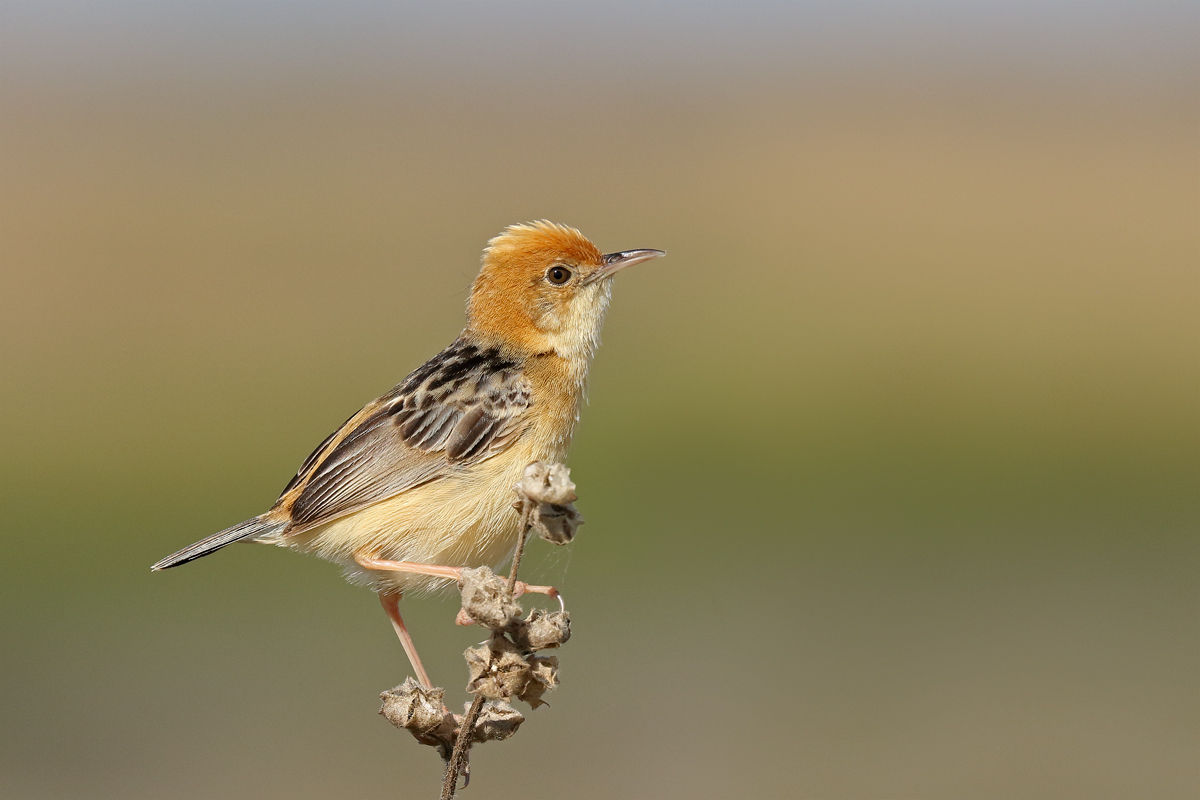
The Golden-headed Cisticola is one of the smallest songbirds in Australia and at the same time one of the best hidden. In the breeding season the male is unmistakable: a plain golden-buff unstreaked head above a short tail, singing from a grass stem or in a high bounding display flight. Outside the breeding season that same bird turns into a drab, streaked, long-tailed mouse barely separable from its relatives — a difference that is the source of many an identification error.
Voice
The voice is the key to the species, because it does not change with the plumage. The male gives a short hoarse insect-like buzz, bzzzt, immediately followed by a sharp clear crack, plik or tschek, that sounds like a small whip being snapped. That buzz-and-snap is unique and separates the species at a stroke from any other small brown bird of Australian grassland. The series is repeated from a projecting stem, a wire or a fence, and above all in an undulating display flight in which the bird drops the crack at each high point. There is besides a thin sustained tseep as contact call and a fast rattling alarm at the nest.
Recording: Richard E. Webster — CC BY-NC-SA 4.0 · Wanga rice fields, Poso Regency, Central Sulawesi, Indonesia · xeno-canto
Identification
A tiny warbler of ten to thirteen centimetres with a fine bill, long legs and a strikingly variable tail. The breeding male is the bird of the name: crown, forehead and nape plain golden-buff to golden-yellow, wholly unstreaked, back and shoulders black-streaked on a buff ground, the throat white and the rest of the underside warm buff; the tail in this plumage is much shortened and looks docked. Against that stands the problem: the female, the male in non-breeding plumage and all young birds lack the golden head entirely. They have a finely black-streaked crown, a buff brow, a drab streaked upperside and a distinctly longer graduated tail with dull buff tips and a vague dark band before them. These two guises of the same species scarcely resemble one another in the field, and that is the classic trap of this bird: a streaked long-tailed cisticola in autumn may well be the same animal as the golden-headed male that sang there in December.
Confusion species
Zitting Cisticola (Cisticola juncidis) is the only real confusion and overlaps throughout northern and eastern Australia. The decisive difference is in the tail: in that species the underside of the tail is black with sharply cut white tips, in the Golden-headed Cisticola the tips are dull buff and the contrast is slight. The Zitting Cisticola has moreover a heavily streaked crown in every plumage, breeding male included, while the male of this species in breeding dress has a wholly unstreaked head. The voice separates them in any case: an even monotonous zip … zip … zip in the Zitting Cisticola against buzz-plus-snap in this one. Little Grassbird (Poodytes gramineus) is darker, longer-tailed and, decisively, streaked on the breast. Tawny Grassbird (Cincloramphus timoriensis) is far larger and has a long pointed tail. Australian Reed Warbler (Acrocephalus australis) is larger and wholly unstreaked.
Habitat
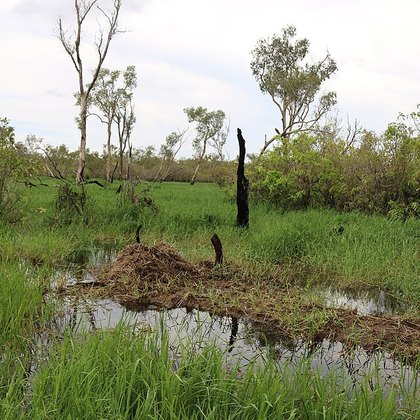
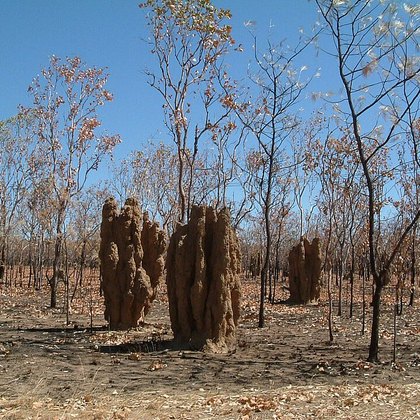
Tall rank grass and herbage on damp ground: reed fringes and sedge fields at the edge of freshwater marsh, wet grassland, the saltmarsh and samphire (low, succulent saltmarsh shrubland on tidal mud) of the coastal plains, the grassy understorey of tropical eucalypt savanna, and in good measure the man-made landscape — cane fields, crop edges, verges, unmown paddocks and rank corners of grazing country. What the species asks is grass tall enough to climb in and dense enough to vanish into, with a few projecting stems to sing from. Mown lawn, closely grazed land and closed forest are unsuitable. The nest is a deep little cup low in the vegetation, its wall stitched with spider silk to the living grass blades around it, so that it hangs among the standing stems and is invisible from outside.
Where the bird is most often found, arranged by main group and formation.



Range and movements
A very widely distributed species from South and South-East Asia to Australasia: from India and Nepal through southern China, Indochina and the Philippines to Indonesia, New Guinea and Australia. In Australia it covers the northern and eastern half of the continent, from the Kimberley through the Top End and Cape York along the whole east coast into south-eastern Victoria, with local occurrences further inland wherever wet hollows lie. It is absent from Tasmania. In Australia the species is resident, with only local shifts between wet and dry years; the continental Asian populations by contrast show clear seasonal migration. In the south-east it has extended its range during the twentieth century, riding on irrigation and on the rank growth of damp verges and banks.
- Resident
- dark = core range, pale = thinly spread
Where and when to look
Go between October and February and listen; outside the breeding season the bird is practically unfindable and an identification is seldom firm. Seek the buzz-and-snap and follow it to the stem the bird sits on, for the male often sings for minutes from the same point. Work from a track or a levee and do not go into the grass: the nests are low and cannot be seen. Anyone who sees a small streaked warbler in grass in autumn does well to go no further than 'cisticola, species uncertain' unless the tail tips have been seen properly; that modesty costs nothing and forestalls the commonest mistake with this species.
Conservation
Least Concern (LC): the species is numerous throughout its very large range, and in Australia it is one of the few native songbirds to have benefited from agriculture, for sugar cane, irrigation channels and rank verges supply exactly the tall grass required. Against that stand the loss of natural wet grassland and saltmarsh on the coastal strip, which has cut deeply in places, and the risk attached to mowing regimes: verges and drain batters cut in mid breeding season cost whole clutches. Management that shifts mowing to winter and leaves a few metres of uncut grass along watercourses keeps the species going without effort. National trends are uncertain because the bird can hardly be counted outside the song period.
Scientific name
Cisticola exilis | (Vigors & Horsfield, 1827)
Vigors and Horsfield described the bird in 1827 as Malurus exilis, from material near Sydney; because the species now sits in another genus, author and date are bracketed. The epithet exilis is Latin for 'small, meagre, slight'. The genus Cisticola was introduced by Kaup in 1829 from Greek kisthos, the rock rose, and Latin colere, 'to inhabit' — the rock-rose dweller, after the Mediterranean species with which the genus began, a name that does not apply to the Australian bird. The English Golden-headed Cisticola and the Dutch goudkopgraszanger both take the breeding male, that is, precisely the plumage the species wears for only part of the year; the Spanish cistícola cabecidorado does the same. Older Australian literature carries the species as Golden-headed Fantail-warbler or simply as Tailorbird, after the way the nest is sewn to living grass blades.