All species › Passerines › Cisticolas and allies › Zitting Cisticola
Zitting Cisticola | Cisticola juncidis
Graszanger | Buitrón
The Zitting Cisticola is a mousy bird of ten to twelve centimetres which in Australia occupies only the damp north and northeast, and which is almost never seen there except as a speck above the grass. The male flies over his territory in high bows and drops a single dry click at every crest — the sound the species is named for.

Voice
The song flight is a monotonous run of sharp metallic clicks, one to each undulation: zit ... zit ... zit, sustained for minutes and audible far across the flat. From the grass comes a short, indignant tzek when the bird is disturbed, often in series. Outside the display season it is all but silent, and then it is hardly to be found by sight.
Recording: Thomas SIGNEAU — CC BY-SA 4.0 · Arrondissement de Vierzon (near Saint-Georges-sur-la-Prée), Cher, Centre-Val de Loire, France · xeno-canto
Identification
A tiny warbler with a short, broad, fan-shaped tail that it constantly cocks and spreads. The upperparts are warm brown with heavy black streaking, the crown included; the underparts are dirty white with buff flanks. The tail is black below with clear white tips, the best mark as the bird goes away. In the breeding season the male shows slightly less crown streaking and more marking on the back than the female. In flight it looks round and short-tailed, with fast bouncing beats.
Confusion species
Cisticola exilis is far commoner in Australia and overlaps throughout: the breeding male has a plain golden-buff, unstreaked crown, and the tail lacks the sharp white tips. Out of the breeding season that species is harder, but its call — a buzz followed by a snap — is nothing like the even ticking. Poodytes gramineus and Cincloramphus timoriensis are both larger and longer-bodied, with a long pointed tail instead of a short fan.
Habitat
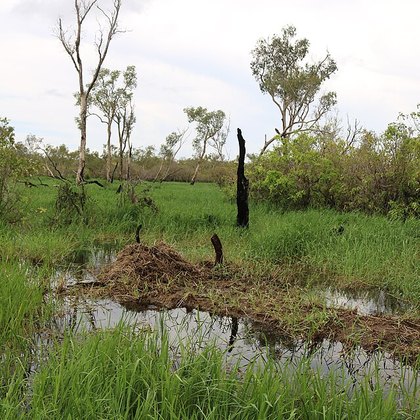
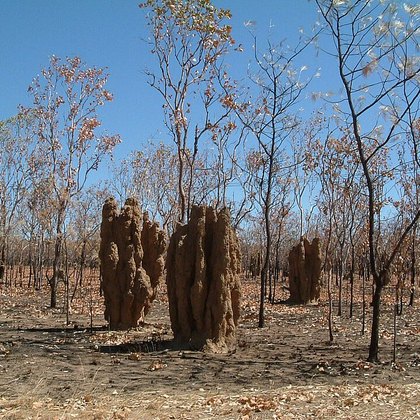
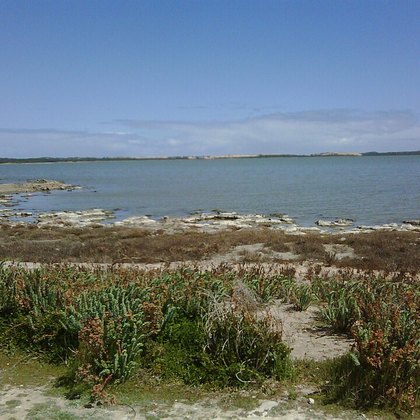
Rank grass and sedge on wet ground: the margins of freshwater marsh and reed, the grass floor of eucalypt savanna while it stays damp, samphire and saltmarsh behind the mangroves, and beyond that cane and wet pasture. It wants grass tall enough to weave a nest into and standing all year; mown or dried-out grass it leaves alone.
Where the bird is most often found, arranged by main group and formation.

Range and movements
In Australia confined to a narrow northern and eastern band: the Kimberley, the Top End, the Gulf of Carpentaria and the Queensland coast into northeastern New South Wales. It does not occur in New Zealand. Beyond Australia it is one of the most widely distributed songbirds on earth, from southern Europe and Africa through southern Asia to Japan. Australian birds are sedentary and shift only locally as the marsh dries.
- Resident
- dark = core range, pale = thinly spread
Where and when to look
Stand at the edge of a wet grass flat early on a December or January morning and look up: the display flight is the one moment the species shows itself. Count the clicks against the undulations — that is the surest way to separate it from Cisticola exilis. Then search the grass for the pear-shaped nest of living leaves stitched together with cobweb; it marks the territory even with no bird in sight.
Conservation
Least Concern (LC), and worldwide one of the most numerous of all songbirds. In Australia it sits at the edge of that vast range and is locally scarce; drainage of marsh, dry-season burning of wet grassland and cane harvest all cost nests. Where reed and sedge are left standing it holds on easily, and it colonises new wet grassland quickly.
Scientific name
Cisticola juncidis | (Rafinesque, 1810)
Rafinesque described the bird in 1810 as Sylvia juncidis, among the warblers; because it was later moved to another genus, author and year stand in parentheses. The genus Cisticola was introduced by Kaup in 1829, from Greek kisthos, 'rock-rose', and Latin colere, 'to dwell'. juncidis derives from Latin iuncus, 'rush', after the growth the bird lives in. The type locality is Sicily.