All species › Passerines › Reed warblers and allies › Australian Reed Warbler
Australian Reed Warbler | Acrocephalus australis
Australische karekiet | Carricero australiano
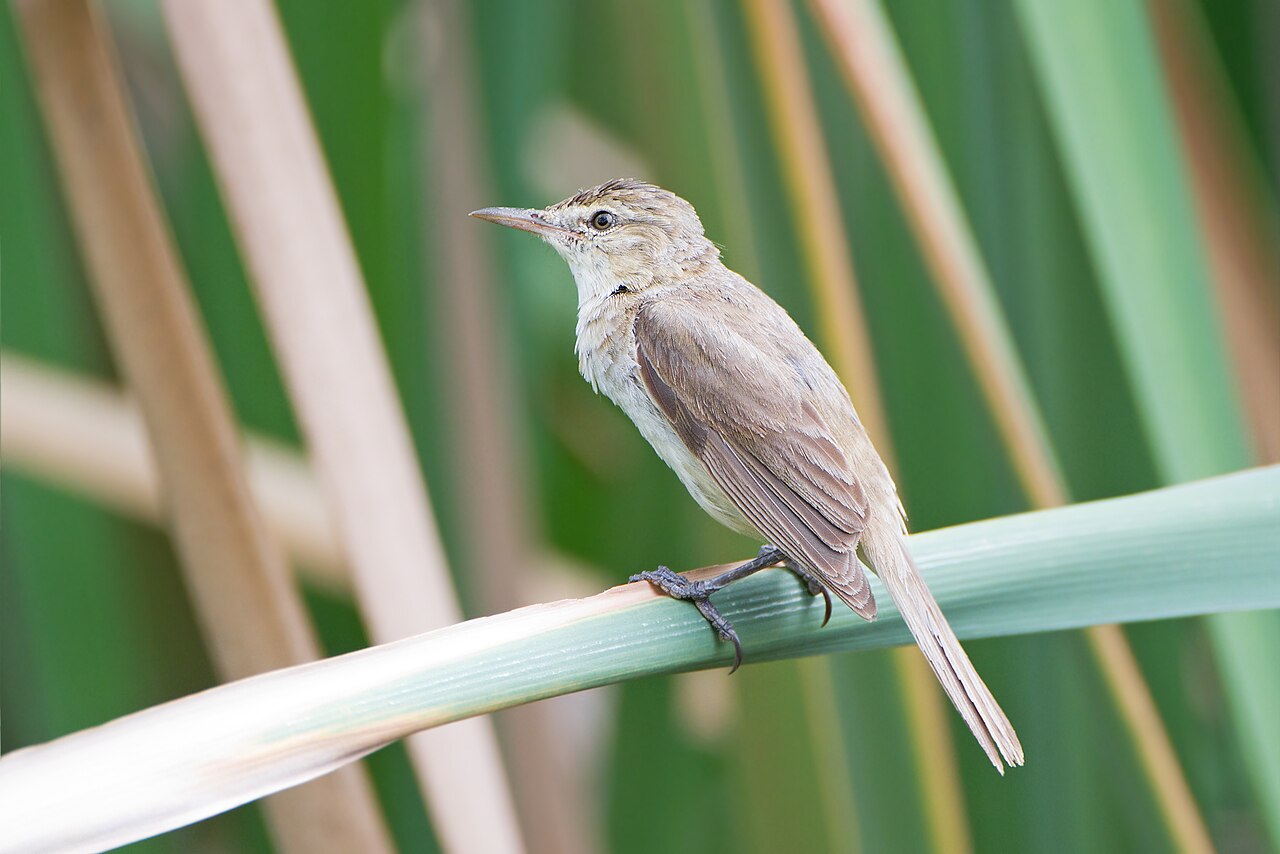
The Australian Reed Warbler is the voice of every Australian reedbed: a plain brown warbler of some sixteen centimetres, braced between two stems, bill open, shouting down the whole swamp. It is seldom in view for more than a few seconds, because the moment the song ends it drops back into cover. In the south it is a summer bird; in the north it stays all year.
Voice
The song is loud, harsh and cheerful at once, built from repeated groups: twitchee-twitchee-twitchee, quarty-quarty-quarty, shot through with fluty and metallic notes. From October to February the males sing all day and much of the night. Disturbed birds give a hard, short chack and a rasping scold that rolls through the reeds.
No freely licensed recording has been found for this species yet; what to listen for is described below.
Identification
A slim warbler of about sixteen centimetres, plain olive-brown above with a rufous rump and dirty white underparts washed faintly golden-orange. The marks that matter are the long pointed bill of nearly two centimetres with a slight hook, the flat forehead, and the vague pale eyebrow that stops just behind the eye. The tail is broad and rounded. The sexes cannot be told apart; young birds are warmer buff below. It climbs stems vertically, legs braced wide.
Confusion species
Poodytes gramineus shares the same reeds but is smaller, clearly streaked on crown and back, and gives a plaintive two- or three-note whistle instead of a loud phrase. Cincloramphus timoriensis is more rufous on the crown and has a long pointed tail. In the far north Acrocephalus orientalis is a rare visitor from Asia: bulkier, with fine streaking on the throat and a longer primary projection. Silent warblers here are, frankly, often best left unnamed.
Habitat
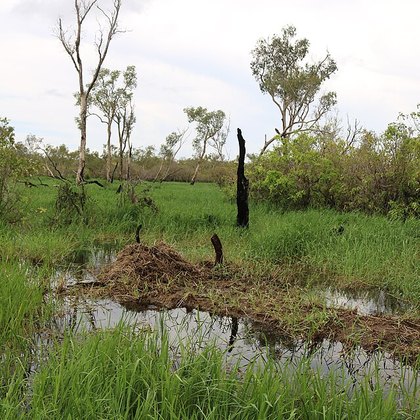
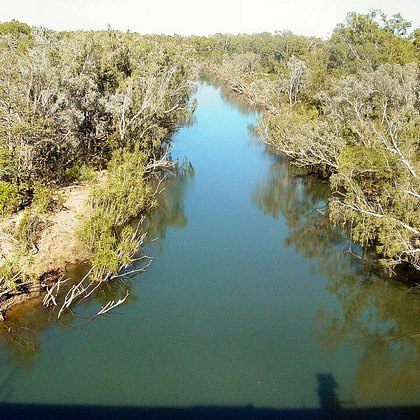
Dense vertical reed and cumbungi in shallow water: swamp, billabong, the reed fringe of lakes, ponds and storages, and the vegetated banks of creeks and rivers. Fresh water is preferred, but it also uses brackish reed and tidal creeks. Where reed is absent it takes tall crops, bamboo or lantana instead, down to suburban detention basins.
Where the bird is most often found, arranged by main group and formation.


Range and movements
Across virtually all of Australia wherever reed stands, permanent or temporary, and on into New Guinea. Tasmania and the southwest hold a subspecies of their own. Birds of the southeast and southwest are migrants: they arrive in September and October, breed into February, and then move north to mix in with the resident birds. It does not occur in New Zealand.
- Resident
- Breeding (summer)
- dark = core range, pale = thinly spread
Where and when to look
Walk a reed fringe in December and stop at the first loud song; the singer is usually within ten metres, halfway up a stem, head tilted upward. Whistle softly back or make a pssht and it will often come to the edge of the reeds to look. Search the same fringe for the deep cup nest woven like a beaker between three or four stems, half a metre above the water.
Conservation
Least Concern (LC), and one of the most numerous reed birds on the continent. It profits from artificial water — stock dams, irrigation channels, sewage ponds and town lakes are occupied within a few years once reed comes in. Where swamps are drained or reed fringes mown or burnt each year it goes at once; so the species does well as long as reed is left standing somewhere.
Scientific name
Acrocephalus australis | (Gould, 1838)
Gould described the bird in 1838, in a genus other than the one it now stands in, so author and year go in parentheses. The genus Acrocephalus was introduced by the Naumann brothers in 1811, from Greek akros, 'topmost', and kephale, 'head' — a name aimed at the peaked crown of the singing bird. australis is Latin for 'southern'. The type came from New South Wales. The species was long treated as a form of the Asian A. stentoreus.