All species › Passerines › Grasshopper warblers, grassbirds and allies › Brown Songlark
Brown Songlark | Cincloramphus cruralis
Roetbruine grasvogel | Yerbera parda
The Brown Songlark is the bird of the empty inland plain: a treeless landscape with nothing but a fence post to sit on, and on that post a sooty male making a sound like a gate on a rusty hinge. It is the Australian songbird with the greatest difference between the sexes: the male weighs about twice what the female does and looks so unlike her that two observers will readily take them for two species. The species follows the rain; a district where it sits on every post one year can be empty the next.
Voice
The voice is dry, metallic and creaking, as though a rusty hinge were being worked: a run of three or four syllables that grinds up and down again, traditionally rendered as skit-scot-a-wheeler. The male sings from a fence post, a wire or a clod, and above all in song flight: he flutters up to fifteen or twenty metres, lets his legs dangle and sinks back down singing. The contact note is a short hard tschk. The song carries surprisingly far across bare ground and in spring is on many inland roads the only bird sound to be heard; outside the breeding season the species is all but silent, which is part of why it is then so easily missed.
No freely licensed recording has been found for this species yet; what to listen for is described below.
Identification
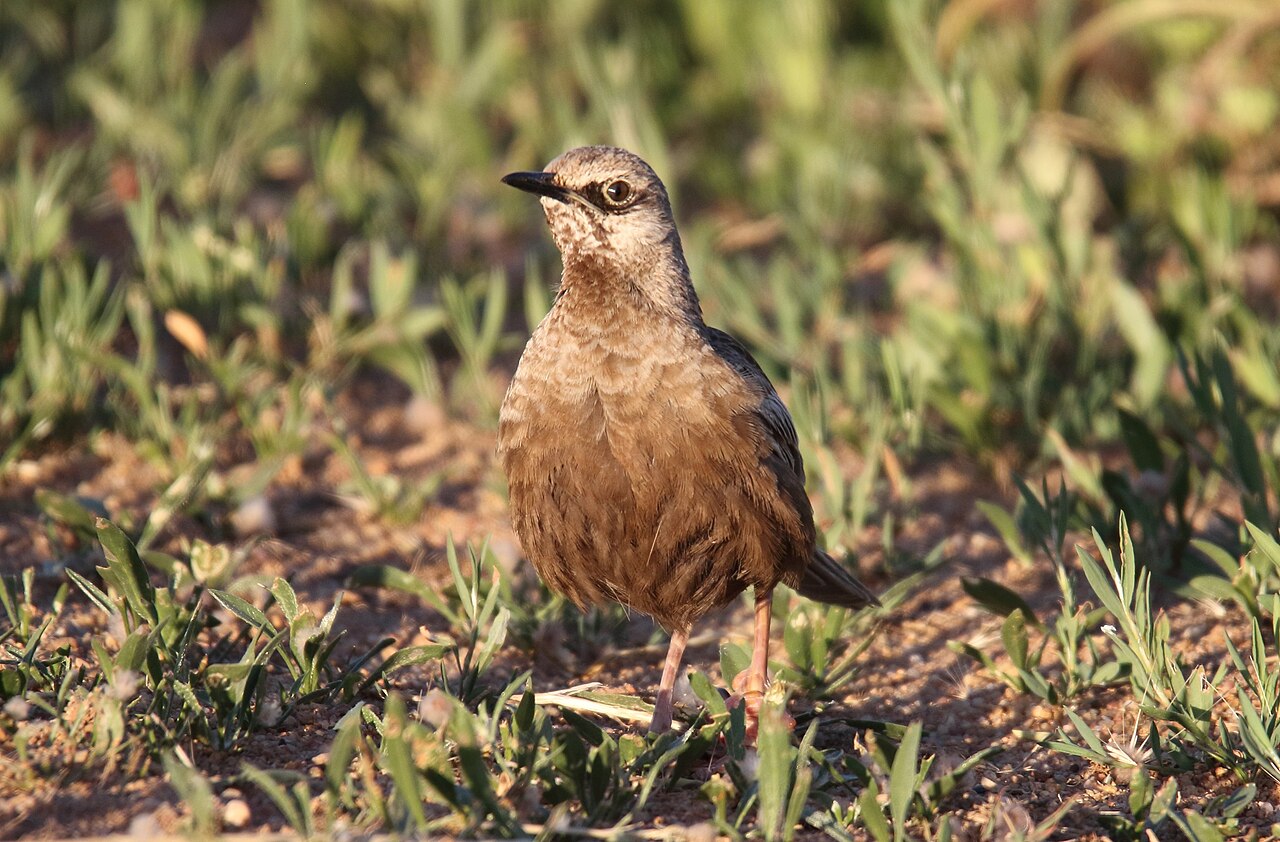
A slim, long-tailed and long-legged songbird of open grass, in which male and female have to be described separately. The male is twenty-three to twenty-five centimetres and a uniform dark sooty brown, almost black on breast and belly in breeding dress, with a dark bill and dark legs; he often carries the long tail cocked and stands strikingly upright on a post. The female, at eighteen to nineteen centimetres, is much smaller, pale buff-brown with dark streaking on crown and back, dirty white below, and shows a pale brow. In flight the wings are broad and the beat fluttering, and in the male the legs hang loose beneath. On the ground the bird walks and runs upright through the grass rather than hopping, and when approached prefers to leave on foot rather than on the wing.
Confusion species
The female is the hard bird of the group. Rufous Songlark (Cincloramphus mathewsi) is smaller and paler, has a clear rusty rump this species lacks, a finely streaked back and a wholly different, clear whistled song; it also prefers grassland with scattered trees to the bare plain. Tawny Grassbird (Cincloramphus timoriensis) has a rufous crown, unstreaked underparts and lives in rank swamp grass near the coast. Australian Pipit (Anthus australis) shares the open ground but is smaller, has white outer tail feathers and wags its tail constantly, which the songlark never does. Singing Bush Lark (Mirafra javanica) is shorter-tailed and shows a rufous wing panel in flight. What settles it is, in the male, the plain sooty colour without streaking, and in the female the combination of long legs, absence of rust on the rump and absence of white in the tail.
Habitat
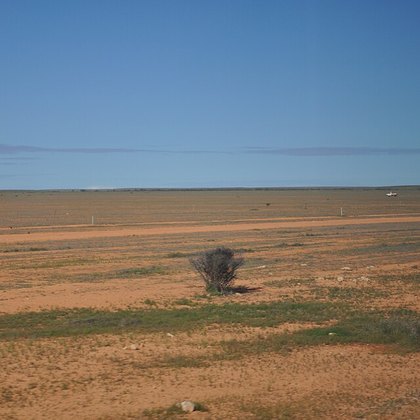
Treeless or all but treeless open country: the Mitchell grass of the interior, saltbush and bluebush plains, stubble, cereal paddocks, fallow, roadsides and overgrazed pasture. The bird needs two things and nothing else: grass or herbage tall enough to hide a ground nest in, and a raised lookout to sing from. Fence posts, barbed wire and telephone lines have supplied that second condition across great stretches of the interior where nothing naturally stood up, and the species makes full use of them. Ground that is cropped short or wholly bare is abandoned; ground that closes over with shrubs equally so.
Where the bird is most often found, arranged by main group and formation.


Range and movements
The whole Australian mainland except the northern Kimberley, the north of the Northern Territory and the north of Cape York; in Tasmania the bird is an irregular visitor. There is no fixed migration route but there is a clear pattern: in the south the species appears in spring to breed and largely withdraws north and inland in autumn. Over that lies a strong nomadic movement following the rain; after good inland rainfall thousands of birds can suddenly be present in a district that was empty the year before, and in drought years the whole population shifts towards the margins of the continent.
- Resident
- Breeding (summer)
- dark = core range, pale = thinly spread
Where and when to look
Drive an inland road in spring and watch not the grass but the fence posts and the wire: a dark, upright, long-tailed bird on a post is in this landscape almost certainly a male. Stop at the first song and wait a minute; the bird usually resumes its song flight quickly, and then the dangling legs are visible at a hundred metres. The female is almost always down in the grass and betrays herself at most by a short low flight from one tussock to the next. On days of hard wind the species falls silent and is scarcely findable in the same ground.
Conservation
Least Concern: the range is enormous and the bird is numerous across much of the interior. The strong swings with rainfall make a real trend hard to read, for a year with few birds in a district means nothing on its own. The species has nonetheless gone or greatly declined where cereals are grown intensively without fallow and where roadsides are mown every year, because no grass is left tall enough for a nest. Overgrazing works the same way: the lookouts remain, the cover goes. Against that, the spread of fencing and powerlines has actually given the bird song posts on plains that were naturally bare. In the longer term the main uncertainty is how far a drier interior will constrain the nomadic movement.
Scientific name
Cincloramphus cruralis | (Vigors & Horsfield, 1827)
Vigors and Horsfield described the bird in 1827 as Megalurus cruralis, from material near Sydney; because the species now stands in another genus, author and date are bracketed. Gould introduced the genus Cincloramphus in 1838, formed from Greek kinklos, the name of a small waterside bird, and rhamphos, 'bill'. The epithet cruralis is Latin for 'of the shin', from crus — a well-chosen word for a bird with such long legs, which it moreover lets hang demonstratively in song flight. The Dutch roetbruine grasvogel takes the colour of the male, as do the English Brown Songlark and the Spanish yerbera parda; none of the three names refers to the female, who looks quite different. The bird has nothing to do with the larks: the family Locustellidae sits among the warblers, and the English name rests on the song, not on relationship.