All species › Passerines › Grasshopper warblers, grassbirds and allies › Rufous Songlark
Rufous Songlark | Cincloramphus mathewsi
Roodstuitgrasvogel | Yerbera de mathews
In the Australian spring the Rufous Songlark is almost impossible to avoid: from September on, every patch of eucalypt woodland with grass beneath it rings with a clear rattling whistle, endlessly repeated, from a brown bird that drops from tree to tree and sings as it goes. Its name sits on the rump, a warm rusty panel that flares as the bird departs and separates it from its two relatives. It is a migrant within its own country: it breeds in the south and the interior and disappears north in autumn.
Voice
The song is the mark of the species and of the Australian spring: a bright, metallic, rattling phrase of four or five syllables, usually written as witchety-witchety or a-witchoo, a-witchoo, repeated without end at short intervals. The male sings from a dead branch, from a wire, and above all in flight: he lets himself down from one tree to the next on stiff quivering wings and sings the whole crossing, which gives him away at a distance. There is also a hard dry tschuk as a contact note. In summer, once breeding is over, the singing stops abruptly and the bird becomes suddenly hard to find in the same wood.
No freely licensed recording has been found for this species yet; what to listen for is described below.
Identification
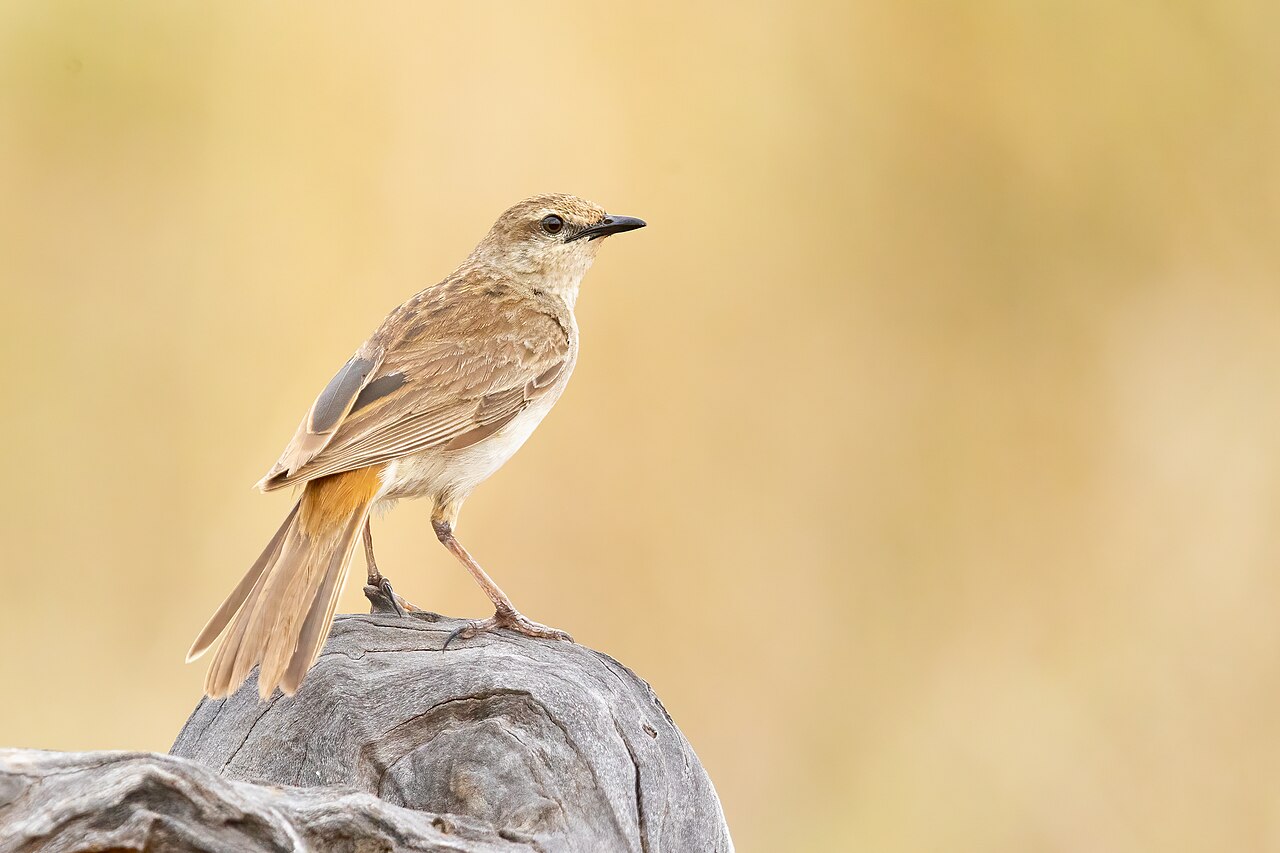
A slim brown songbird of sixteen to nineteen centimetres with a long tail, a strikingly long fine slightly decurved bill and long legs. The upperparts are warm grey-brown with fine dark streaking on crown and back; the underparts are dirty white to pale buff, sometimes faintly streaked across the breast. The feature everything turns on is the rump: a warm rufous to cinnamon panel above the tail base, which at rest can be half hidden under the wing but lights up the moment the bird takes off. A pale brow runs over the eye with a dark eyestripe beneath it. The male is larger than the female but wears the same plumage, unlike the Brown Songlark; young birds are duller and show a weaker rump colour.
Confusion species
Brown Songlark (Cincloramphus cruralis) is the chief stumbling block, above all the female: she lacks the rusty rump entirely, is heavier-legged, sits on bare plains rather than in wooded grassland, and the male is besides a uniform sooty colour. Tawny Grassbird (Cincloramphus timoriensis) carries the rufous on the crown instead of the rump, has unstreaked underparts and a shorter blunter bill, and keeps to wet rank grass. Spinifexbird (Poodytes carteri) of the interior is smaller, carries its tail cocked and stays in spinifex hummocks. Australian Pipit (Anthus australis) also comes into it on the ground, but has white outer tail feathers and a far shorter bill. In practice the song flight from tree to tree, together with the flaring rusty rump, settles the matter.
Habitat
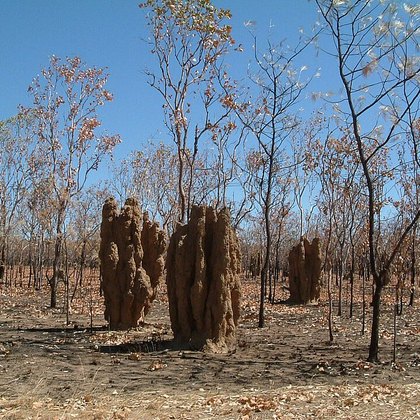
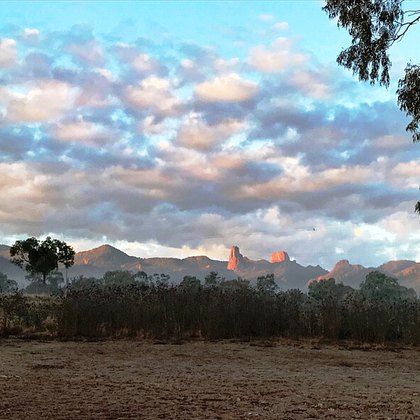
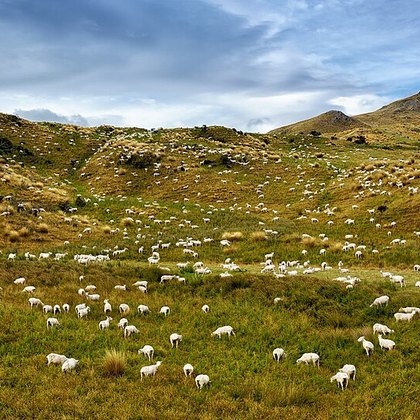
Open eucalypt woodland and savanna with a grassy understorey, timbered pasture, crop margins with retained trees, mulga with grass beneath it and the riverine woodland along inland creeks. Unlike the Brown Songlark this species needs trees: it sings from the canopy and in flight between canopies, and forages on the ground in the grass below. The combination is what counts — grass without trees is too empty, closed forest without grass too dense. Grazing country with scattered eucalypts has thus become some of the best ground for the species, and it is absent precisely from the dense wet forest of the east coast.
Where the bird is most often found, arranged by main group and formation.


Range and movements
Almost all of Australia except the Nullarbor Plain and Tasmania, at its densest in the south-eastern interior and along the inland river systems. The species is a genuine internal migrant: southern populations arrive in August and September, breed into December and then withdraw north, as far as the tropical north where passage birds and winterers then appear. On top of that pattern lies, as with so many inland Australian birds, a nomadic component that follows the rain, so that numbers differ markedly from year to year and district to district.
- Resident
- Breeding (summer)
- dark = core range, pale = thinly spread
Where and when to look
Walk through open grassy eucalypt woodland in September or October and simply listen: in those months this is the most conspicuous singer of that landscape and sings almost without pause. Follow the sound and watch the air between two canopies, for the bird sings precisely during the crossing. As it leaves, look at the rump and not at the back; the rusty colour is the only feature that survives distance and backlight. After Christmas it no longer pays to search by song and one must work the ground, where the bird walks among the grass.
Conservation
Least Concern: the species is widespread and locally very numerous, and it has benefited from the conversion of closed forest into timbered pasture, a landscape in which grass and song posts lie side by side. The reverse is that it goes where the last retained trees are taken out of cropland, since without trees the ground is unusable, and that it also goes where the grass is removed by heavy grazing or annual mowing. In the south-east local declines are reported in districts with high stocking rates. Because breeding numbers move strongly with rainfall, individual poor years are no warning sign; only long runs of counts show a trend, and those do not so far indicate a national decline.
Scientific name
Cincloramphus mathewsi | Iredale, 1911
Iredale described the bird in 1911 as Cincloramphus rufescens mathewsi, from material at Yalgoo in Western Australia; the epithet honours Gregory Macalister Mathews, the Australian ornithologist who compiled the great survey of Australian birds in the early twentieth century. Because the bird has stayed in the same genus, author and date carry no brackets. The genus Cincloramphus was introduced by Gould in 1838, from Greek kinklos, the name of a small waterside bird, and rhamphos, 'bill'. The Dutch roodstuitgrasvogel takes the most usable field character, as does the English Rufous Songlark; the Spanish yerbera de Mathews keeps to the dedication in the scientific name. Together with the Brown Songlark and the Tawny Grassbird the species was lifted in the twenty-first century out of the broad genus Megalurus, which molecular work has broken into several genera.