All species › Grebes › Grebes › Great Crested Grebe
Great Crested Grebe | Podiceps cristatus
Fuut | Somormujo lavanco
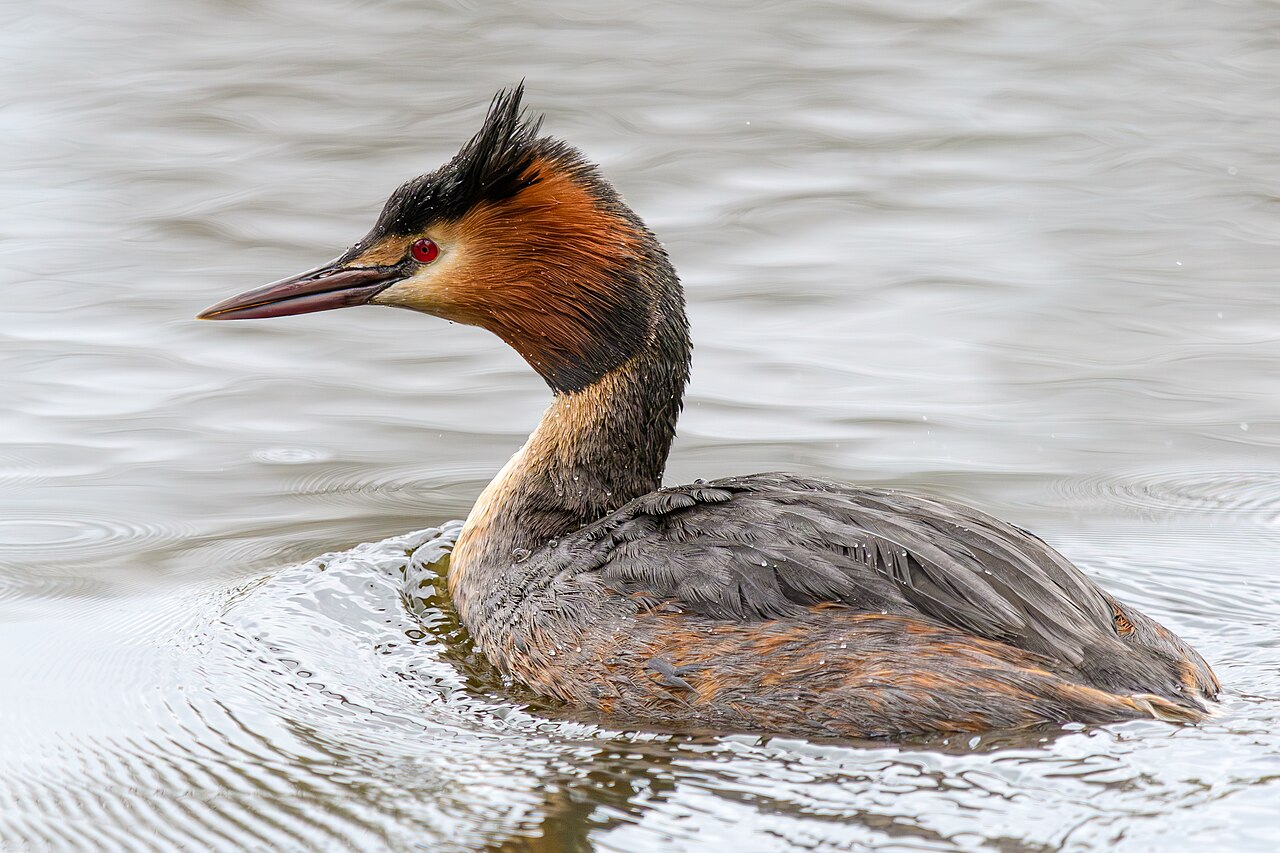
The same large, slender grebe that fills every pond in Europe, but here on the far side of the world: in Australia the largest grebe on the continent, in New Zealand the puteketeke of the deep high-country lakes of the South Island. The double black crest and the chestnut cheek frill edged in black make it unmistakable in breeding plumage.
Voice
A surprisingly harsh bird for so elegant a shape. In the breeding season guttural notes and a shrill trumpeting kaarr carry across the water, alternating with moaning and whirring sounds during display. Young birds beg with a persistent high piping pee-pee-pee from their parents' backs, and that sound often gives away a breeding pair before the nest is seen.
No freely licensed recording has been found for this species yet; what to listen for is described below.
Identification
The largest grebe in the region, 48 to 61 cm and a good kilogram, with a long slender white neck, a dagger-shaped pink bill and a low, drawn-out silhouette on the water. The head carries two black crests and, in the breeding season, a broad chestnut frill edged with black that is fanned out when the bird is roused. The upperparts are dark brown, the underparts silky white, and a black line runs from the base of the bill to the red eye. Juveniles have a black-and-white striped head and neck.
Confusion species
Within the map window confusion with the two small grebes is effectively impossible: Hoary-headed Grebe (Poliocephalus poliocephalus) and New Zealand Grebe (Poliocephalus rufopectus) are both barely thirty centimetres, stocky and short-necked, lack crest and frill, and have a short straight bill instead of a long pink dagger. At long range, when only a white neck shows above the water, a swimming Australasian Darter (Anhinga novaehollandiae) may briefly come to mind, but that bird has a thin kinked neck without white cheeks and swims with its body submerged.
Habitat
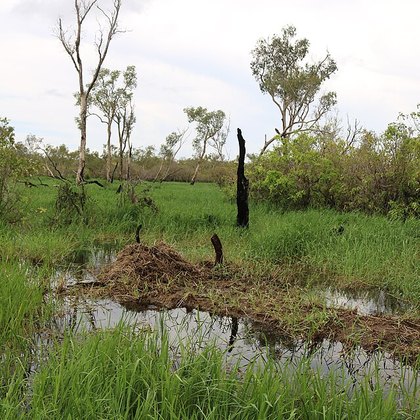
Large, deep and clear fresh water: lakes, reservoirs, lagoons, broad river arms and saltworks ponds, preferably with a reed fringe or a belt of water plants to anchor the floating nest in. In Australia it also uses estuaries and sheltered bays; in New Zealand it is mainly on the deep cold lakes of the hill country. It hunts by sight, and clear water matters more to it than shallow water.
Where the bird is most often found, arranged by main group and formation.


Range and movements
In Australia spread across every state and territory, with the largest numbers in the south-east, in Tasmania and in the south-west; birds move between waters as rain and drought dictate. In New Zealand it has gone as a breeder from the North Island and is reduced to the high-country lakes of the South Island, with the core in Canterbury, Otago and the Mackenzie Basin. Australasian birds belong to the subspecies australis and are resident or nomadic rather than migratory like their European relatives.
- Resident
- dark = core range, pale = thinly spread
Where and when to look
On a large deep lake look for a long low silhouette with a white neck like a periscope; in spring the penguin dance and the weed-dance ritual — two birds rising breast to breast out of the water with waterweed in their bills — are the finest display of any waterbird here. On a New Zealand lake in late spring, count the striped heads riding on the parents' backs: that is the most reliable way to gauge breeding success.
Conservation
Least Concern worldwide, because the species holds an enormous range across Europe, Asia, Africa and Australasia. Within this map window the picture differs: in New Zealand the bird is nationally vulnerable, with a population recovered from about two hundred birds in the 1980s to well over six hundred, but still under a thousand. Predation by stoats and ferrets, loss of marginal vegetation and disturbance from recreational boating are the pinch points; floating nest rafts have worked well locally. In 2023 the puteketeke won New Zealand's Bird of the Century poll with 290,374 votes, a campaign that brought the species more attention than half a century of conservation work.
Scientific name
Podiceps cristatus | (Linnaeus, 1758)
Linnaeus described the bird in 1758 as Colymbus cristatus; because it later moved to another genus, author and year stand in parentheses. Latham introduced Podiceps in 1787, from Latin podex, podicis, 'rump', and pes, 'foot': the bird whose legs are set right at the back of the body. cristatus means 'crested'. The type locality is Sweden. The Australasian subspecies australis was named by Gould in 1844; the Maori names are puteketeke and kamana.