All species › Grebes › Grebes › Hoary-headed Grebe
Hoary-headed Grebe | Poliocephalus poliocephalus
Grijskopfuut | Zampullín canoso
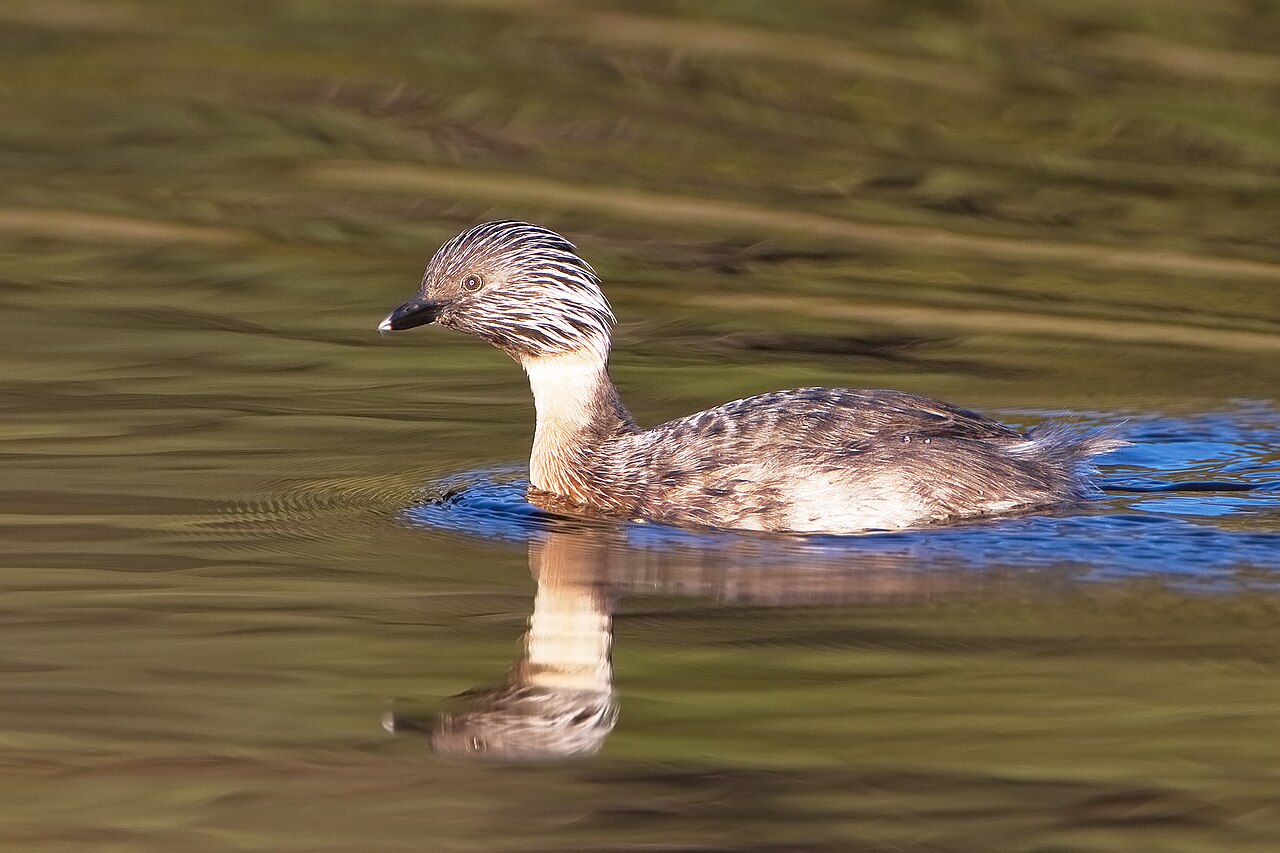
The Hoary-headed Grebe is a small grey-and-white grebe of open water across almost all of Australia, named for the fine silvery-white streaks that cover the whole black head in the breeding season and give it a frosted, hoary look. It likes room around it and swims in loose parties well out from the shore, and it is one of the few grebes that would rather fly off than dive when alarmed.
Voice
Usually a silent bird: away from the breeding colony it is rarely heard at all. At the floating nests come a soft rolling guttural note and a short churring krrr-krrr, low and muffled, that barely carries across the water. Display and nest relief bring a quick rattling chatter, but anyone looking for this bird on a large lake must go by sight, not sound.
No recording with a suitable Creative Commons licence has been found for this species yet; what to listen for is described below.
Identification
A small, stocky grebe of 29 to 30 cm, dark grey above and white below, with a straight stout dark bill tipped pale and an inconspicuous brown eye. In breeding plumage the black head is covered all over with fine silvery-white streaking and a sharply squared black chin stands out below the bill; a narrow black line runs down the nape. In non-breeding plumage the dark cap extends below the eye and contrasts with white cheeks and neck sides. Juveniles have a striped face and a mottled white hindneck.
Confusion species
New Zealand Grebe (Poliocephalus rufopectus) is the closest relative and the same size, but has a bright yellow eye, a rufous breast and neck when breeding, and silvery streaks that lie mainly as swept-back plumes along the side of the head; the ranges are separate — rufopectus breeds only in New Zealand — but that is precisely where Hoary-headed Grebe turns up regularly, and then the eye decides it: brown against yellow. Great Crested Grebe (Podiceps cristatus) at nearly sixty centimetres is twice as long, with a slender white neck, a double black crest and, in the breeding season, a chestnut cheek frill edged in black, all of which this bird lacks entirely. Australasian Grebe (Tachybaptus novaehollandiae) is smaller and rounder, shows a yellow patch at the base of the bill, and always dives where the Hoary-headed often flies.
Habitat
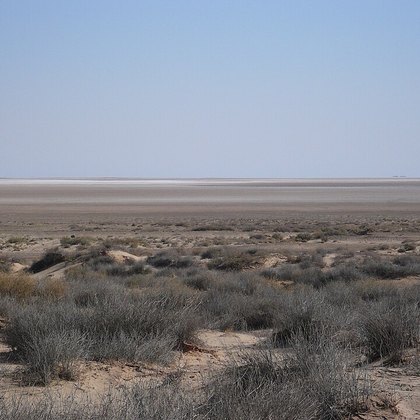
Wide, deep and open water: large lakes and reservoirs, saltworks ponds, brackish lagoons and estuaries, and after rain the shallow claypans (shallow clay basin that holds water for a time after rain) and temporary inland lakes as well. Unlike most grebes it avoids the shoreline and the reed fringe and stays out in the middle of the water; only to breed does it withdraw, colonially, among floating waterplants in the shallows.
Where the bird is most often found, arranged by main group and formation.


Range and movements
Spread across every Australian state and territory apart from the driest desert core; numerous in the south-east, in Tasmania and in the south-west of Western Australia, and wandering further inland as soon as rain fills the inland lakes and claypans. In New Zealand it is not a long-established breeder but a regular transtasman arrival, which has settled there over recent decades and has bred; New Zealand records remain scarce against the Australian ones.
- Resident
- Breeding (summer)
- dark = core range, pale = thinly spread
Where and when to look
Put a telescope on the middle of a large lake or a saltworks pond and look for a loose party of small pale grebes well off the bank; a group that clatters away in flight when disturbed instead of slipping under is almost certainly this species. In non-breeding plumage watch the cap: on Hoary-headed it runs below the eye, on Australasian Grebe it does not.
Conservation
Least Concern (LC): the range is enormous, the population is put at around half a million birds and there is no sign of any serious decline. The species gains from stock dams, reservoirs and saltworks, which add permanent open water inland. Drought can swing local numbers sharply, but the bird is nomadic enough to absorb that; drainage of swamps and salinisation of wetlands are the only concerns of any size.
Scientific name
Poliocephalus poliocephalus | (Jardine & Selby, 1827)
Jardine and Selby described the bird in 1827 as Podiceps poliocephalus; because it later moved to another genus, author and year stand in parentheses. Selby introduced the genus Poliocephalus in 1840, from Greek polios, 'grey, grizzled', and -kephalos, '-headed' — the specific epithet repeats the same word, so the scientific name literally says 'grey-head' twice. The type locality is New South Wales. In New Zealand the species carries the Maori name taihoropi.