All species › Gamebirds › Partridges, pheasants, grouse and allies › Brown Quail
Brown Quail | Synoicus ypsilophorus
Bruine kwartel | Codorniz tasmana
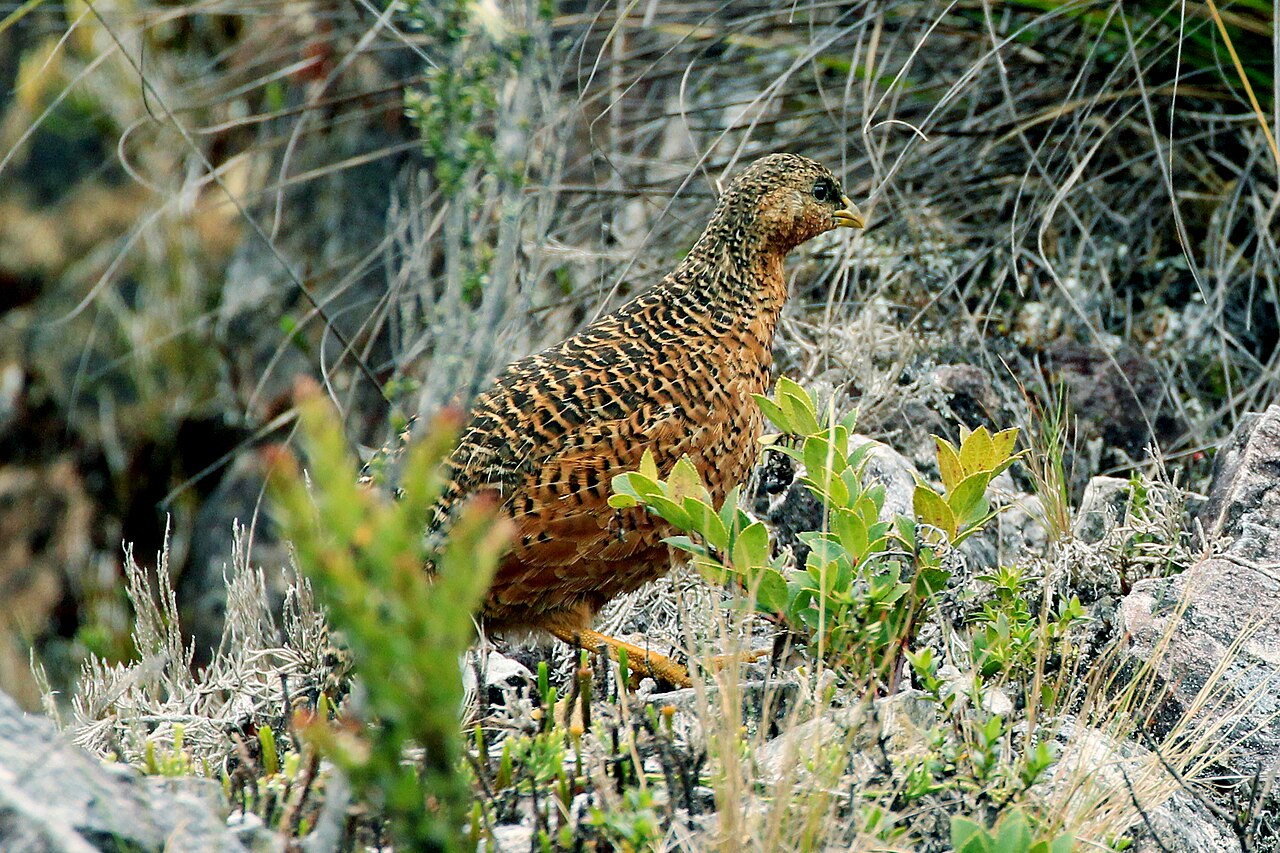
The Brown Quail is the commonest small gamebird of dense, rank grass in northern and eastern Australia, and the only quail that has held on in New Zealand. You seldom see one walk: it usually bursts from the grass a few metres away with a whirring rush, drops back into cover fifty metres on, and is gone. Plain dark brown, short-tailed, with orange-yellow legs.
Voice
The best-known call is a double whistle that slides upward: pee-peeer, the second note longer and clearly rising; in New Zealand the same call is written ker-wee. It calls chiefly at first light and in the late afternoon, and on moonlit nights as well; one calling bird sets its neighbours off, so the sound travels the length of a valley. A flushed covey adds a sharp, high chip-chip between the whirring of wings.
No freely licensed recording has been found for this species yet; what to listen for is described below.
Identification
A squat, short-tailed quail of seventeen to twenty centimetres and about ninety grams, which stays on the ground. The plumage is red-brown to grey-brown, finely barred black above with narrow white shaft-streaks, and chestnut below with fine black vermiculation; at any range the bird reads as plain and dark, without the bold lengthwise streaking of the other quails. The bill is black, the legs orange-yellow, the eye red to yellow. The female is larger and more heavily marked than the male. Tasmanian birds, known there as Swamp Quail, are distinctly bigger and darker and have a pale yellow iris. In flight it comes down to three things: plain upperparts, dark flanks, and short rounded wings.
Confusion species
Stubble Quail (Coturnix pectoralis) is the main confusion: paler and greyer, with obvious cream streaks along the back and flanks, a pale eyebrow, pinkish legs, and an orange-buff throat in the male; it flies higher and further on longer, more pointed wings. Check the legs — orange-yellow on Brown Quail, pale pink on Stubble Quail — and the absence of streaking. King Quail (Synoicus chinensis) is a third smaller; the female looks like a miniature Brown Quail but has a white throat and more sharply barred underparts, and the male, with slate-blue breast and a black-and-white throat pattern, cannot be mistaken. Button-quails (Turnix) lack a hind toe and show pale coverts against dark primaries in flight. In New Zealand, California Quail (Callipepla californica) is larger and greyer and carries a black forward-curving plume. Farmed Japanese Quail (Coturnix japonica) escapes from aviaries now and then and can be awkward: it is streaked like a Stubble Quail and never as uniformly dark as this species.
Habitat
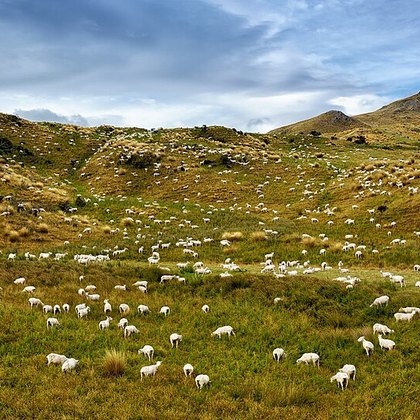
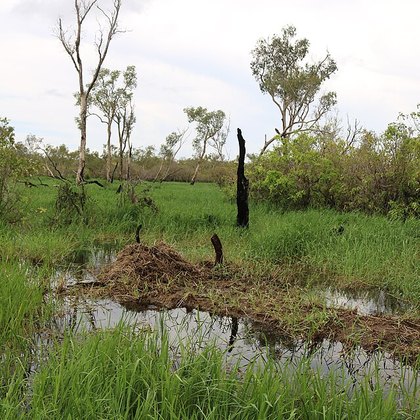
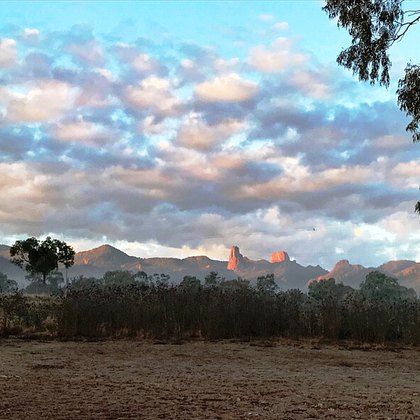
Dense tall grass and rank herbage on damp ground: the margins of swamps and creeks, bracken, sedgeland, rough pasture and the open edge of eucalypt forest. Also sugar cane, road verges and fallow land, provided there is cover to dive into. It needs moisture nearby and avoids closely grazed ground and closed forest. In New Zealand it occupies rough grass, gorse and manuka around wetlands and on the islands of the Hauraki Gulf.
Where the bird is most often found, arranged by main group and formation.
Range and movements
In Australia along the northern and eastern rim: from the Kimberley in Western Australia through the Top End and Queensland to Victoria and Tasmania, with a separate population in the south-west of Western Australia. In New Zealand it was released between 1866 and 1880 near Auckland, Wellington, Otago and Southland; only in the north did it persist, and its range now runs from East Cape to the Three Kings Islands. Strong populations sit on Tiritiri Matangi — an estimated two to three hundred birds — in Shakespear Regional Park and at Tawharanui.
- Resident
- dark = core range, pale = thinly spread
Where and when to look
Walk a grassy track between swamp and pasture at sunrise and listen for the rising double whistle; it gives the bird away long before the eye finds it. On quiet gravel roads and wide verges look for coveys that come out to feed at the start and end of the day, when they stand briefly in the open. If a bird flushes, use that half second on the legs and the plain dark upperparts: those two marks settle it.
Conservation
Least Concern (LC), with a wide range and a firm population across most of Australia; only in South Australia is it rated vulnerable, where its damp grasslands have largely been cleared. In New Zealand it is an established introduction, and that is where the shadow falls: the releases of the 1860s and 1870s are implicated in the extinction of the endemic New Zealand Quail (Coturnix novaezelandiae), probably through introduced disease. In Australia overgrazing and the burning of rank grass weigh heaviest.
Scientific name
Synoicus ypsilophorus | (Bosc, 1792)
Bosc described the species in 1792, in the genus Coturnix; the later move to Synoicus puts author and year in parentheses. The epithet is built from Greek upsilon, the letter Y, and -phoros, 'bearing', and is read as a reference to the Y-shaped pale figure made by the shaft-streaks on the mantle feathers. The genus Synoicus was introduced by Gould in 1843, from Greek sunoikos, 'living together', after the habit of going in coveys. Bosc gave no locality; Mathews later fixed the type locality as Tasmania.