All species › Passerines › Bowerbirds › Green Catbird
Green Catbird | Ailuroedus crassirostris
Groene katvogel | Maullador verde
The Green Catbird is the southern counterpart of the Spotted Catbird and, like it, is almost always heard first: a wailing cat-like cry out of the subtropical rainforest between Gladstone and Sydney. It builds no bower, collects nothing and lives in pairs that stay together — within the bowerbird family that is the exception.
Voice
A loud, nasal miaow that early Australian settlers rendered as 'here-I-aaaar', carrying at least half a kilometre through dense forest; it sounds like a cat or a whining child and explains the name. The call rises in pitch and breaks off at the end. Pairs call in turn and answer one another. Beyond that, coarse rattling and a hard dry clicking close to the nest. Song with a melody does not exist here.
No freely licensed recording has been found for this species yet; what to listen for is described below.
Identification
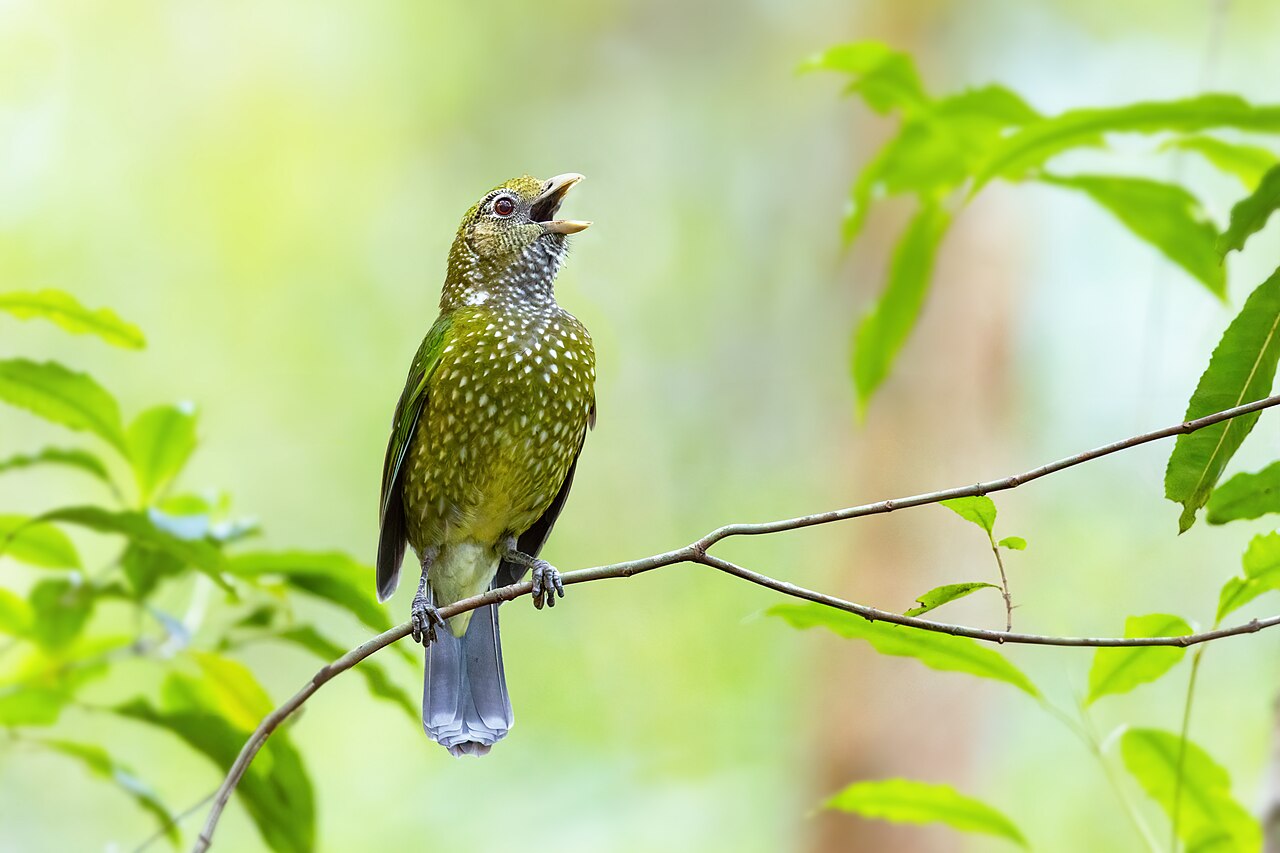
A heavy, short-tailed bird of 27 to 33 centimetres, almost wholly bright emerald green, a little paler and yellower below. The head is evenly green: there is no black ear patch, at most a faint dark shadow behind the eye. Fine white flecks mark the crown and nape, the wing coverts and outer primaries carry small white tips and the tail is tipped white. The underparts bear narrow fine white streaks and drops, far less lavish than on the Spotted Catbird. The bill is thick, deep and pale horn, the iris red. The sexes are alike.
Confusion species
The Spotted Catbird (Ailuroedus maculosus) has a grey-brown crown with a sharp black ear patch and large cream-white drops over the whole underside; it also lives a good thousand kilometres further north, so the two never meet. Females and young males of the Satin Bowerbird (Ptilonorhynchus violaceus) are green as well and share the same forest, but are slimmer, scalloped rather than streaked below, with a violet-blue iris and a dark bill. The Regent Bowerbird (Sericulus chrysocephalus) in female plumage has a dark crown and a dark iris. Fruit-doves of the same forest are green but show a pigeon outline and call softly and dully.
Habitat
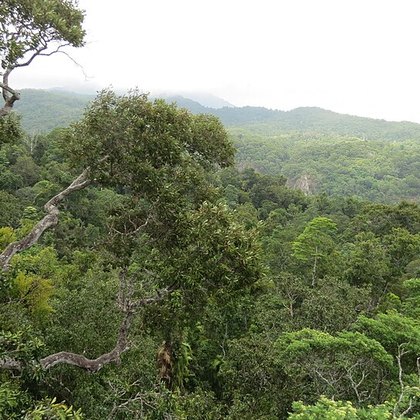
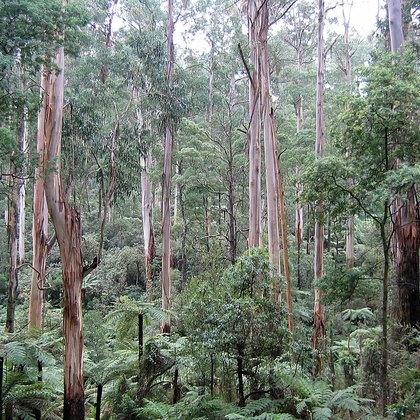
Subtropical and warm-temperate rainforest with a dense shrub layer, and wet eucalypt forest invaded by rainforest species. Also in regrowth, in dense tangles of lantana along forest edges, and in old, heavily planted gardens and parks close to forest — around Brisbane and on the northern edge of Sydney it reaches the suburbs. Fruiting trees decide where it sits.
Where the bird is most often found, arranged by main group and formation.

Range and movements
The east coast of Australia, from Kroombit Tops and the country around Gladstone in south-east Queensland south through the border ranges and the coastal forests of New South Wales into the south of that state. The range is narrow and follows the ranges and the coastal plain wherever forest has survived. Sedentary: pairs hold the same territory all year and wander at most a few kilometres to a tree in fruit.
- Resident
- dark = core range, pale = thinly spread
Where and when to look
Stand still on a rainforest track and wait for the sound; then go to the nearest fruiting tree and look in the middle storey for a heavy green bird that barely moves. It swallows large fruits whole and often betrays itself by a swinging branch or by falling skins. The wailing can be heard all year but is strongest from August to December.
Conservation
Least Concern and common in suitable forest. The range was badly fragmented by the wholesale clearing of the east-coast rainforests in the nineteenth and twentieth centuries; what remains is largely protected within the Gondwana World Heritage reserves. The species holds on in small remnants and even in lantana thickets, which leaves it less exposed than many other rainforest birds, but the connections between those remnants remain the point of concern.
Scientific name
Ailuroedus crassirostris | (Paykull, 1815)
Paykull described the species in 1815 as Lanius crassirostris, among the shrikes, with 'Nova Hollandia' as type locality, understood as Sydney; because it was later moved to another genus, author and year stand in parentheses. Ailuroedus comes from Greek ailouros, 'cat', and aoidos, 'singer'. crassirostris is Latin for 'thick-billed', after the notably heavy bill with which the bird handles large fruit. The English and Dutch names point to the green plumage.