All species › Tubenoses › Southern storm petrels › Grey-backed Storm Petrel
Grey-backed Storm Petrel | Garrodia nereis
Grijsrugstormvogeltje | Golondrina de mar subantártica
Grey-backed Storm Petrel is the smallest storm petrel of southern waters and the only one with a grey rather than white rump. The dark grey foreparts run without a sharp break into a pale grey back and rump, against which the black tail stands out as a dark band — that one image is the whole identification. It breeds on New Zealand's subantarctic islands and feeds with a fluttering action along the edge of the continental shelf.

Voice
At sea it is silent. At the colony, which it visits at night, a monotonous, wheezy two-syllable chirping comes from the burrows, most like a cricket: chi-churr, chi-churr, repeated endlessly, with softer purring notes between partners. Over the colony itself it is far less noisy than the larger species.
No freely licensed recording has been found for this species yet; what to listen for is described below.
Identification
Eighteen centimetres and barely thirty-five grams, with a wingspan of about forty: a compact, short-legged storm petrel. Head, throat, neck and breast are dark slate-grey, the mantle greyer, and back, rump and uppertail coverts pale ash-grey — not white — so that the black tail forms a sharp dark terminal band. The upperwing shows two faint pale bars. The belly is white and the underwing white with a dark leading edge and a dark trailing edge. Bill and legs are black, and the feet barely project past the tail. It flutters more and uses its legs far less than the other storm petrels here: no bouncing and no walking, but a light, butterfly-like flutter low over the swell.
Confusion species
White-faced Storm Petrel (Pelagodroma marina) is larger, has a white face with a black mask and much longer legs, and bounces over the water on dangling feet. Wilson's Storm Petrel (Oceanites oceanicus) has a dark belly and a sharply bounded white rump band — the difference between white and pale grey really can be seen at sea if you look for it, because in Wilson's the rump contrasts with the back while here the pale tone runs on gradually. Black-bellied (Fregetta tropica) and White-bellied Storm Petrel (Fregetta grallaria) are larger and heavier, with a jet-black head and breast, a white rump and long legs. At long range a Common Diving Petrel (Pelecanoides urinatrix) may also pass as a small black-and-white bird, but it has short blunt wings, a whirring bee-like flight, and dives.
Habitat
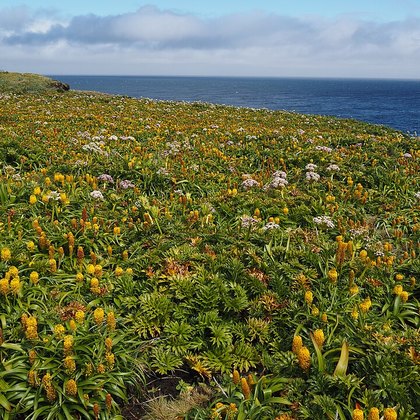
Cold water over and along the shelf edge in the subantarctic and cool temperate zone, where it flutters over the surface taking small crustaceans and the larvae of barnacles and crabs; unlike most seabirds it largely leaves the deep mid-ocean alone. It breeds in loose colonies on subantarctic islands, in cavities under mats of creeping vegetation and at the base of tussocks, where it barely digs at all but works its way in among the roots.
Where the bird is most often found, arranged by main group and formation.


Range and movements
Circumpolar; within this map window it breeds on New Zealand's subantarctic islands — the Antipodes, the Aucklands and Campbell — and on the Chathams, and according to some sources also on islets off the Fiordland coast. Outside the breeding season it ranges over cooler waters and is seen regularly on pelagic trips off south-eastern Australia, around Tasmania and in Bass Strait, and around New Zealand's South Island; most often in the colder months. It does not occur in the subtropical waters of northern Australia.
- Breeding (summer)
- dark = core range, pale = thinly spread
Where and when to look
Take a pelagic trip out to the shelf edge — Kaikoura, Stewart Island, Eaglehawk Neck in Tasmania or Port Fairy — and look in the chum for the smallest storm petrel in view. Wait until it banks and then look only at the rump: pale grey, running on out of the back, with a black tail below it. Do not be led by the white belly, because the other species have that too; the grey rump belongs to no one else.
Conservation
Least Concern (LC), with a world population of the order of two hundred thousand birds and probably tens of thousands of pairs in the New Zealand island groups. New Zealand nonetheless lists the species as 'relict': it has gone from everything that acquired predators and has been pushed back onto predator-free islands. Rats, mice and cats on the breeding islands are accordingly the main threat, and it is exactly there that ground has been won: the rats of Campbell Island were eradicated in 2001 and the mice of the Antipodes in 2016, and on such islands a ground-nester like this can spread again. At sea, plastic and shifts in the food chain play a part, but neither has been established as an acute threat to this species.
Scientific name
Garrodia nereis | (Gould, 1841)
Gould described the species in 1841; because it was later placed in another genus, author and year stand in parentheses. Forbes introduced the genus Garrodia in 1881, naming it after the English zoologist Alfred Henry Garrod. The epithet nereis refers to the Nereids, the sea nymphs of Greek myth — daughters of Nereus, who walked on the waves. In Maori the bird is reoreo. The Spanish guide name stresses the subantarctic range, the Dutch and English the grey back.