All species › Tubenoses › Southern storm petrels › Wilson's Storm-Petrel
Wilson's Storm-Petrel | Oceanites oceanicus
Wilsons stormvogeltje | Paíño de Wilson
Wilson's Storm-Petrel is barely larger than a swallow and counts among the most numerous birds on earth. It breeds around Antarctica in the southern summer and then crosses the equator to the northern hemisphere, so that in the waters of this region it is a bird of the summer half-year: November to April, and most numerous around the turn of the year.
Voice
At sea it is almost always silent; over a feeding patch at most a soft high peeping runs between dozens of birds. At the breeding burrows, far south of this region, it gives a fast, persistent rattle ending in a drawn-out krrr-ee. Anyone who sees one in Australian or New Zealand waters sees it silent.
Recording: Kevin Guille — CC0 · Mayes island, France · xeno-canto
Identification
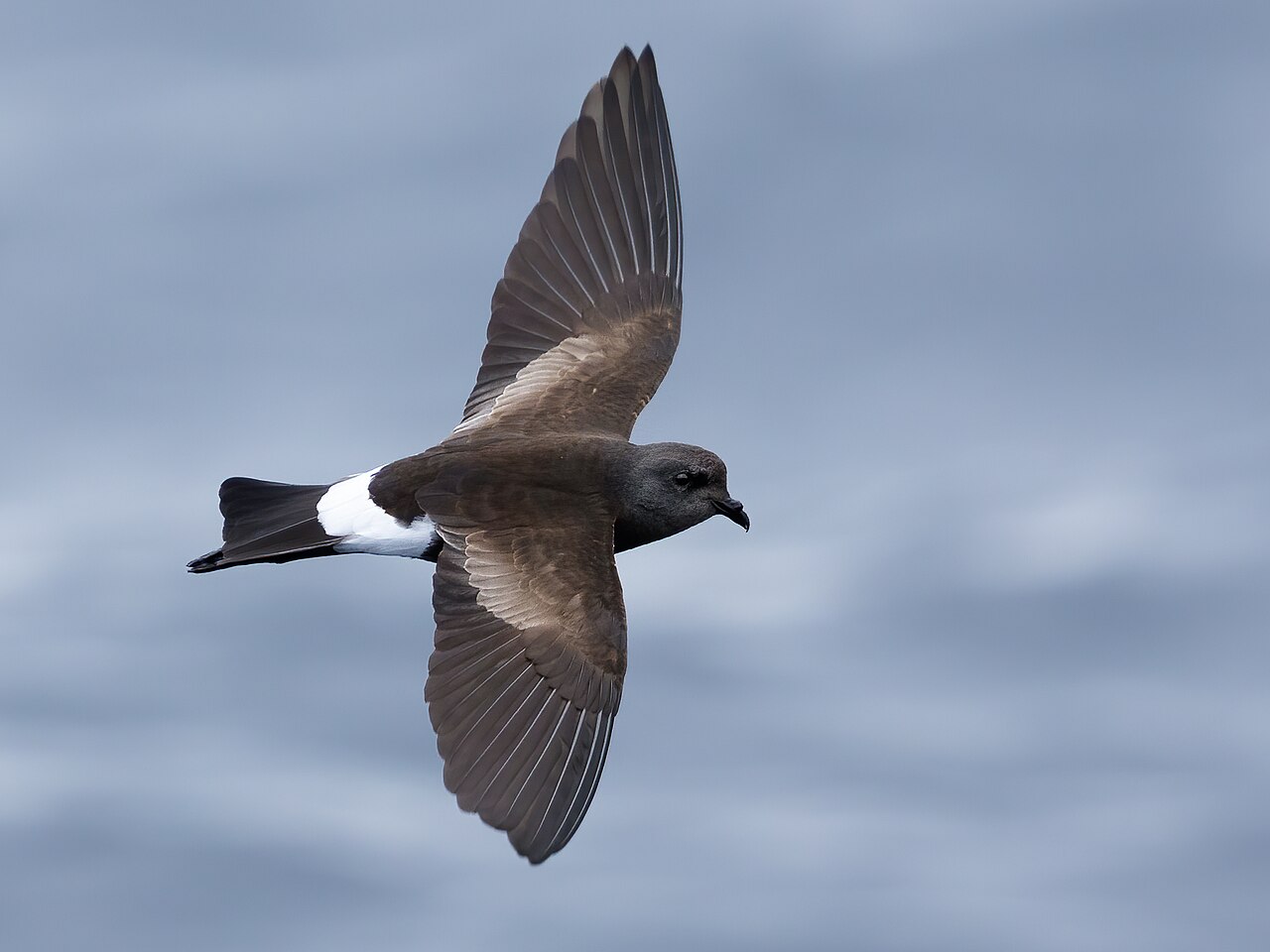
A small, sooty black storm petrel of eighteen centimetres with a broad, straight white rump band that continues onto the flanks and under the tail. A dull grey bar crosses the upperwing, the tail is short and square-cut, and the long black legs project clearly beyond the tail tip in flight. The webs between the toes are bright yellow, at close range a clear and conclusive feature. The sexes are alike and young birds do not differ. Flight is direct on quick shallow beats with short glides; over food it holds the wings high in a V and patters across the surface with its feet.
Confusion species
Band-rumped Storm-Petrel (Hydrobates castro) and Leach's Storm-Petrel have a notched or forked tail, longer wings and feet that do not project beyond the tail, and fly either more erratically or on longer glides. The larger Fregetta storm petrels — Black-bellied and White-bellied — have a white belly and a much heavier build. New Zealand Storm-Petrel also shows a white belly, but heavily streaked. So do not let a bird be named on the rump band alone: look at the tail shape and at whether the feet project.
Habitat
Open sea, favouring the edge of the continental shelf and places where current brings food to the surface. It follows trawlers and whales, gathers over oil and fish waste, and within this region sits mainly over the slope off New South Wales and in Bass Strait. It is rarely seen from the coast and comes to land only to breed.
Where the bird is most often found, arranged by main group and formation.


Range and movements
The breeding sites lie on Antarctica itself and on the islands of the southern ocean, south of this region, in crevices and scree; laying runs from December to January. After breeding the whole population moves north, as far as the North Atlantic and the Arabian Sea, returning in the southern spring. In Australian and New Zealand waters it is therefore a summer bird, present from October or November to April, with peak numbers from December to February.
- Breeding (summer)
- Winter
- dark = core range, pale = thinly spread
Where and when to look
Take a pelagic trip out of Wollongong, Port Stephens or Portland between November and March and watch the small birds behind the berley: Wilson's comes closest to the boat and stays longest. Then look for the yellow webs and for the feet projecting beyond the tail — with binoculars at fifteen metres both show at a glance.
Conservation
Least Concern (LC), with a world population running into the millions and no measurable decline. Bycatch hardly affects this species; it is, however, drawn to the lights of ships and research stations, and it takes in plastic with its food. On the breeding grounds the main uncertainty is the shrinking of sea ice and of the krill that depends on it.
Scientific name
Oceanites oceanicus | (Kuhl, 1820)
Kuhl described the bird in 1820 as Procellaria oceanica; because it was later placed in another genus, author and year stand in parentheses. The genus Oceanites was introduced in 1840 by Keyserling and Blasius, after the Oceanids, the sea nymphs of Greek tradition. oceanicus means of the ocean. Kuhl gave no type locality; Murphy designated South Georgia in 1918. The Dutch and English names honour Alexander Wilson, the Scottish-American founder of North American ornithology.