All species › Tubenoses › Southern storm petrels › White-faced Storm Petrel
White-faced Storm Petrel | Pelagodroma marina
Bont stormvogeltje | Paíño cariblanco
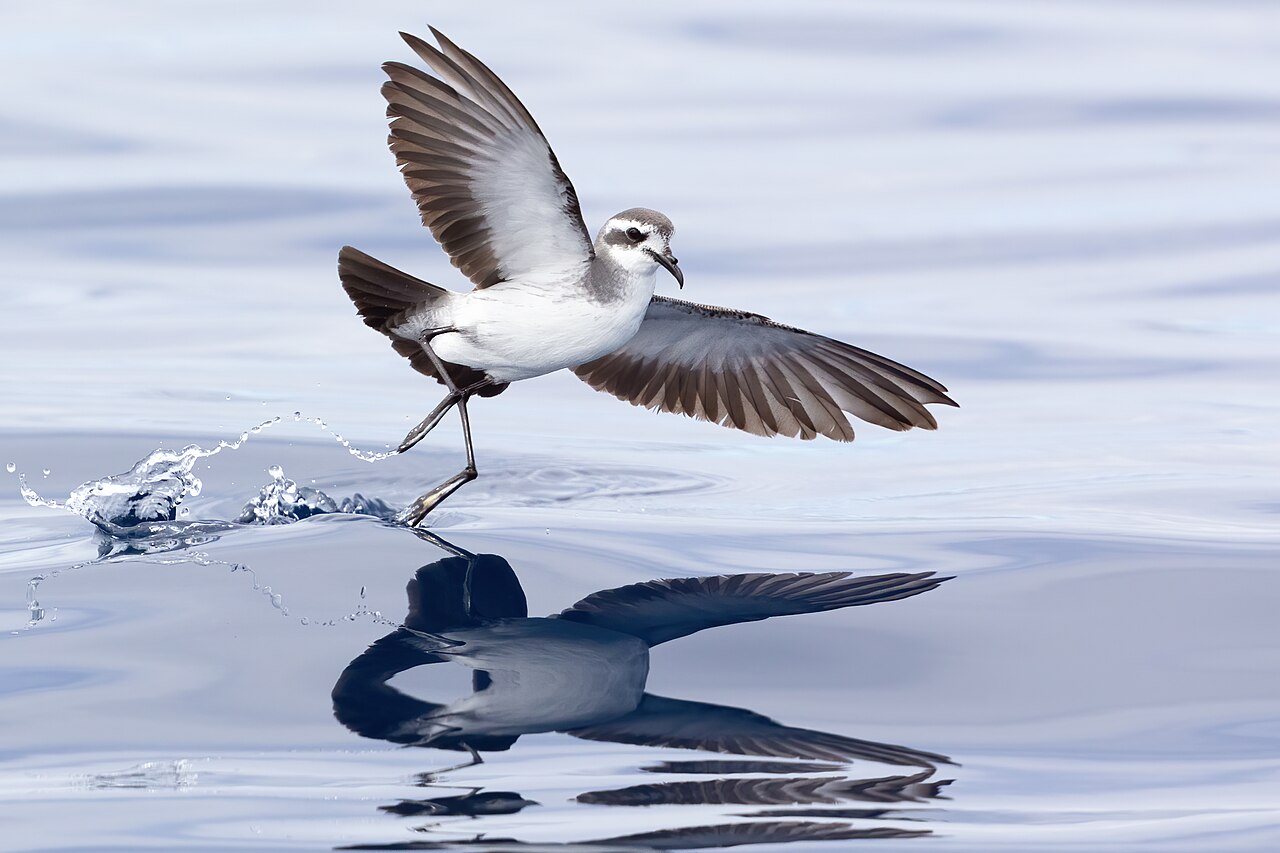
White-faced Storm Petrel is the only storm petrel in this region with a white face and a black eye-mask — a pattern that gives it the look of a pocket-sized phalarope. It is also the only one that bounces across the water on dangling legs in short springy hops. In Australia and New Zealand it breeds in enormous numbers on offshore islands, but it comes ashore only after dark.
Voice
At sea it is silent. At the colony, which it visits only at night, a shrill, hurried chattering comes from the burrows, a rapid wik-wik-wik-wik audible through the ground, and birds flying over give a short, high yelp. A large colony at night sounds like a continuous soft rattling murmur rising out of the soil, thousands of birds at once.
No freely licensed recording has been found for this species yet; what to listen for is described below.
Identification
Nineteen to twenty-one centimetres, wingspan a little over forty. Grey-brown above with a paler grey rump and dark flight feathers, clean white below including the underwing, which is dark only along the margins. The face is white with a sharply defined black stripe through the eye; no other storm petrel here has that. The legs are strikingly long with yellowish webs and project well past the tail in flight. The flight action is the strongest character: it swings low over the surface and pushes off with both feet each time, bounding forward in short springy hops like a stone skipping. The sexes are alike and juveniles differ hardly at all.
Confusion species
Grey-backed Storm Petrel (Garrodia nereis) is the obvious pitfall in the same waters: smaller, with a dark grey head and breast instead of a white masked face, and with shorter legs that do not project so far; it flutters more and uses its legs far less. Wilson's Storm Petrel (Oceanites oceanicus) has a broad white rump band and a dark belly. The Fregetta storm petrels — White-bellied (Fregetta grallaria) and Black-bellied (Fregetta tropica) — are heavier-built, with a black head and breast and a white rump, and lack the white face entirely. In poor light or at long range the white underside of all of these stands out; then go to the face and to the hops.
Habitat
Open sea over and beyond the continental shelf, where it takes small crustaceans, squid and fish from the surface as it bounds along. It breeds on offshore islands, preferring low-growing ground with soft, diggable soil: sandy or peaty earth under samphire, tussock or low scrub, where it digs a burrow half a metre to a metre long. It avoids islands with rats and cats, and with them almost the whole mainland.
Where the bird is most often found, arranged by main group and formation.

Range and movements
In this region a numerous breeder on islands off both coasts. In Australia the subspecies dulciae breeds from the Houtman Abrolhos in Western Australia east to the Broughton Islands in New South Wales, with colonies in Bass Strait, on Tasmania and on the Mud Islands in Port Phillip Bay near Melbourne. In New Zealand the subspecies maoriana breeds on countless islands around both main islands, on the Chathams — which hold the largest colonies in the world — and on the subantarctic islands. Birds attend the colonies from mid-September to mid-April; outside that they disperse across the open ocean, so few remain in the area through the southern winter.
- Breeding (summer)
- dark = core range, pale = thinly spread
Where and when to look
The easiest chance is a pelagic trip in the southern summer half-year, out of Wollongong, Port Fairy, Kaikoura or the Hauraki Gulf, over the shelf edge. Do not go to colour first but to movement: a storm petrel bounding over the water on dangling legs is almost certainly this species, and the white face with the black eye-stripe confirms it. From shore, look after a sustained gale at sea.
Conservation
Least Concern (LC), with a world population of millions, the bulk of it in Australian and New Zealand waters. The picture differs sharply from colony to colony, though. On the Mud Islands in Port Phillip Bay numbers fell from about twenty-two thousand pairs in 1928 to fewer than two and a half thousand by 2007, through damage to the soil and vegetation, trampling and introduced animals. Where rats or cats reach an island the colony usually disappears altogether, because the birds nest on the ground and are defenceless at night. Where islands stay predator-free, or have been cleared, the species holds numbers no other seabird here can match.
Scientific name
Pelagodroma marina | (Latham, 1790)
Latham described the species in 1790 as Procellaria marina; because it has since stood in another genus, author and year go in parentheses. Reichenbach introduced the genus Pelagodroma in 1855: 'sea runner', after exactly that running, bouncing flight. The epithet marina simply means 'of the sea'. The type locality was originally given vaguely as 'the southern oceans' and was restricted by Murphy in 1924 to waters off the mouth of the Río de la Plata. In Maori the bird is takahikare-moana.