All species › Waders, gulls and terns › Skimmers, noddies, terns and gulls › Grey Noddy
Grey Noddy | Anous albivitta
Grijze noddy | Tiñosa gris
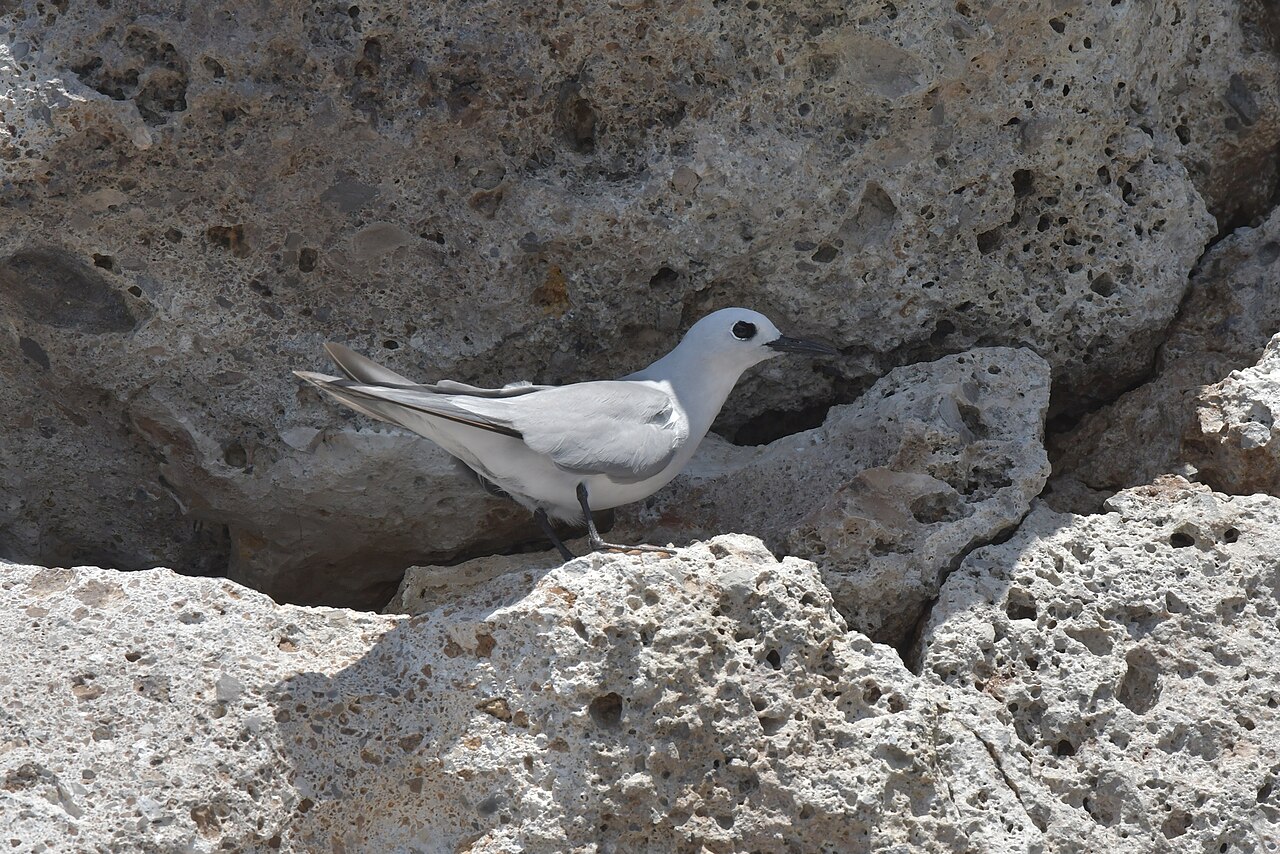
The Grey Noddy is the odd one out in its genus: where the other three noddies are dark with a pale cap, this one is pale blue-grey with a white head, and only a black crescent before and around the eye breaks that pale whole. It is the smallest noddy, barely more than seventy grams, and lives off whatever drifts on the sea surface: small fish, shrimps and above all sea-skaters, which it picks from the water while pattering and all but hanging still. In this region it is a bird of the cliffs of Lord Howe, Norfolk and the north-eastern islets of New Zealand.
Voice
The usual note is a soft, rolling, purring prrr or toorr, low and burring and at close range almost dove-like; from a colony on a cliff ledge it sounds like a steady murmur. At the nest short barking cries and a soft twitter between partners are added. At sea it is nearly always silent, which makes it harder still to notice.
No freely licensed recording has been found for this species yet; what to listen for is described below.
Identification
A small, graceful tern of twenty-five to thirty centimetres, pale blue-grey above, light grey to white below, with a white head grading into grey towards the back. The primaries are darker grey and the underwing is grey with a dark trailing edge, so the bird looks two-toned in flight. Before and around the eye sits a sharp black mark, the only hard feature on an otherwise soft head. The bill is short and black, the tail slightly forked, the legs blackish grey and strikingly large for so small a bird. Sexes alike; young birds are a little greyer on the crown and show pale feather fringes on the mantle. The flight is light and dancing, with hovering and pattering over the water.
Confusion species
Among the noddies it is unmistakable: Brown Noddy (Anous stolidus), Black Noddy (Anous minutus) and Lesser Noddy (Anous tenuirostris) are all dark-bodied with a pale cap — exactly the reverse — and all heavier. The risk lies with other pale seabirds: Blue-billed White Tern (Gygis candida) of the same islands is pure white rather than grey and has a black eye-ring and blue bill base; a prion can look as grey-and-white at range, but shows a dark M across the upperwing and a fast shearing, banking flight instead of this light dance. Young Silver Gulls (Chroicocephalus novaehollandiae) are larger, have pale bill and legs and fly more heavily.
Habitat
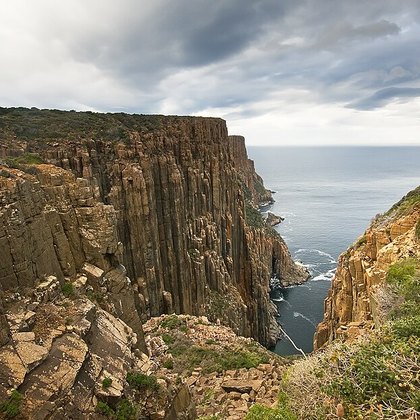
It forages in open sea around its breeding islands, often over current lines where drift collects, taking its food from the surface while hovering and pattering, never by diving. It breeds on sea cliffs and rock islets: the single egg lies without a nest on a bare ledge, in a crevice or under an overhanging stone, usually where no predator can reach. It makes no use of wooded or vegetated land, nor of the mainland.
Where the bird is most often found, arranged by main group and formation.

Range and movements
In this region it breeds on Lord Howe and on Norfolk, where the colonies are mainly on Phillip Island and the surrounding rocks, and in New Zealand on the Kermadec Islands, the Three Kings, the Poor Knights and other rock islets off the north-east of the North Island. That is at once the species' southern limit in the Pacific. On mainland Australia it is a rarity — usually an exhausted bird after a cyclone — and along the New Zealand coast it is seen chiefly after prolonged north-easterly gales.
- Resident
- Breeding (summer)
- dark = core range, pale = thinly spread
Where and when to look
Look for it by boat at a rock islet: at the Poor Knights or around Phillip Island the birds fly low along the cliff and allow an approach to a few metres. Watch the flight action — hanging still and tapping the water with the feet is typical and separates it at once from any prion. In a party of pale seabirds check the head: a white head with a single black eye mark above a grey body can be nothing else here.
Conservation
Least Concern (LC) worldwide, but the species is nowhere numerous and the New Zealand list treats it as naturally uncommon. Because it breeds on bare ledges and lays a single egg, it is unusually sensitive to introduced rats and cats; on islands where those have been cleared — Raoul in the Kermadecs is the best-known case — it recovers. Erosion of cliff ledges, storms in the breeding season and changes in the plankton-rich surface water count as well.
Scientific name
Anous albivitta | (Bonaparte, 1856)
Bonaparte described the species in 1856 as Procelsterna albivitta; because it now sits in Anous, author and year take parentheses. The genus Anous, Stephens 1826, is Ancient Greek for 'mindless'; the old genus Procelsterna was a contraction of Procellaria and Sterna, after the petrel-like impression these pale birds make. albivitta means 'with a white band', for the pale head and neck. The type locality is Lord Howe Island, in the middle of this guide's area.