All species › Waterfowl › Ducks, swans and geese › Grey Teal
Grey Teal | Anas gracilis
Australische taling | Cerceta gris
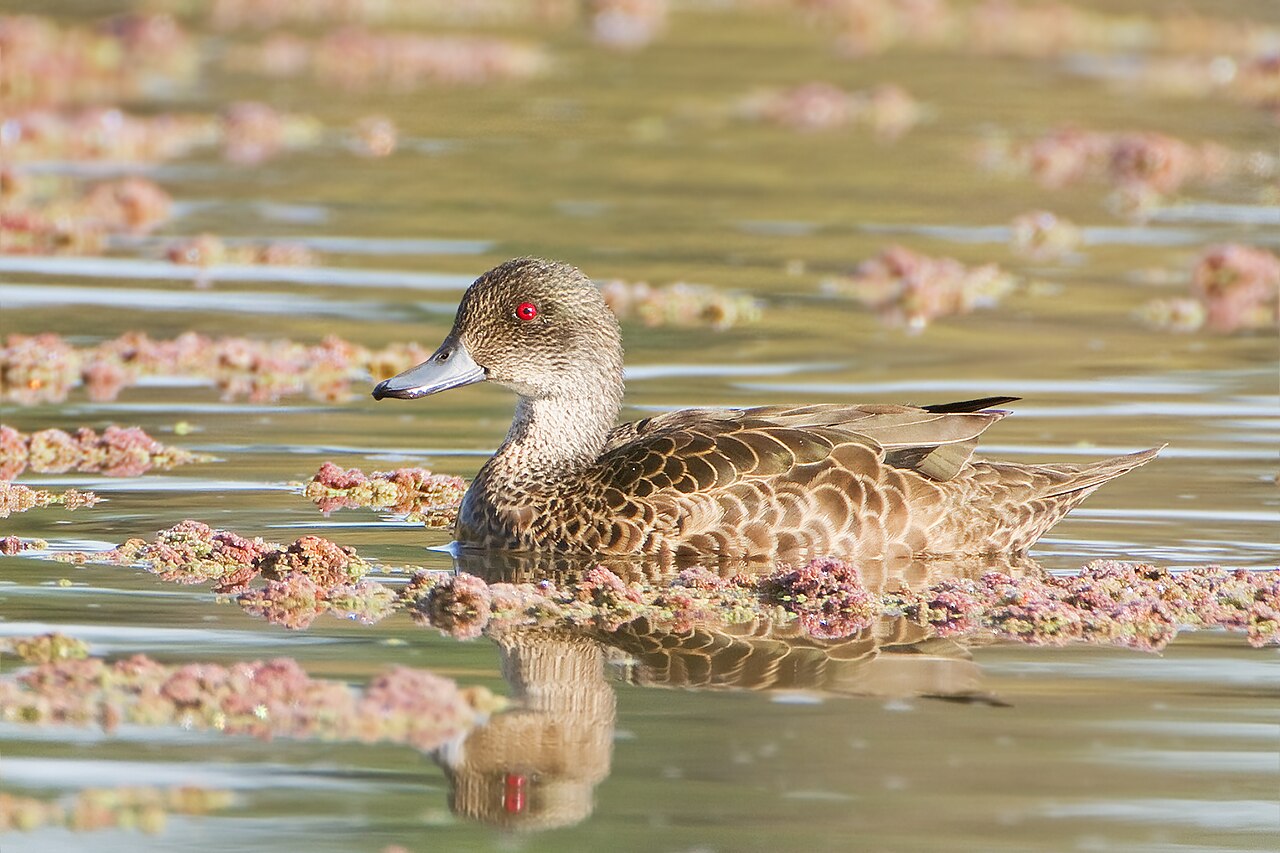
The Grey Teal is the duck of unpredictable water: a slight, grey-brown bird with a white throat and a red eye that appears as soon as an inland claypan fills with rain and is gone again when it dries. It breeds when the water arrives rather than when the calendar says so, and in a drought the whole population may be a thousand kilometres away.
Voice
The contact note is a rapid, wooden cuck-cuck-cuck-cuck, heard above all at dusk and through the night. The male adds a short clear whistle, a high peep that cuts through the babble; the female quacks loud, harsh and laughing in a descending series. As a large flock lifts, the whole lot merges into a sustained rattle.
No freely licensed recording has been found for this species yet; what to listen for is described below.
Identification
A small, slender duck of 40 to 48 cm, almost uniformly grey-brown because every feather carries a pale edge; only the rump is plain. Chin and throat are white against a slightly darker cheek, the bill is dark grey and the eye is a striking red. In flight a large white panel lights up on the underwing, while the upperwing shows a green speculum set between a white leading edge and a white trailing edge. The sexes look the same.
Confusion species
Female Chestnut Teal (Anas castanea) is the hard one: the same size and the same grey-brown, but with a plain dark head lacking the white throat, and a darker, warmer body. Pacific Black Duck (Anas superciliosa) is much larger and carries two black stripes across a cream face. Young Pink-eared Duck (Malacorhynchus membranaceus) is also pale, but has a broad drooping bill tip and fine barring along the flank.
Habitat
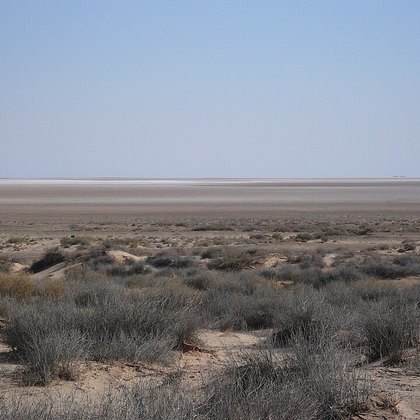
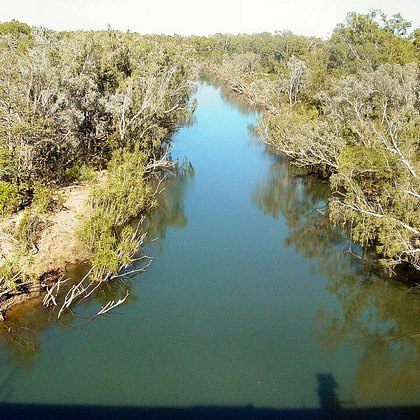
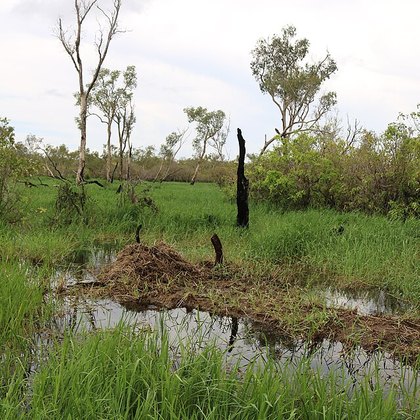
Any sheltered water, fresh, brackish or salt: forest pools and billabongs, inland creeks and rivers, reservoirs, sewage lagoons, saltmarsh and estuaries. Its true domain is the temporary lakes and claypans of the interior, which after rain fill with food in a matter of weeks. The nest is usually in a hollow of a dead tree standing in or beside the water, sometimes on the ground under a bush.
Where the bird is most often found, arranged by main group and formation.


Range and movements
Throughout Australia and Tasmania, and throughout New Zealand, where it has increased strongly since the middle of the twentieth century. Fixed haunts it barely has: it is the most nomadic duck in the region and follows rain for hundreds to thousands of kilometres. In the drought of 1957 large numbers left Australia and crossed the Tasman to New Zealand, where the species has bred ever since.
- Resident
- dark = core range, pale = thinly spread
Where and when to look
Look for it on any artificial water in the dry interior — a stock dam, a bore trough, a sewage pond — because that is where it sits when everything around is bone dry. On any pale teal check the throat first: white means Grey Teal, uniformly dark means Chestnut Teal. Drive past a filled claypan after a wet summer; the flocks rafting there arrived out of nowhere within weeks.
Conservation
Least Concern (LC), and probably the Australian duck best able to ride out drought, precisely because it is tied to no single place. Artificial water — stock dams, bores, sewage ponds and reservoirs — has thickened the net of usable sites across the dry interior. Draining of swamps and regulation of the big rivers do, however, cut the number of years in which really large-scale breeding is possible.
Scientific name
Anas gracilis | Buller, 1869
Buller described the species in 1869 as Anas gracilis, and it remains in that genus, so author and year carry no parentheses. Anas is the Latin word for duck, taken as a genus name by Linnaeus in 1758. gracilis means 'slender, slight', which suits the build. The type locality is Manawatu on the North Island of New Zealand — so the bird that stands as an emblem of the Australian interior was described from New Zealand specimens.