All species › Waterfowl › Ducks, swans and geese › Brown Teal
Brown Teal | Anas chlorotis
Bruine taling | Cerceta maorí
The Brown Teal or pāteke is the only flighted member of the New Zealand brown teal complex: a dark, thickset duck with a conspicuous white eye-ring, sitting out the day hidden in a shaded pool and going to work only at dusk. It was once common throughout New Zealand; today it survives mainly in Northland, on Great Barrier Island and on a string of predator-free islands.
Voice
The male has a soft, thin trill and a piping whistle, used in alarm and in defence of territory; it sounds more like a wader than a duck. The female answers with a rasping growl and, besides that, a high, rapid rattling quek-quek-quek. After dark, when the birds are active, this is often the only evidence that pāteke are in a creek at all.
No freely licensed recording has been found for this species yet; what to listen for is described below.
Identification
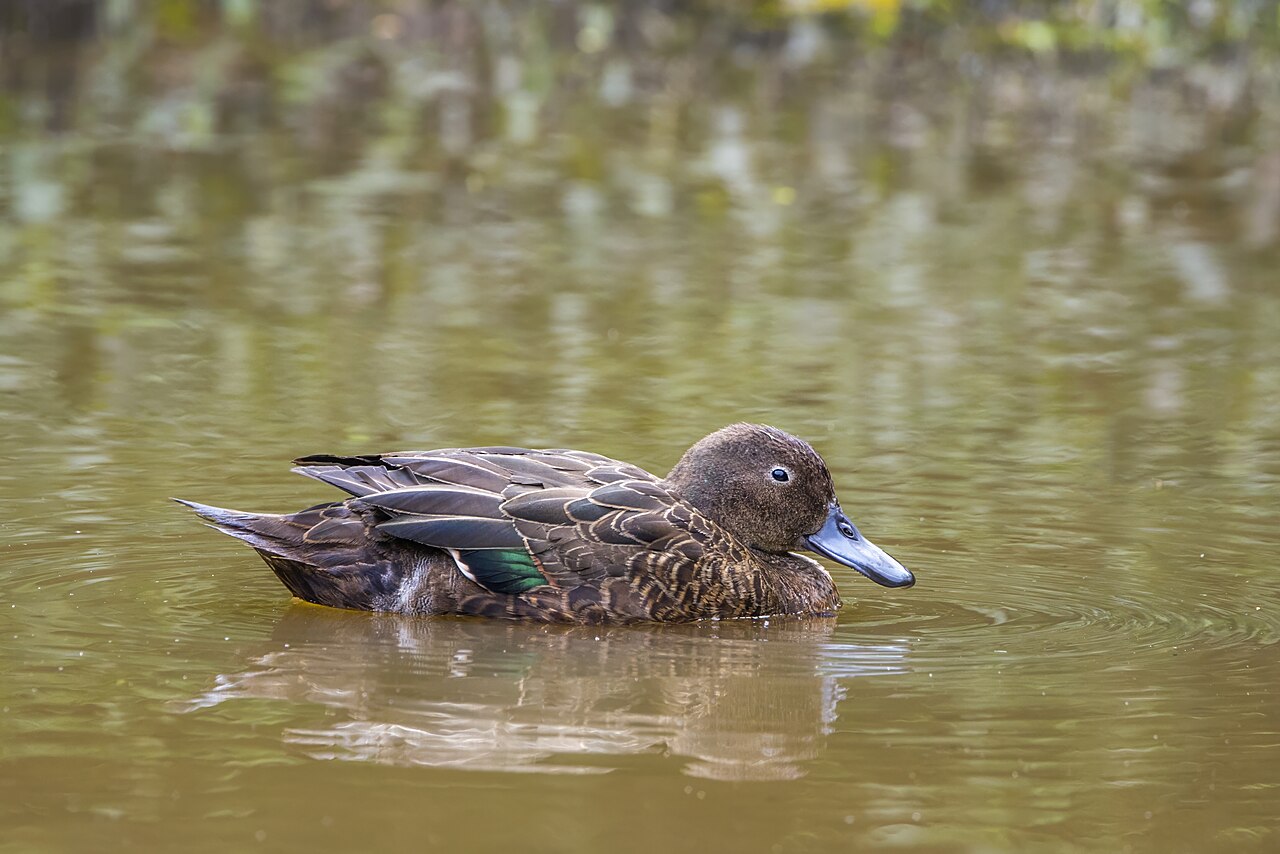
A dark teal of forty-eight centimetres, large as teal go, short-legged and low-slung. The breeding male has green gloss over head and neck, a narrow white neck ring, a dark chestnut breast and finely barred flanks, with a whitish patch at the base of the tail. The female is uniformly dull dark mottled brown. Both sexes carry a conspicuous white eye-ring in an otherwise dark head, a dark grey bill, dark grey legs and a green speculum. Decisive: this teal flies perfectly well — the wings are fully grown and reach back past the rump.
Confusion species
Auckland Teal (Anas aucklandica) is strikingly like it, but smaller (45 cm), with very short wings whose tips reach only about halfway along the back, and it cannot fly; it lives on the Auckland Islands alone, some five hundred kilometres south of Bluff. Campbell Teal (Anas nesiotis) is smaller still and darker, also flightless, and confined to Campbell Island and Codfish Island. The three nowhere overlap, so location alone settles it; if doubt remains, look at the wings and at whether the bird can take off. Grey Teal (Anas gracilis) is paler, has a white throat and a red eye, and lacks the white eye-ring.
Habitat
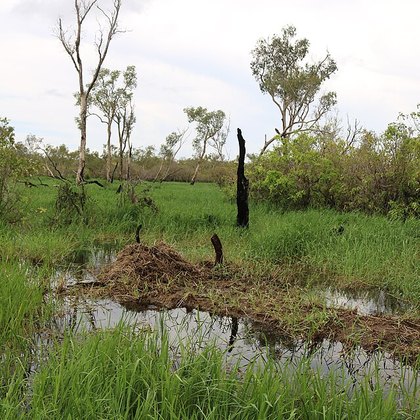
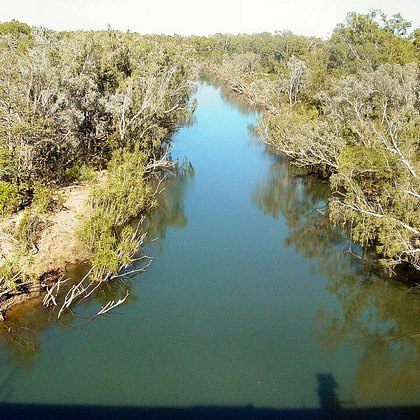
Slow forest streams, freshwater swamp, densely vegetated margins and, very much, the farmed landscape: shaded stock ponds and pasture drains have become one of its main breeding and feeding grounds. At night it moves out to estuaries, saltmarsh and the weed line to hunt invertebrates. The diet is remarkably broad: terrestrial, freshwater and marine invertebrates, fungi, sedge seeds, caddisfly larvae and beetles.
Where the bird is most often found, arranged by main group and formation.

Range and movements
New Zealand, and within it much contracted to the north of the North Island: Northland, Great Barrier Island (Aotea), Little Barrier (Hauturu) and the Coromandel Peninsula. It went from Chatham Island in 1925 and from Stewart Island in 1972. Reintroduction has put birds back on Kapiti, Mana and Tiritiri Matangi, in Zealandia and at Cape Kidnappers, and since 2017 in Abel Tasman National Park. It does not occur in Australia.
- Resident
- Breeding (summer)
- dark = core range, pale = thinly spread
Where and when to look
Go at dusk to a quiet stock pond or a shaded creek in Northland or on Great Barrier and wait: by day the bird sits dead still under overhanging branches, but as the light drops it comes out onto open water. Find the white eye-ring first, which stays visible in half-light longer than any other mark. A pair that lifts high off a pool together and swings away can only be pāteke — the other two teals of the complex never leave the ground.
Conservation
Near Threatened (NT) on the world list, and rated Nationally Increasing in New Zealand: numbers are rising, but from a very low base, with an estimate of fifteen hundred to twenty-five hundred birds in 2011. The decline came through stoats, cats, rats and dogs, the drainage of lowland swamp, and road deaths. Recovery rests on captive breeding with release onto predator-free islands and into fenced sanctuaries. Two worries remain: the genetic base of the captive stock is narrow, since the founders came almost entirely from Great Barrier Island, and crossing with the introduced Mallard (Anas platyrhynchos) locally pollutes the population.
Scientific name
Anas chlorotis | Gray, 1845
G.R. Gray described the species in 1845 as Anas chlorotis, in the bird volume of the Zoology of the Voyage of H.M.S. Erebus and Terror, and it has stayed in that genus, so author and year carry no parentheses. Anas is the Latin word for duck. chlorotis is built from Greek khlōros, 'green', and ōtis, 'eared', hence 'green-eared', after the green gloss behind the male's eye. The type locality is given no more closely than New Zealand. The Maori name pāteke is now the usual name in English too, precisely to keep it apart from the two flightless island teals.