All species › Waterfowl › Ducks, swans and geese › Chestnut Teal
Chestnut Teal | Anas castanea
Kastanjetaling | Cerceta castaña
The Chestnut Teal is the coastal teal of southern Australia: a small, dark duck and the only one in the region that genuinely tolerates the salt water of estuaries and saltmarsh. In good light the drake is superb — a bottle-green head over a deep chestnut body, with a white block on the rear flank — while the female is among the hardest of Australia's brown ducks.

Voice
The drake has a deep, short whistle together with low grunting, the female a chuckling, rattling quack that falls away in a series. Both are close to Grey Teal, but the drake's whistle is clearly deeper and fuller, pyoo rather than the thin peep of its grey cousin. In a mixed flock on an estuary that difference is often the first thing to register.
No freely licensed recording has been found for this species yet; what to listen for is described below.
Identification
A small duck of thirty-five to fifty centimetres, averaging about forty-two. The drake has a glossy dark green head and neck, a deep chestnut breast, flanks and belly finely spotted darker, dark brown upperparts, a black undertail and a sharply cut white block on the rear flank. The female is mottled dark brown and grey, with a pale throat streaked brown and a dark eye-stripe. Both sexes show a deep red eye, a blue-grey bill, green-grey legs and a dark green to purple speculum edged white.
Confusion species
The female Grey Teal (Anas gracilis) is the real snag: the same size and the same grey-brown, but paler, with a clean white throat set against the dark head, whereas the female Chestnut Teal is darker with a dull, brown-streaked throat. Pacific Black Duck (Anas superciliosa) is far bulkier with two black stripes across a cream face. The drake Australasian Shoveler (Spatula rhynchotis) also carries chestnut flanks, but is larger, with a blue-grey head, a white crescent and that unmistakable spoon of a bill.
Habitat
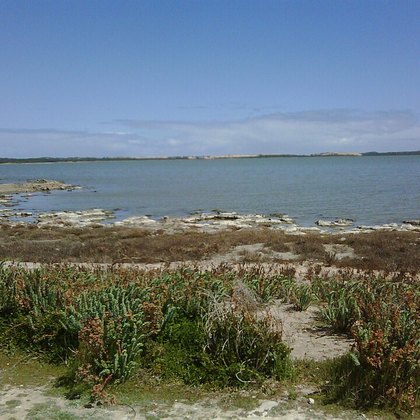
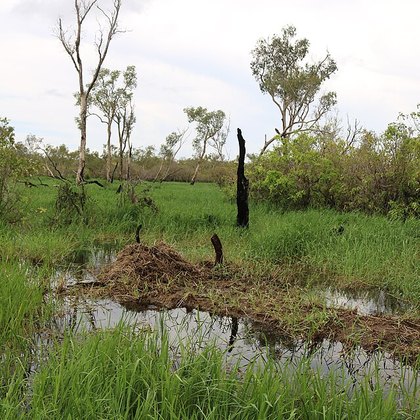
Shallow coastal wetland: estuaries, mangrove edge, samphire saltmarsh and brackish coastal lagoons, where it dabbles along the waterline on a rising tide and takes food being washed in. It tolerates very saline water but needs fresh water to drink. Inland it uses freshwater lakes, reservoirs and sewage ponds, and for nesting hollow trees standing in water, six to ten metres up, or dense grass tussocks close to the shore.
Where the bird is most often found, arranged by main group and formation.


Range and movements
Australia, in two separate areas: the south-west of Western Australia and a broad south-eastern belt from about Ceduna in South Australia to Rockhampton in Queensland, with the strongholds in Victoria, Tasmania and New South Wales. The coastal marshes of Corner Inlet, Western Port and the Tasmanian east coast hold the densest concentrations. To New Zealand it is a vagrant: the first was seen at the Manawatu Estuary in June 1991 and a dozen or so records have followed, nearly all coastal. Lord Howe has scattered records too.
- Resident
- dark = core range, pale = thinly spread
Where and when to look
Use the pair bond: Chestnut Teal stay paired all year, so a brown duck beside a green-headed drake is almost certainly a female Chestnut Teal, while a brown duck in a large loose gathering is more likely a Grey Teal. Search the coast rather than inland: on a rising tide they collect in the saltmarsh and along the mud edges. Against the light, watch for the white block on the rear flank, which still shows even in silhouette.
Conservation
Least Concern (LC). The species is numerous in Australia and benefits from the many artificial waters — reservoirs, stock dams and sewage ponds — that carry it through dry years. In some states it is a game bird. The main pressure is the loss of coastal marsh and saltmarsh to reclamation, urban growth and sea-level rise, and locally the loss of old hollow trees along the water, since without a nest cavity breeding stops.
Scientific name
Anas castanea | (Eyton, 1838)
Eyton described the species in 1838 as Mareca castanea, in his Monograph on the Anatidae; because it was later moved to Anas, author and year are bracketed. Anas is the Latin word for duck, taken as a genus name by Linnaeus in 1758. castanea means 'chestnut-coloured', after the drake's breast and flanks. The type locality is New South Wales. Molecular work points to the Sunda Teal of Indonesia as its closest relative.