All species › Waterfowl › Ducks, swans and geese › Auckland Teal
Auckland Teal | Anas aucklandica
Aucklandtaling | Cerceta alicorta de Auckland
The Auckland Teal or tete kakariki is a small, dark duck that cannot fly: its wings are so far reduced that the tips reach only halfway along the back. It lives on the Auckland Islands alone, some five hundred kilometres south of Bluff, working the rocky shoreline at dusk for crustaceans and molluscs among the stranded kelp.

Voice
The male gives a soft, thin trill and a piping whistle, mostly in alarm and in defence of his patch of shore; the female has a rasping growl and a high, rapid rattling quek-quek-quek. On the sheltered lee side of an island these carry far over the water, and they are often the first sign that a pair is sitting in the kelp.
No recording with a suitable Creative Commons licence has been found for this species yet; what to listen for is described below.
Identification
A small, dark teal of forty-five centimetres; the male weighs about 550 grams, the female only 420. The male shows green gloss over the head, a dark chestnut breast and light and dark barred brown flanks, with a white patch at the base of the tail; the female is uniformly dark brown. Both sexes carry a clear white eye-ring, a dark grey bill and dark grey legs. The decisive mark is the wing: short, loose and so small that the bird cannot leave the ground; escape is always by running and swimming, never by flight.
Confusion species
Brown Teal (Anas chlorotis) is its closest relative and very like it, but larger (48 cm), with full-grown wings reaching past the rump, and it flies perfectly well; it lives on the North Island and its offshore islands, more than a thousand kilometres to the north. Campbell Teal (Anas nesiotis) is also flightless but smaller and darker still, and occurs only on Campbell Island and Codfish Island. The three never occur together, so location alone settles the identification; in practice, a flightless brown teal in the Auckland Islands is this species by definition. Pacific Black Duck (Anas superciliosa), which also occurs in the Auckland Islands, is far larger, paler and crossed by two black stripes on a cream face.
Habitat
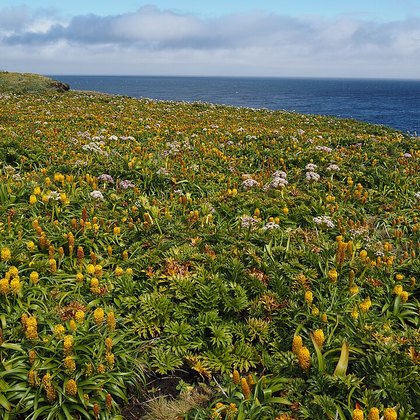
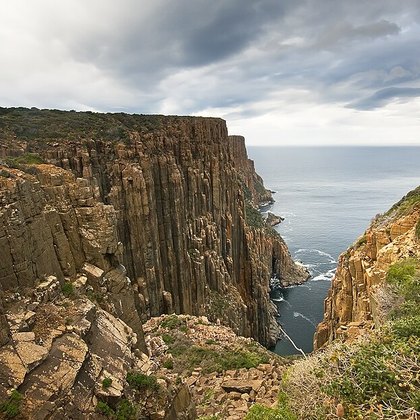
The sheltered, lee-side shoreline: rocky shores with windrows of stranded kelp, shallow tide pools and inshore kelp beds, where it takes most of its food by night. Behind that it uses peaty streams and boggy ground with sedge and tussock (grassland of loose, tall clump-forming grasses, especially in New Zealand), for daytime cover and for nesting. The diet is largely animal: marine invertebrates, crabs and molluscs, terrestrial arthropods, plus some seeds of rushes and grasses.
Where the bird is most often found, arranged by main group and formation.


Range and movements
Endemic to the Auckland Islands and found nowhere else in the world. It occupies all the larger islands of the group except main Auckland Island itself, where introduced cats and pigs wiped it out: Adams Island, Enderby, Disappointment, Rose and a string of smaller stacks. Old reports from elsewhere in New Zealand almost certainly rest on confusion with Brown Teal. It has no connection with Australia at all.
- Resident
- dark = core range, pale = thinly spread
Where and when to look
Only to be seen from a subantarctic island voyage, and then best on a landing at Enderby Island. Walk the sheltered north-eastern side and search along the kelp windrows on the beach: the birds are tame, but sit low and dark among brown weed, so scan slowly and watch for movement. If a teal makes a dash and runs off without ever taking wing, the identification is confirmed on the spot.
Conservation
Near Threatened (NT) on the world list and rated Nationally Vulnerable in New Zealand, with probably somewhat over a thousand birds. The blow came from introduced mammals: cats and pigs cleared it from the main island, and rabbits stripped out the shoreline vegetation. Since rabbits were eradicated from Enderby and Rose Islands in 1993, numbers there have risen. The lasting risk is the very small area everything depends on: one rat or cat ashore on any of the islets could clear a sub-population in short order, which is why the strict quarantine rules for visiting vessels are the single most important protection.
Scientific name
Anas aucklandica | (Gray, 1844)
G.R. Gray described the species in 1844 as Nesonetta aucklandica, in volume three of his The Genera of Birds; because it was later placed in Anas, author and year are bracketed. The old genus name Nesonetta is built from Greek nēsos, 'island', and nētta, 'duck', hence literally 'island duck'. aucklandica means 'of the Auckland Islands', which is also the type locality. For a long time the species was treated as one with Brown Teal and Campbell Teal; only later were the three separated on size, flight and genetic work. The Maori name is tete kakariki.