All species › Waterfowl › Magpie goose › Magpie Goose
Magpie Goose | Anseranas semipalmata
Ekstergans | Ganso urraca
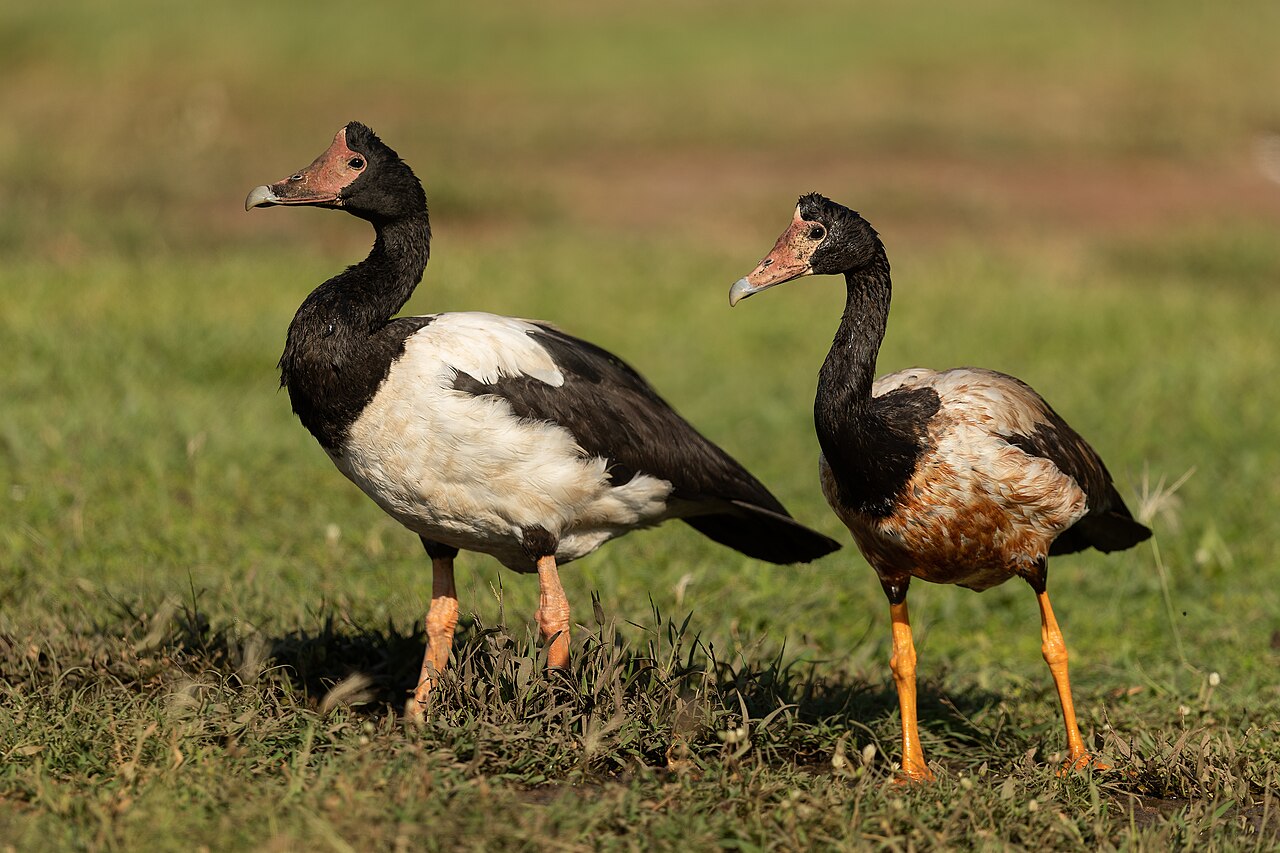
The Magpie Goose is the only species in its family and resembles no other waterbird: black and white, with long orange legs, half-webbed toes and a knob on the crown that keeps growing with age. It gathers in noisy flocks on the floodplains of tropical Australia and digs bulbs of sedge out of the mud with its bill.
Voice
A loud, penetrating, trumpeting call that makes the flock audible long before it is seen: ang-ank, higher and sharper in the male than in the female, and repeated in series by both. In flight it builds into a sustained honking from dozens of birds at once, carrying a long way. At the nest partners exchange a soft grunting mutter; young give a thin, repeated peeping.
No freely licensed recording has been found for this species yet; what to listen for is described below.
Identification
Seventy-one to eighty-nine centimetres, with a long neck, tall orange legs and a heavy, slightly hooked horn-coloured bill. Head, neck, hind wing, rump and tail are black, the rest of the body white; in flight the sharp boundary between the black primaries and the white centre of the wing stands out. The bare knob on the crown is taller in the male and breaks the head profile. The toes are only half webbed and the claws are long: it swims little and perches and climbs in trees. Young birds are dull brown-black with a flat crown.
Confusion species
In the north there is no second black-and-white waterbird of this size. Australian White Ibis (Threskiornis molucca) shares the colour scheme but has a bare black head and a long decurved bill. Black-necked Stork (Ephippiorhynchus asiaticus) is larger, glossed green-black and red-legged, and goes alone or in twos. A passing flock can suggest pelicans at range, but the Magpie Goose flies with the neck extended, the legs projecting well past the tail and in a loose, ragged formation.
Habitat
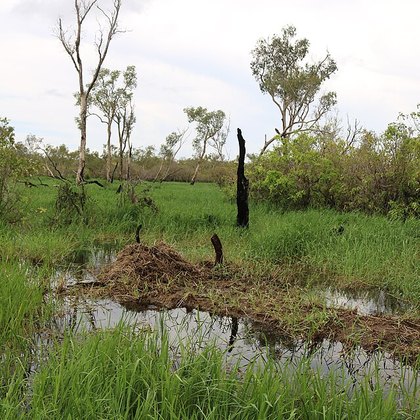
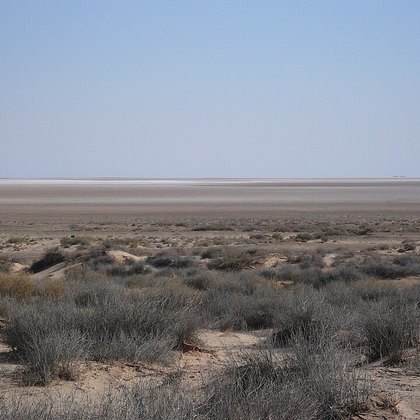
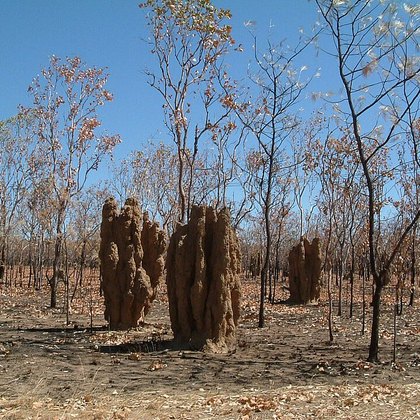
Freshwater swamp with reed, wild rice and sedge on the floodplains of the Top End and Cape York, with melaleuca swamp forest at the edge where it roosts and nests. In the dry season it packs onto the last billabongs and onto ephemeral lakes and claypans, digging for the bulbs of spike-rush. Cane fields and freshly sown paddocks are an extension of that same behaviour, and the reason farmers dislike it.
Where the bird is most often found, arranged by main group and formation.


Range and movements
Northern and eastern Australia, from the Fitzroy in the Kimberley across the Top End and the Gulf into Queensland, and on into southern New Guinea. In the southeast it was numerous into the nineteenth century as far as Victoria and South Australia, but the draining of the swamps and shooting wiped it out there. Since the 1990s it has been returning: on its own along the New South Wales coast, and by release into several Victorian wetlands. It does not migrate, but in the dry season it wanders hundreds of kilometres to whatever water is left.
- Resident
- Passage
- dark = core range, pale = thinly spread
Where and when to look
Go in the dry season, between June and October, to a billabong or a wet flat in Kakadu or along the Mary River: the flocks are then packed together and thousands can be seen in a single morning. With a passing group, watch the slow, heavy wingbeat and the loose formation, quite unlike the tight V of ducks.
Conservation
Not threatened (LC) and numerous in the north: after good wet seasons the Top End floodplains hold hundreds of thousands of birds. That concentration in a small part of the range does leave the species exposed to changes in water management and to saltwater pushing into the coastal swamps. In Victoria, South Australia and New South Wales it stands on the state lists as threatened.
Scientific name
Anseranas semipalmata | (Latham, 1798)
Latham described the bird in 1798 as Anas semipalmata, among the ducks; because it was later placed in a genus of its own, author and year stand in parentheses. Lesson introduced Anseranas in 1828, a contraction of Latin anser, 'goose', and anas, 'duck' — the bird is neither, and stands alone in its family. semipalmata means 'half-webbed', after toes joined by membrane only to halfway. The type locality is the Hawkesbury near Sydney, where the species is appearing again after a long absence.