All species › Kiwis › Kiwis › Okarito Kiwi
Okarito Kiwi | Apteryx rowi
Okarito-bruine kiwi | Kiwi de Okarito
The Okarito Kiwi, or rowi, is the rarest kiwi: the entire naturally breeding population lives in a single lowland forest of about eleven thousand hectares at Okarito on the west coast of the South Island. It resembles a brown kiwi but is paler, with a greyish cast to the plumage and often white feathering on the face — and it was only described as a separate species in 2003.

Voice
As in the other brown kiwi: the male a high ascending whistle repeated fifteen to twenty-five times, the female a slower, lower, hoarse guttural call given ten to twenty times. Because the young here stay with their parents for four to five years, more voices can overlap at one territory than in other kiwi. The snuffling blow while probing the litter carries surprisingly far on a still night.
No freely licensed recording has been found for this species yet; what to listen for is described below.
Identification
About forty centimetres, and at 1.9 kilograms in the male and 2.6 in the female clearly lighter than tokoeka. The plumage is pale brown streaked with brown and black and carries a soft greyish cast that sets it apart from North Island Brown Kiwi; a proportion of birds have white feathering around the base of the bill and the eye, sometimes forming half a mask. The bill is long and pale, the legs, toes and claws short and pale.
Confusion species
Southern Brown Kiwi (Apteryx australis) is the nearest species, at Haast a good hundred kilometres to the south: larger, heavier and a warmer rufous, without the grey cast and without white on the face. North Island Brown Kiwi (A. mantelli) occurs only on the North Island and is likewise more rufous. Little Spotted Kiwi (A. owenii) is grey with white cross-bars, smaller and half the weight — and since the 2025 find near Whataroa a real possibility again in South Westland, so watch for barring against streaking. On Mana Island, where both species have been released, that colour difference is the only handle.
Habitat
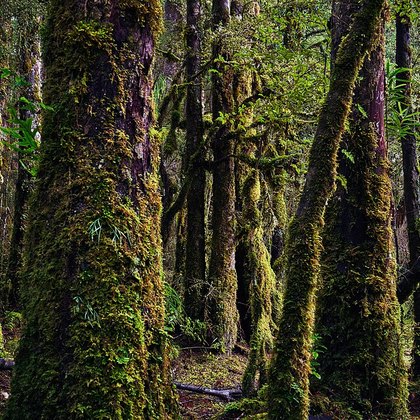
Dense lowland podocarp-broadleaf forest on moist, workable ground: rimu, kahikatea and matai with a thick understorey, cut through by pakihi bogs and creeks, from sea level to the first slopes. On the islands where it has been released it is regenerating forest and scrub. It nests in burrows it digs itself, in hollow tree bases and in hollow logs.
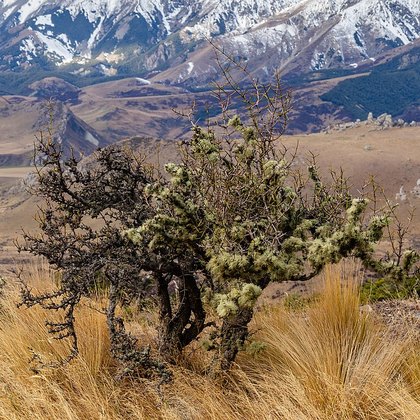
Where the bird is most often found, arranged by main group and formation.

Range and movements
New Zealand only, and within it the Okarito forest of South Westland between the coast and the foothills of the Southern Alps — some eleven thousand hectares, the only naturally breeding stock. Beyond that, groups have been released on Blumine Island (2010), Mana Island (2012) and Motuara Island in the Marlborough Sounds, and on the mainland in the Omoeroa Range (2018) and Ballyhooly Bush. Formerly the range ran through the northern South Island and into the southern North Island, as far as Lake Poukawa in Hawke's Bay.
- Resident
- dark = core range, pale = thinly spread
Where and when to look
Seeing one in the wild is close to out of the question: the Okarito forest is dense and the stock small. The realistic route is the West Coast Wildlife Centre at Franz Josef, where the breeding birds and newly hatched Operation Nest Egg chicks can be seen at close range. For those who still want to try in the field: stand at the edge of the Okarito lagoon or along the Three Mile track after dark and listen for the duet — red light, no dogs, and stay on the track.
Conservation
Vulnerable (VU) on the world list, ranked nationally endangered within New Zealand. The low point came in the mid-1990s at some hundred and sixty to two hundred largely ageing birds, because stoats killed nearly every chick before it could defend itself. Operation Nest Egg — lifting eggs or chicks, rearing them elsewhere to over a kilogram and returning them — reversed that: by around 2019 there were some six hundred. The whole stock is under active management; without trapping and without the rearing programme the species slides back.
Scientific name
Apteryx rowi | Tennyson, Palma, Robertson, Worthy & Gill, 2003
Tennyson, Palma, Robertson, Worthy and Gill described the bird in 2003 as Apteryx rowi; it still stands in the genus in which it was described, so author and year carry no parentheses. That the Okarito birds differed from ordinary brown kiwi was suspected as early as the 1950s; DNA work in the mid-1990s and a host-specific feather louse of its own (Apterygon okarito) settled it. Apteryx is Greek for 'without wing'; the epithet rowi takes up the name used for this bird by Poutini Ngai Tahu on the West Coast. The type locality is South Okarito Forest in South Westland.