All species › Kiwis › Kiwis › Little Spotted Kiwi
Little Spotted Kiwi | Apteryx owenii
Kleine grijze kiwi | Kiwi moteado menor
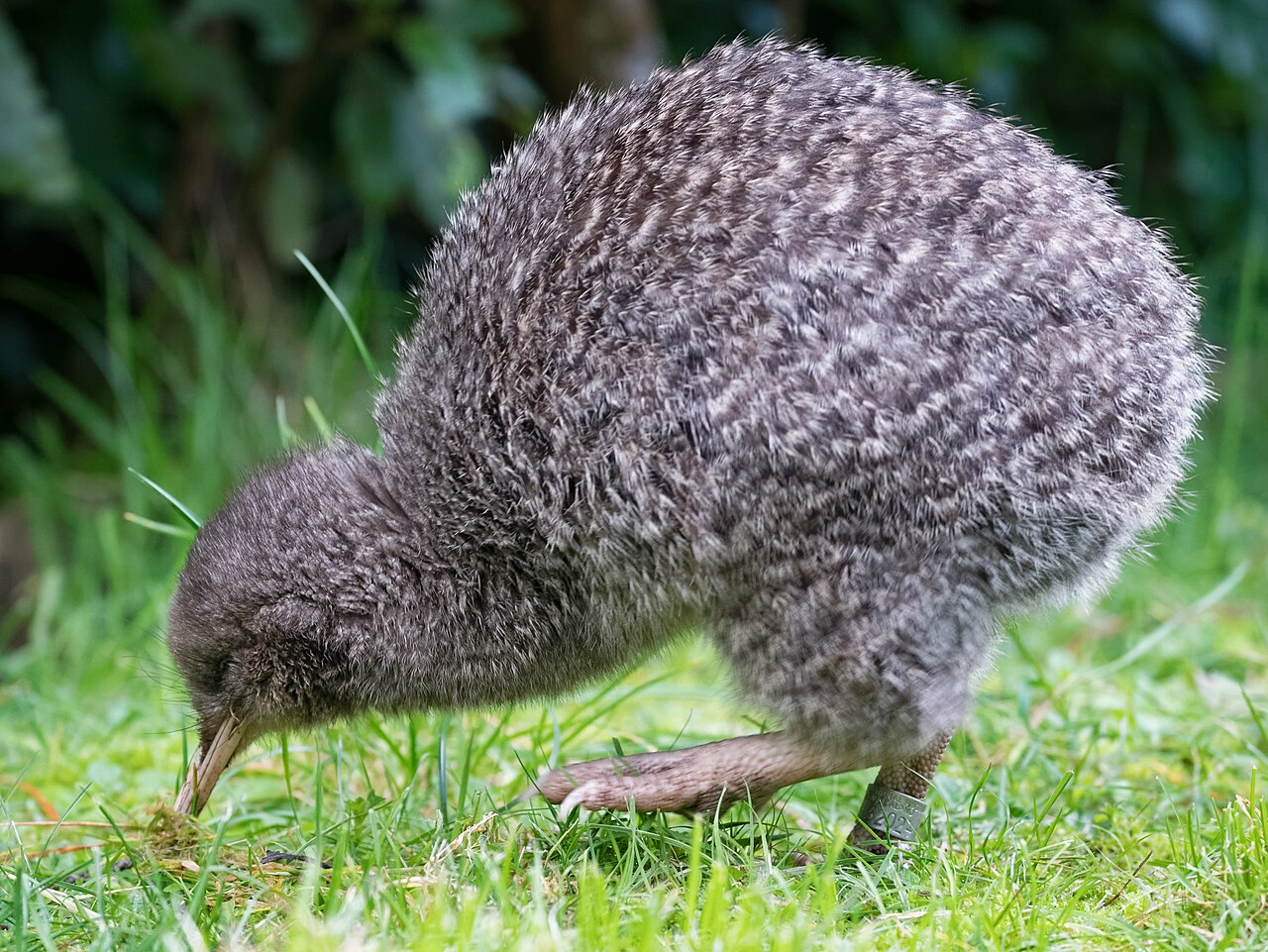
The Little Spotted Kiwi is the smallest of the five kiwi, barely bigger than a bantam hen: pale brownish grey, finely barred with white, with a long pale bill and short pale legs. It disappeared almost entirely from the mainland in the nineteenth century, and it owes its survival to five birds moved to Kapiti Island in 1912.
Voice
The male whistles a high ascending note repeated twenty-five to thirty-five times in a row — faster, thinner and in longer series than in the brown kiwi — and the female answers with a slower, lower ascending trill given as often. While feeding it snuffles and blows audibly through the nostrils at the bill tip. On Kapiti the calling starts soon after sunset and carries on deep into the night.
No freely licensed recording has been found for this species yet; what to listen for is described below.
Identification
A kiwi of about thirty centimetres and a little over a kilogram — males around 1,150 grams, females around 1,350 — and by a good margin the smallest species. The plumage is light brownish grey with fine white cross-bars that give a mottled or banded look at close range. The bill is long, ivory and slightly curved, longer in the female; legs, toes and claws are short and pale. Beside the brown kiwi it looks not only smaller but rounder, paler and lighter on its feet.
Confusion species
Colour separates it from the three brown kiwi: North Island Brown Kiwi (Apteryx mantelli), Southern Brown Kiwi (A. australis) and Okarito Kiwi (A. rowi) are rufous to pale brown streaked with black, while this bird is grey with white bars and half the weight. Overlap is nearly absent in any case: it sits on predator-free islands and in fenced sanctuaries where the brown kiwi are missing, with Mana Island the exception, where it has lived alongside rowi since 2012. Great Spotted Kiwi (A. maxima) of the north-west South Island is barred in the same way but more than twice as heavy and dark-legged; its young birds are the one real trap.
Habitat
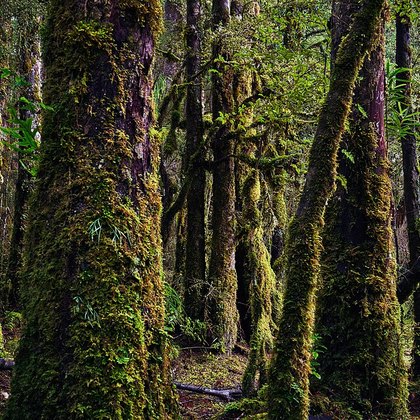
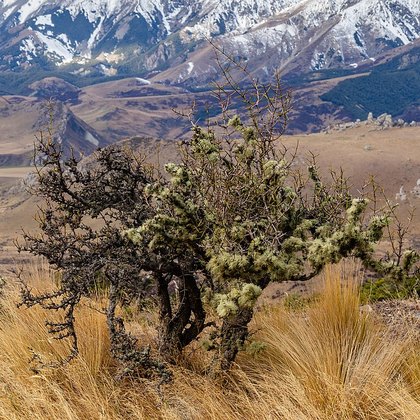
Podocarp-broadleaf forest and dense regenerating scrub over a moist, workable litter layer, on Kapiti Island from the coastal fringe to the summit. It does equally well in manuka and kanuka scrub and in rough forest edge, as long as worms and larvae can be had and there is cover for the day. It digs burrows, but uses hollow logs, tree bases and dense tussock just as readily.
Where the bird is most often found, arranged by main group and formation.

Range and movements
Not in Australia; within New Zealand almost entirely on predator-free islands and in fenced sanctuaries. Kapiti Island holds about twelve hundred birds, the bulk of a total of roughly fifteen to sixteen hundred mature birds; beyond that there are groups on Tiritiri Matangi, Hen Island, Long Island, Red Mercury and Anchor Island, and in Zealandia at Wellington. In July 2025 two birds were found in the open near Whataroa in South Westland — the first wild mainland record since 1978 — and in May of that year forty birds went to Brook Waimārama near Nelson.
- Resident
- Breeding (summer)
- Passage
- dark = core range, pale = thinly spread
Where and when to look
Zealandia in Wellington and Kapiti Island are the places where it can be done: book a night walk, sit quietly at the edge of a track and let the bird come to you rather than hunting for it. Listen for the snuffling and rustling in the leaf litter, which often gives it away before the call does. Use red light rather than a white torch, and keep dogs out of kiwi country everywhere.
Conservation
Near Threatened (NT) on the world list, and in New Zealand actually recorded as increasing, because numbers are growing on nearly every island where it has been released. The bottleneck is not predation at the present sites but the genetic base — every bird descends from the five taken to Kapiti in 1912 — and the shortage of predator-free ground to expand into. On the mainland it was lost to stoats, cats and the clearing of lowland forest; new releases into fenced sanctuaries are meant to win that ground back step by step.
Scientific name
Apteryx owenii | Gould, 1847
Gould described the species in 1847 as Apteryx owenii, and it has stayed in that genus, so author and year carry no parentheses. The genus Apteryx was introduced by Shaw in 1813, from Greek a-, 'without', and pteryx, 'wing'. The epithet honours Richard Owen, the anatomist who described the kiwi skeleton and deduced the moa from a single fragment of femur. The type locality is the South Island, restricted in the New Zealand checklist to the Nelson district; the Maori name is kiwi pukupuku.