All species › Kiwis › Kiwis › Great Spotted Kiwi
Great Spotted Kiwi | Apteryx maxima
Grote grijze kiwi | Kiwi moteado mayor
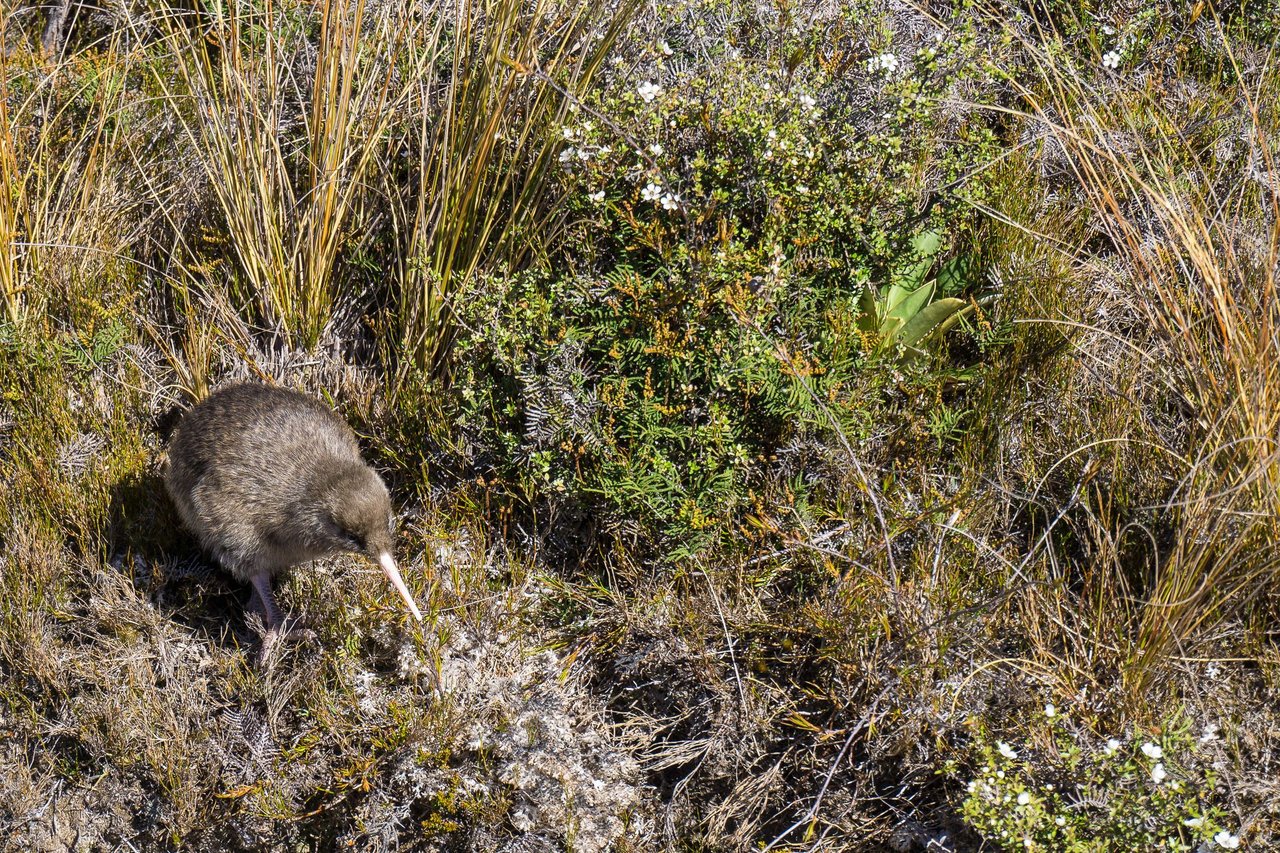
The Great Spotted Kiwi or roroa is the spotted kiwi of the mountains: a brownish-grey bird finely barred with white which, at three kilograms, is among the heaviest of the kiwi and lives mostly above seven hundred metres, in the beech forest and tussock (grassland of loose, tall clump-forming grasses, especially in New Zealand) of the north-west South Island. Few people ever see one; anyone who spends the night in those mountains may well hear it.
Voice
The male whistles a high ascending note repeated ten to twenty times in a row; the female answers with a slower, lower ascending trill of ten to fifteen notes. Pairs often call in duet, one breaking into the other's series. Calling is only occasional, a few times a night from soon after dark. Otherwise the bird gives itself away by rustling and snuffling in the leaf litter, and by growls, hisses and bill-snapping when disturbed.
No recording with a suitable Creative Commons licence has been found for this species yet; what to listen for is described below.
Identification
A large, pear-shaped kiwi of about forty-five centimetres; the female is clearly larger than the male, at roughly three kilograms against 2.2. The plumage is brownish grey, finely mottled and barred horizontally with white, which gives a speckled look at close range and appears greyer in torchlight than any brown kiwi. The bill is long and ivory, the legs and toes are short, heavy and dark, and the claws are often dark or streaked. Young birds look very like Little Spotted Kiwi, but already have the more massive, dark legs.
Confusion species
Little Spotted Kiwi (Apteryx owenii) has the same barred grey plumage but is half the weight, with pale legs, toes and claws; with a young bird, look above all at the thickness and colour of the legs. There is little overlap, since Little Spotted Kiwi lives almost only on predator-free islands and in fenced sanctuaries. Okarito Kiwi (A. rowi) is streaked rather than barred and lives further south, at Okarito; it was there that hybrids of rowi and Little Spotted Kiwi were collected in the nineteenth century and long taken for this species, and such hybrids still occur. Here too a rustling Weka (Gallirallus australis) is often taken for a kiwi in the dark, but it has a tail and a short bill.
Habitat
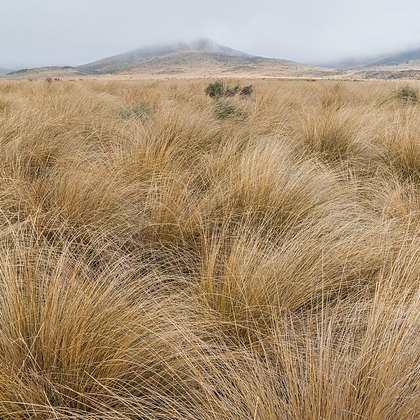
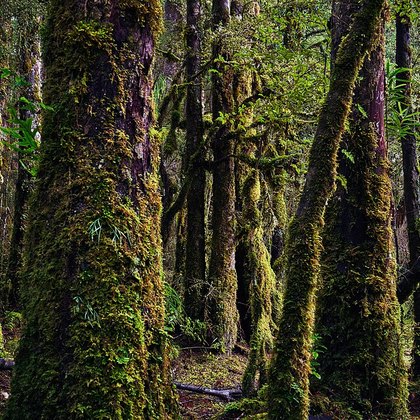
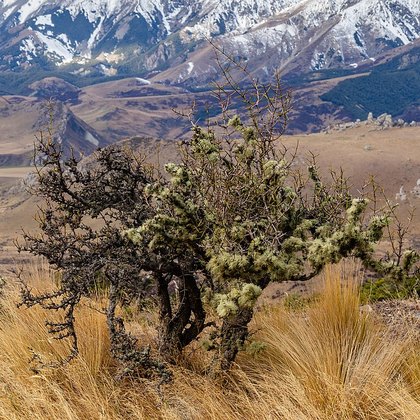
From sea level to about fifteen hundred metres, but the centre of gravity lies in the subalpine zone between seven hundred and eleven hundred metres: southern beech forest, subalpine scrub and tussock above the treeline, and lower down also podocarp-broadleaf forest and rough scrub. A pair uses many shelters within its territory: short burrows, rock crevices, hollow tree bases and hollow logs. Its food — worms, beetle and cicada larvae, weta, spiders and freshwater crayfish — it takes from leaf litter and rotten wood.
Where the bird is most often found, arranged by main group and formation.


Range and movements
Not in Australia; only in the north-west of New Zealand's South Island, in three strongholds: north-west Nelson as far as the Buller, with Kahurangi and over half of all birds, the Paparoa Range with about thirty per cent, and the Southern Alps from Lewis Pass to Arthur's Pass and the Hurunui with about fifteen per cent. DOC recognises four genetically distinct groups within these, with a separate population near Westport. Together they amount to some fourteen to fifteen thousand birds in roughly eight hundred thousand hectares of remote mountain country. Sedentary; it has gone from the lowlands.
- Resident
- dark = core range, pale = thinly spread
Where and when to look
Seeing one is the exception, hearing one is not: spend the night in a hut on the Heaphy Track or in Arthur's Pass village and go outside after dark to listen. Count the notes: ten to twenty per series fits this species, while Little Spotted Kiwi whistles longer series. Do not walk into the forest with a bright torch to look for it — use red light on the track at most — and leave the dog at home: dogs are the greatest danger to adult kiwi.
Conservation
Vulnerable (VU) on the world list, and listed in New Zealand as Nationally Vulnerable. Numbers are slowly falling, by about 1.6 per cent a year according to DOC. Stoats are the main threat: they kill chicks and strike especially hard after a beech mast year, when mice and stoats boom. Adults fall mainly to dogs. Where predators are controlled at landscape scale, by aerial 1080 or trapping, the decline appears to have halted or reversed locally.
Scientific name
Apteryx maxima | Sclater & von Hochstetter, 1861
Sclater and von Hochstetter described the species in 1861 as Apteryx maxima, and since it remains in that genus, author and year carry no parentheses. The name fell into oblivion: for more than a century the bird was called Apteryx haastii, after Potts (1872), who honoured the geologist Julius von Haast with it. In 2021 DNA work showed that the types of haastii, collected at Okarito, were hybrids of rowi and Little Spotted Kiwi, and the old name maxima, Latin for 'largest', was reinstated. Apteryx is Greek for 'without a wing'. The type locality is the South Island; the Maori name is roroa.