All species › Passerines › Whistlers and allies › Grey Whistler
Grey Whistler | Pachycephala simplex
Grauwe fluiter | Silbador simple
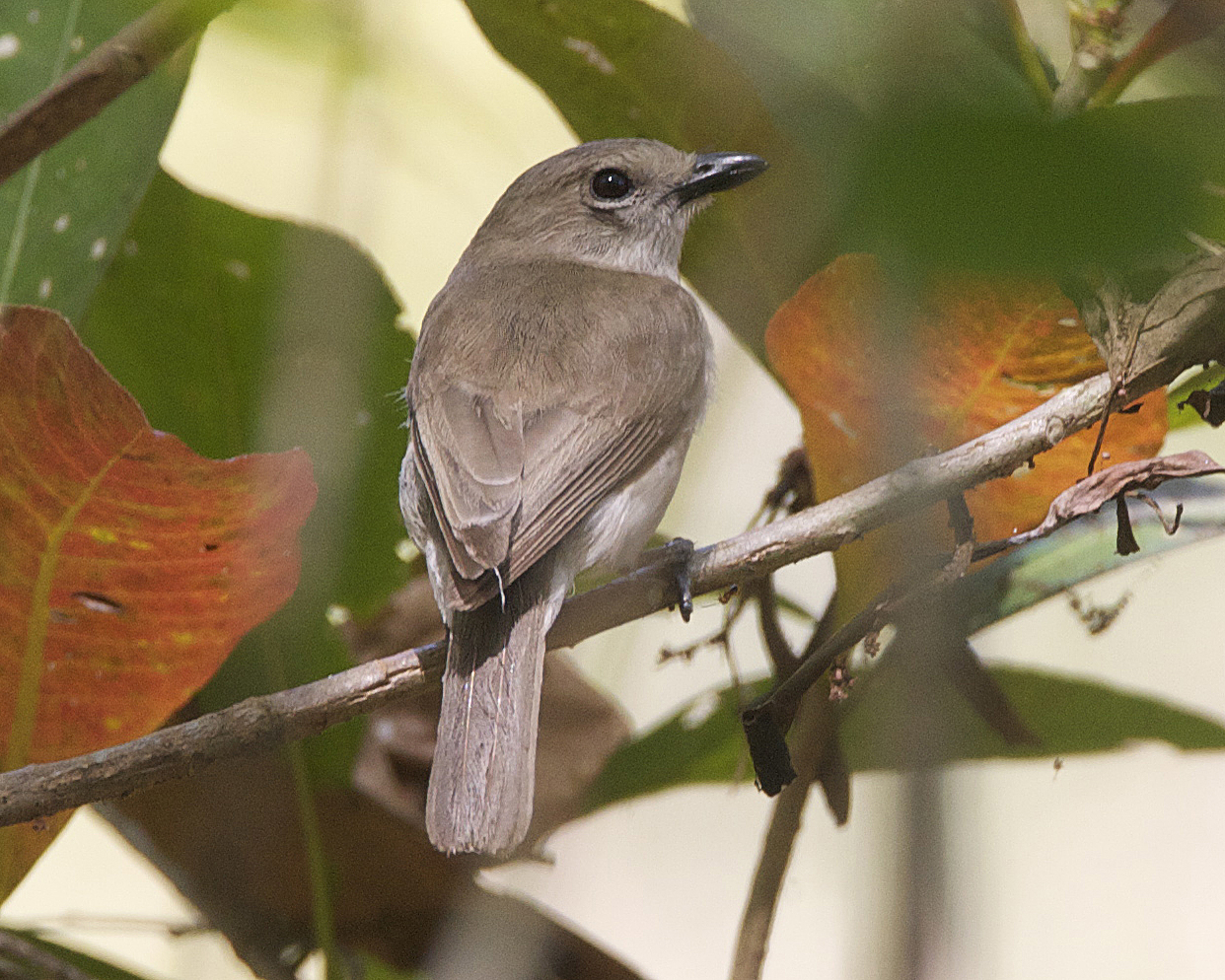
The Grey Whistler is the smallest and plainest whistler in Australia: an evenly grey-brown to olive-grey bird with no black head, no breast band and none of the bright colour the genus is known for. Male and female look exactly alike. Identification runs on build and voice rather than colour, and on habitat: monsoon forest, rainforest and the margins of mangrove in the tropical north.
Voice
Surprisingly rich for so unobtrusive a bird. The best-known phrase is a series of clear whistles that jumps up in steps, as though the bird were climbing a scale and skipping a rung halfway. Alongside it comes a long rambling babble of mixed notes that ends less explosively than the ringing song of the Australian Golden Whistler. In dense monsoon forest the voice is almost always the first and often the only evidence that the bird is there.
No freely licensed recording has been found for this species yet; what to listen for is described below.
Identification
A small, rounded songbird of thirteen to fifteen centimetres with the typical whistler build — a large round head, a short neck and a sturdy bill hooked at the tip — but all of it in miniature. The bird is plain and shows no contrasting pattern whatever. In the Top End the birds are grey-brown above with a whitish throat and a faintly ochre breast; on Cape York they are greyer on the head and more olive on the back, with a clearly yellowish belly. Some birds show a very faint fine streaking on the chest. Both sexes are alike, and that in itself is a character: in almost every other Australian whistler the male differs sharply from the female.
Confusion species
The female Australian Golden Whistler (Pachycephala pectoralis) is the commonest error: it is larger, heavier-billed and shows faint chest streaking, and in northern Queensland the ranges overlap. The female Mangrove Golden Whistler (Pachycephala melanura) is likewise muted, but distinctly yellower on the belly and undertail coverts, and sits in mangrove. Little Shrikethrush (Colluricincla megarhyncha) shares the monsoon forest and the dull colour, but is considerably larger, longer-billed and heavier-headed. The real danger, though, is not another whistler but the gerygones of the genus Gerygone, which forage in the same foliage: those have a thin pointed bill and a slimmer build, whereas the Grey Whistler always keeps that heavy hooked bill and the domed head.
Habitat
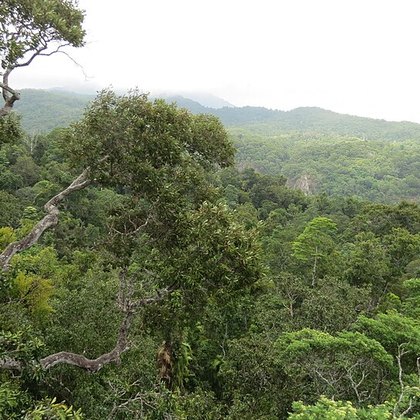
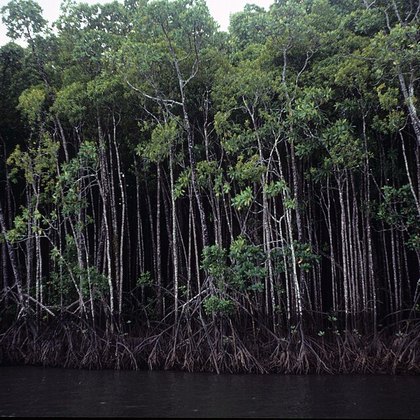
Monsoon forest and vine thicket, tropical rainforest and the landward fringes of mangrove, along with melaleuca swamp forest and the dense belts lining northern creeks. The bird forages restlessly in the middle and upper foliage, gleaning insects and spiders from the leaves, and regularly joins mixed flocks. Dry, open woodland is avoided.
Where the bird is most often found, arranged by main group and formation.



Range and movements
The tropical north of Australia, in two separated areas: the Top End of the Northern Territory with its offshore islands, and Cape York Peninsula in northern Queensland, south to roughly the Wet Tropics. Beyond Australia the species occurs in New Guinea and adjacent islands. The Australian birds are resident with no appreciable migration, though within the region they shift between forest patches as food supply changes.
- Resident
- dark = core range, pale = thinly spread
Where and when to look
Learn the rising whistled scale first; it will bring you to the bird within minutes. Then look at shape rather than colour: a domed head, a short neck and a thick hooked bill make it a whistler, whereas an equally grey bird with a needle-fine bill is a gerygone. Search the shaded mid-storey of monsoon forest, especially along tracks and light gaps.
Conservation
Not Evaluated (NE) under the taxonomy followed here. That is because the species limits are still moving: part of the literature places the Cape York birds with New Guinean Pachycephala griseiceps and part with Pachycephala simplex, and while that knot remains untied the Australian taxon has not been separately assessed. There is no sign of decline: the species is common in suitable forest. The vulnerability lies in the habitat, since monsoon forest occurs as small, separated patches easily damaged by fire and by trampling stock.
Scientific name
Pachycephala simplex | Gould, 1843
John Gould described the species in 1843 from a bird taken at Port Essington in the Northern Territory. The epithet simplex is Latin for 'plain, unmarked' and names exactly what the bird lacks: any pattern. The genus Pachycephala was introduced in 1827 by Nicholas Vigors and Thomas Horsfield, from Ancient Greek pakhus ('thick') and kephalē ('head'). The Dutch Grauwe fluiter, the English Grey Whistler and the Spanish silbador simple all take the absence of colour, the Spanish following the Latin literally. In older Australian literature the browner Top End form is sometimes named separately as Brown Whistler.