All species › Passerines › Whistlers and allies › Red-lored Whistler
Red-lored Whistler | Pachycephala rufogularis
Roodteugelfluiter | Silbador gorjirrufo
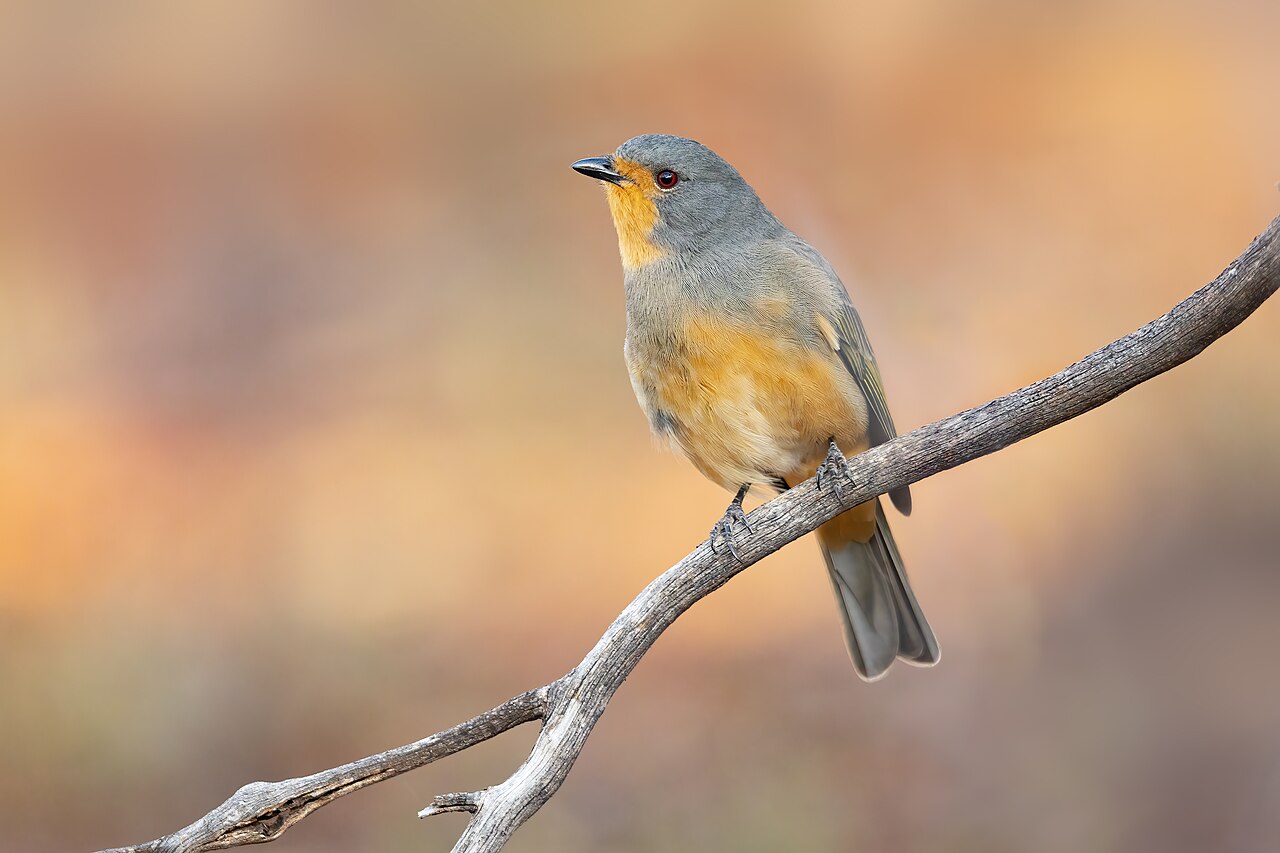
The Red-lored Whistler is the rarest whistler in Australia and one of the few birds tied entirely to old, long-unburnt mallee: a large, long-tailed bird with a rufous-orange face and throat, a grey breast band and a buff belly. It lives in a handful of reserves in the inland of South Australia, Victoria and New South Wales, is seldom seen, and is listed as Vulnerable because a single large fire can wipe out a whole sub-population.
Voice
A slow, plaintive and far-carrying whistle, quite unlike the explosive rattle of the Rufous Whistler. The best-known phrase is a series of slow, clear notes that hangs over the mallee like a mournful piping, with long silences between, alongside a repeated piping 'peeu'. The bird often calls from a low branch inside a bush and moves between calls, so the sound seems to jump from place to place. Early morning after a cold night in late winter offers the best chance.
No freely licensed recording has been found for this species yet; what to listen for is described below.
Identification
A large, slim whistler of about twenty centimetres with a strikingly long tail and a moderately heavy bill. The face is the character: the lores — the strip between bill and eye — and the throat are warm rufous-orange, and that orange runs as a sharply bounded patch from the bill down onto the upper breast. Below it lies a broad, plain grey breast band, and below that a buff belly. The upperparts are grey-brown. The female closely resembles the male but is duller, with less saturated orange. There is no black in the plumage: no black cap, no black breast band.
Confusion species
The species to rule out is Gilbert's Whistler (Pachycephala inornata), which occurs in the same mallee and is treated elsewhere in this guide. Its male has black lores against a grey face and wears the rufous only as a small patch on the throat, with plain grey underparts; in the Red-lored Whistler it is the lore stripe itself that is rufous-orange, the orange continues onto the breast, and the belly is buff rather than grey. The female Gilbert's Whistler is plain grey-brown and lacks the orange altogether. The female Rufous Whistler (Pachycephala rufiventris) shares the mallee, but is clearly dark-streaked below. Australian Golden Whistler (Pachycephala pectoralis) also occurs in mallee, but its male is unmistakably yellow and black and its female is smaller and shorter-tailed.
Habitat
Mallee, and within it a very particular kind of mallee: old, long-unburnt stands with a dense understorey of spiny spinifex hummocks or heath shrubs. That understorey takes decades to build, which makes the bird dependent on patches that have not burnt for a long time. It forages largely on and just above the ground, searching litter and hummocks for insects, and seldom flies high or far.
Where the bird is most often found, arranged by main group and formation.

Range and movements
A small, fragmented range in the south-eastern inland, almost entirely within protected areas: the Riverland Biosphere Reserve and the Ngarkat, Billiatt and Bakara parks in South Australia, Murray-Sunset and the Big Desert in north-western Victoria, and the Nombinnie and Round Hill reserves in central New South Wales. Large stretches of unsuitable or burnt country lie between those cores. The bird does not migrate, but it does abandon areas that have burnt and returns only once the understorey has recovered.
- Resident
- Winter
- dark = core range, pale = thinly spread
Where and when to look
Go early, in late winter or early spring, and search old mallee with a dense spinifex understorey — young, open or recently burnt mallee yields nothing. Stand still and listen for the slow, mournful whistles; the bird almost never shows itself by chance. If you do see one, look immediately at the lore stripe between bill and eye: rufous-orange in this species, black in Gilbert's Whistler. That one detail settles the identification.
Conservation
Vulnerable (VU). The population is small and divided among a few separated reserves, and the species depends for its survival on mallee that has not burnt for decades. Large, hot summer fires destroy that understorey across thousands of hectares at once, and the ground then takes decades to become habitable again. To this are added the historical clearing of mallee for agriculture, grazing by goats and rabbits that opens up the understorey, and the fragmentation that makes recolonisation after a fire difficult. Management therefore turns almost entirely on fire: preventing a whole sub-region from burning in a single season.
Scientific name
Pachycephala rufogularis | Gould, 1841
John Gould described the species in 1841 from a bird taken near Adelaide in South Australia. The epithet rufogularis combines Latin rufus ('rusty red') with gula ('throat'), hence 'rufous-throated'. The genus Pachycephala was introduced in 1827 by Nicholas Vigors and Thomas Horsfield, from Ancient Greek pakhus ('thick') and kephalē ('head'). The Dutch Roodteugelfluiter and the English Red-lored Whistler take the rufous lore stripe, the character that separates the species from its nearest neighbour; the Spanish silbador gorjirrufo instead follows the Latin and takes the throat.