All species › Parrots › Old World parrots › Hooded Parrot
Hooded Parrot | Psephotellus dissimilis
Kapparkiet | Perico capirotado
The Hooded Parrot is the northern counterpart of the Golden-shouldered Parrot: a turquoise parrot with a jet-black hood over crown and cheek and a large golden patch on the wing, which digs its nest chamber into a conical termite mound. It is the parrot of the Top End savanna, and in a few small towns around Pine Creek it can be watched at very close range.

Voice
In flight a high, clear two-note whistle, chu-weet … chu-weet, distinctly sharper and thinner than the lower call of the Golden-shouldered Parrot, and often the first sign of an incoming party. Feeding on the ground it is silent; come too near a nest and it breaks into shrill, agitated chattering with sharp clipped notes.
No freely licensed recording has been found for this species yet; what to listen for is described below.
Identification
A slim parrot of some twenty-six centimetres with a long tail. The male is unmistakable: a jet-black hood runs from the forehead over the crown to below the eye — with no yellow frontal band at all — the back and mantle are dull brown, the rump and the whole underside are bright turquoise to blue-green, and a large golden-yellow block on the wing coverts travels as a yellow stripe in flight. The undertail-coverts are orange-red with white feather margins, the tail is olive-green with a pale blue tip, the bill blue-grey and the legs pink-grey. The female is dull green with a grey-brown forehead, crown and forecheek and pink-grey undertail-coverts edged white; juveniles resemble her.
Confusion species
The Golden-shouldered Parrot (Psephotellus chrysopterygius) is nearly its mirror image, but the two never meet: the Carpentarian barrier separates the Top End from Cape York. For the record: the Golden-shouldered Parrot carries a narrow pale yellow band across the forehead below the black cap, has a grey-brown rather than dull brown mantle, and salmon-pink rather than orange-red undertail-coverts. Within the Top End the risk is small: the Mulga Parrot (Psephotellus varius) does not occur there, the much smaller Budgerigar (Melopsittacus undulatus) is yellow with black barring, and the region's Red-winged Parrot (Aprosmictus erythropterus) is green with a red wing panel. Females and juveniles are dull green, and then the orange-pink vent plus the long tail is the handle.
Habitat
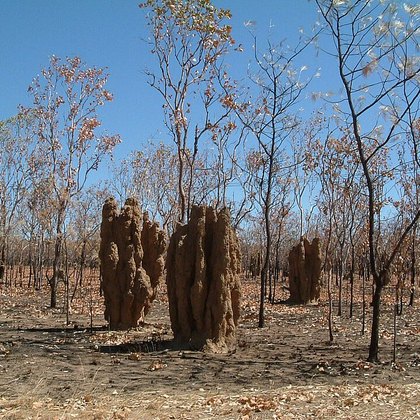
Dry open savanna of eucalypt and spinifex and, above all, melaleuca-dominated floodplains, always in country with conical termite mounds. Into such a mound it digs, over about three weeks, a nearly horizontal tunnel of fifty to eighty centimetres ending in a nest chamber whose temperature stays steady of its own accord. It forages on the ground for grass seed, and it drinks faithfully and often, which ties it in the dry season to waterholes and even to garden sprinklers.
Where the bird is most often found, arranged by main group and formation.


Range and movements
The north-east of the Northern Territory only, roughly between Adelaide River in the north and Mataranka in the south, with Pine Creek, Katherine and Nitmiluk as the heart of the range. Eastward it reaches into Arnhem Land. It does not occur in Queensland, nor in Western Australia, nor in New Zealand or on Norfolk Island.
- Resident
- dark = core range, pale = thinly spread
Where and when to look
Sit down in Pine Creek: in the late afternoon and again early in the morning parties come in from the surrounding savanna to drink at the lawn sprinklers in front of the Lazy Lizard Tavern and at the water feature on the Railway Reserve, and they take little notice of people walking past. Otherwise work a termite-mound flat towards Edith Falls and listen for the high two-note whistle; May is a good month, with nests in the mounds still in use.
Conservation
Least Concern (LC). It has gone from a good part of its original range, but stays common where management is right: in national parks and on Aboriginal-managed land, where stock is few and burning is early and cool. Where it fails, it fails along three lines: cattle trample and break down the termite mounds it must nest in, late and hot fires destroy the seeding herb layer, and drinking water becomes fouled. Of the illegal trapping for the bird trade, once substantial, little remains now that the species breeds readily in captivity.
Scientific name
Psephotellus dissimilis | (Collett, 1898)
The Norwegian zoologist Robert Collett described the species in 1898 as Psephotus dissimilis, from Northern Territory material; Mathews placed it in Psephotellus in 1913, which is why author and year stand in parentheses. Latin dissimilis means 'unlike, different' and refers to the wide gap between male and female, or to the difference from its nearest relative. For a long time the bird was treated as a subspecies of the Golden-shouldered Parrot; genetically their ancestors probably parted in the late Miocene or early Pliocene. The Dutch, English and Spanish guide names all name the same black hood.