All species › Parrots › Old World parrots › Golden-shouldered Parrot
Golden-shouldered Parrot | Psephotellus chrysopterygius
Geelschouderparkiet | Loro hombroamarillo
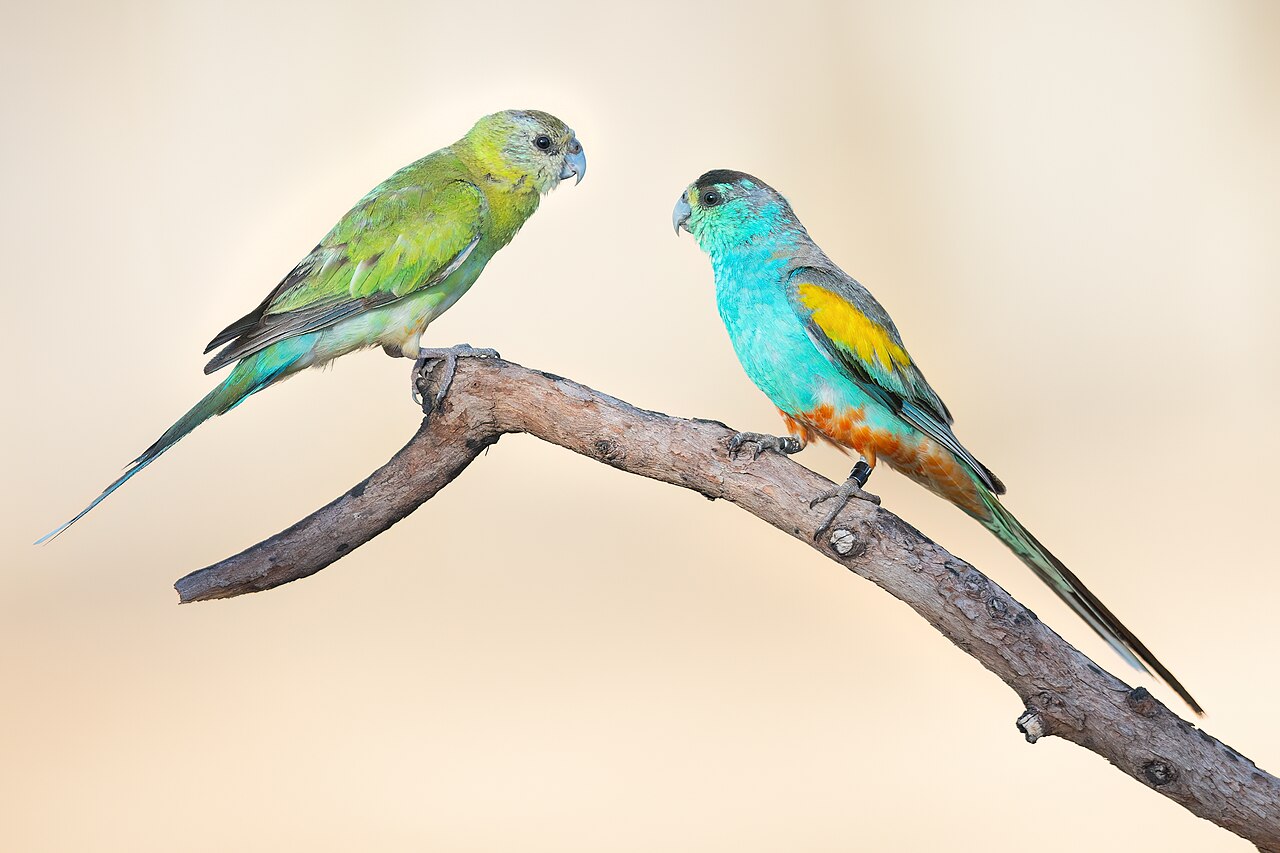
The Golden-shouldered Parrot is the rarest parrot of tropical Australia: a slim turquoise bird with a black cap, a narrow straw-yellow band across the forehead and a golden patch on the shoulder, which digs its nest into a termite mound. It hangs on at a handful of places in the south of Cape York Peninsula, where at most a few hundred birds remain.
Voice
A two-note whistled contact call, lower and less shrill than that of its close relative the Hooded Parrot: chu-weet, usually given in flight and often the only sign that a party is crossing the grassland. Separate clear whistles are added. Feeding on the ground it is all but silent; alarmed, it breaks into shrill, hurried chattering with sharp isolated notes.
No freely licensed recording has been found for this species yet; what to listen for is described below.
Identification
A slim parrot of some twenty-six centimetres with a long graduated tail. The male is mostly turquoise: the head carries a black cap reaching below the eye, and just below it lies a narrow pale yellow band across the forehead that shows at distance as a light line. Cheeks, breast and belly are turquoise-blue, a large golden-yellow patch sits on the wing coverts, and the mantle and lower back are grey-brown, which sets off the blue of the rump. Lower belly, thighs and undertail-coverts are salmon-pink. The female is dull greenish-yellow with a pale yellow forehead, a broad cream bar across the underwing and a salmon wash around the vent; older females acquire a dull grey cap. Juveniles resemble the female, but newly fledged males already show brighter blue cheeks.
Confusion species
The only real confusion species is its closest relative, the Hooded Parrot (Psephotellus dissimilis), but that bird sits more than a thousand kilometres away in the Northern Territory: the two are separated by the Carpentarian barrier and nowhere overlap. On features: the Hooded Parrot lacks the pale yellow frontal band altogether, its black hood runs further back across the cheek, its back is a warmer brown and its undertail-coverts are orange-red rather than salmon-pink. The Mulga Parrot (Psephotellus varius) of the dry interior is grass-green rather than turquoise, carries a red nape patch, and does not occur on Cape York. Females and young birds are the hard ones, but a dull greenish-yellow parrot with a cream underwing bar on the plains of southern Cape York is almost certainly this species.
Habitat
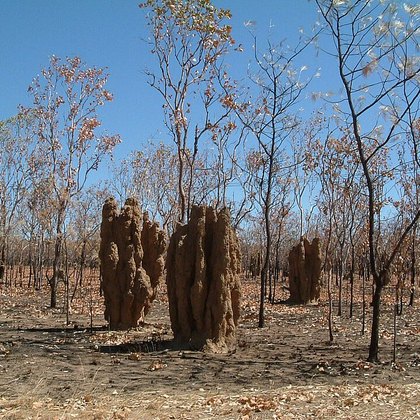
Open grassy savanna of eucalypt and melaleuca on flat, seasonally wet ground, where conical and magnetic termite mounds stand among the grass. Those mounds are the heart of its existence: it digs a tunnel of five to thirty-five centimetres into one and nests in a chamber that the termites hold at around twenty-eight to thirty degrees. Food comes almost entirely from the ground, above all the seed of firegrasses, which matters most in the weeks before the wet. Once the grassland thickens with shrubs and young trees, a site becomes unusable to it.
Where the bird is most often found, arranged by main group and formation.


Range and movements
Southern Cape York Peninsula in Queensland only, in two separated nuclei: the Morehead district — the upper Morehead River and Saltwater Creek catchments, plus the Alice River on the far side of the Great Dividing Range — and Staaten River National Park further west. Artemis Station near Musgrave is the best-known site. Until the early twentieth century it bred across almost all of Cape York; it vanished from old strongholds such as Coen and Port Stewart in the 1920s and 1930s. Nowhere else in the world does it occur.
- Resident
- dark = core range, pale = thinly spread
Where and when to look
Look for it early in the morning at a waterhole or along a grassy flat with conical termite mounds off the Peninsula Developmental Road between Musgrave and Coen, and listen for the low two-note whistle of a party going over. In the breeding season, March to August, fresh diggings on the flank of a mound betray a nest — keep well clear, because disturbance at the nest counts among the threats. Do not simply drive onto a station: Artemis is private land and permission first is the rule.
Conservation
Endangered (EN). Some seven hundred and seventy birds are thought to survive in the wild; estimates of mature individuals run from about seven hundred and eighty to eleven hundred, and the species has gone from more than half its range since the 1920s. At Artemis Station, for years the stronghold, numbers fell to around fifty birds in a decade. The core problem is woody thickening: changed fire regimes and grazing let shrubs and young trees close over the open grassland, so the seeding herb layer disappears and predators — above all Pied Butcherbird and feral cats — gain far more cover and far more success. Added to that is trampling of the termite mounds by cattle and feral pigs; and from the 1950s to the 1970s nestlings were taken on a large scale for the bird trade. Intervention is intensive: sixty hectares of breeding habitat were restored between 2019 and 2023, nests are protected from goannas with electric fencing, birds are fed at stations, and cats and meat ants are controlled. In 2023 flocks of thirty or more juveniles were seen again, the largest in years.
Scientific name
Psephotellus chrysopterygius | (Gould, 1858)
Gould described the species in 1858 as Psephotus chrysopterygius; Mathews moved it to Psephotellus in 1913, so author and year stand in parentheses. The epithet is from Greek khrusos 'gold' and pterux 'wing', for the golden shoulder patch — exactly what the Dutch, English and Spanish guide names all name. The type series is remarkable: Joseph Ravenscroft Elsey shot three birds on 14 September 1856 at Clarina Creek between Normanton and Croydon in the Gulf country of Queensland, during Gregory's North Australian Exploring Expedition — far outside the area where the species survives today.