All species › Parrots › Old World parrots › Superb Parrot
Superb Parrot | Polytelis swainsonii
Barrabandparkiet | Perico soberbio
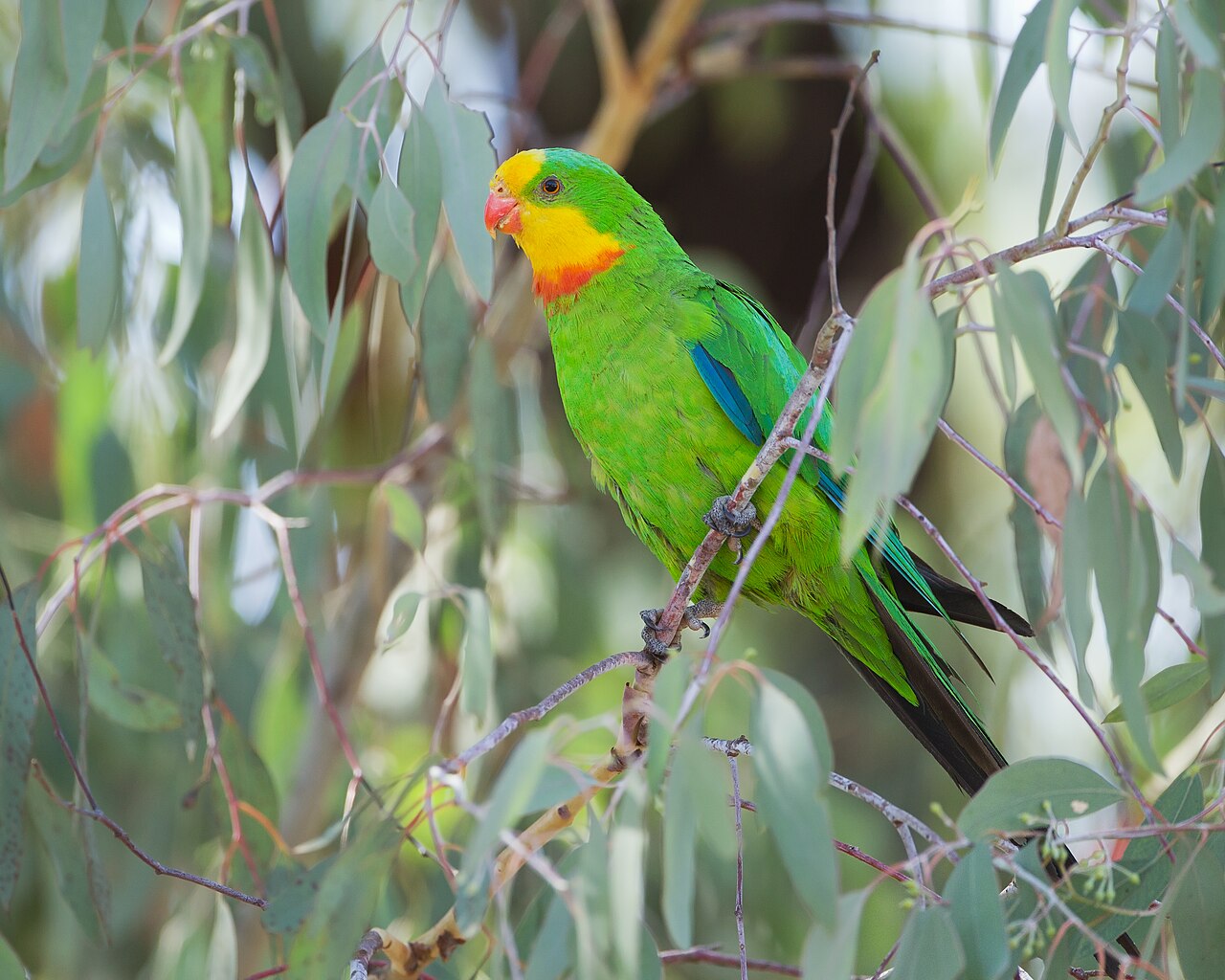
The Superb Parrot is the slender, grass-green parrot of the Murrumbidgee and Murray floodplains: long and narrow in the tail, with back-swept pointed wings and a fast, straight flight low over the treetops. The male carries a bright yellow forehead and throat with a scarlet crescent below it across the chest; the female is plain green. It breeds in hollows of old River Red Gums and feeds on the ground in the box woodland around them.
Voice
The flight contact call is a hard, two-syllable krak, krrak with a marked throaty, rolling quality that runs through all this bird's calls and separates it at once from the rosellas. Feeding birds keep up a soft, continuous twittering audible only from twenty metres or so. At the nest hollow male and female hold a quieter, high chattering conversation, and disturbance brings a sharp, repeated screech.
No freely licensed recording has been found for this species yet; what to listen for is described below.
Identification
A slim parrot of forty centimetres, nearly half of it tail. The long, narrow, tapering tail and the back-swept pointed wings give it a flight silhouette closer to a falcon than to a rosella. The male is grass green with a bright yellow forehead, face and throat and a scarlet crescent across the upper breast; the iris is red and the bill coral pink. The female lacks both the yellow and the red: she is plain green with a blue-grey wash over the cheek, reddish thighs and pink edges to the outer tail feathers. Young birds resemble the female; young males gain the yellow and red only in their second year.
Confusion species
Regent Parrot (Polytelis anthopeplus) shares the slim build and long narrow tail but is deep yellow rather than green, with a large yellow shoulder patch, a red wing patch and no red breast band. Princess Parrot (Polytelis alexandrae) is pastel, with a pink throat and a blue crown, and keeps to the desert interior well beyond this bird's range. Swift Parrot (Lathamus discolor) shares the long pointed tail but is much smaller, with a red face and chestnut underwing, and flies with fast sickle-shaped beats. Australian King Parrot (Alisterus scapularis) is far heavier, with a broad tail, and the male is red from head to belly.
Habitat
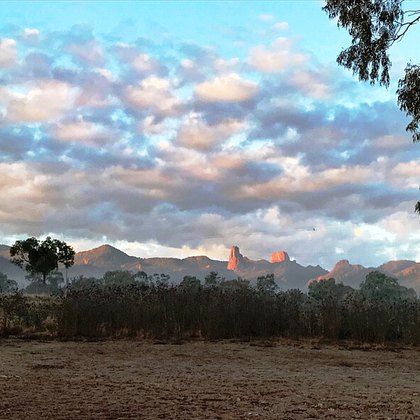
River Red Gum forest along the Murrumbidgee and the Murray supplies the nest hollows: old, thick trees with a deep rotted cavity, often several pairs in one stand. To feed it moves out into the adjoining box woodland of Grey Box and Yellow Box, or onto the ground in pasture and stubble, taking seeds of grasses and herbs along with blossom, nectar, berries and the odd insect. In Canberra it nests in the River Red Gums along the Molonglo, right into the suburbs.
Where the bird is most often found, arranged by main group and formation.



Range and movements
Inland south-eastern Australia only. The breeding range lies in the Riverina of New South Wales and northern Victoria, along the Murrumbidgee and the Murray, and south into the Australian Capital Territory around Canberra. Outside the breeding season part of the population moves north into northern New South Wales, to the valleys of the Namoi and the Macquarie. It occurs nowhere else in Australia, and not at all in New Zealand.
- Resident
- dark = core range, pale = thinly spread
Where and when to look
Stand in October or November at the edge of a line of old River Red Gums along the Murrumbidgee, at Narrandera or on the Canberra reach, and listen: the rolling krak of a passing bird arrives before the bird does. They fly low and fast along the river line, usually in parties of three to eight. Check the forehead of every bird — yellow means male — and watch for the very long, narrow tail, which fixes the species even against the sky.
Conservation
Least Concern (LC) on the world list, but within Australia the species is listed as Vulnerable nationally and as Endangered in Victoria. The bottleneck is a double one: most of the box woodland it feeds in has been cleared for farmland, and the old River Red Gums it nests in are not being replaced, because young plantings take well over a century to grow a usable hollow. To that add the altered water regimes of the rivers, which are killing the old gums, and nest robbing for the bird trade.
Scientific name
Polytelis swainsonii | (Desmarest, 1826)
Desmarest described the species in 1826 as Psittacus swainsonii; because it later moved to another genus, author and year stand in parentheses. The genus Polytelis was introduced by Wagler in 1832, from the Greek polytelēs, 'costly' or 'sumptuous'. The epithet swainsonii honours the English naturalist William Swainson. The original description gives only 'New Holland' as a locality; Mathews later fixed it on New South Wales. The Dutch name refers to Jacques Barraband, the French bird painter who drew Levaillant's parrot plates around 1800.