All species › Parrots › Old World parrots › Mulga Parrot
Mulga Parrot | Psephotellus varius
Regenboogparkiet | Perico variado
The Mulga Parrot earns the Dutch name it carries in this guide, regenboogparkiet, 'rainbow parrot': grass-green, yellow, red, orange and blue sit side by side on one bird, in sharply bounded blocks. It is the parrot of the dry interior — mulga, mallee and saltbush — usually flushing from the ground in pairs or threes and vanishing into the next shrub on a fast, slightly undulating flight.

Voice
Remarkably quiet for a parrot of this size. The contact call is a soft, thin whistle repeated three or four times, chee-chee-chee, often given on taking off; between feeding birds there is no more than a soft, held-back chatter. Anyone birding by ear walks past it easily.
No freely licensed recording has been found for this species yet; what to listen for is described below.
Identification
A slim parrot of a good thirty centimetres with a long narrow tail. The male is bright grass-green to emerald, with a blue cast on the neck and above the eye and a paler green breast; a yellow band crosses the forehead and a clear red patch sits on the hindcrown. The wing coverts carry a yellow block, the outer webs of the primaries are blue, the lower belly and thighs are yellow marked with orange-red, and a small dark red patch lies on the uppertail-coverts. The bill is blue-grey edged black. The female is far duller: olive-brown head and breast, faded yellow frontal band and faded red nape patch, pale green belly, sometimes some red on the shoulder, and a brown-grey bill.
Confusion species
The confusion species above all is the Red-rumped Parrot (Psephotus haematonotus), with which it shares the eastern interior. The male Red-rumped Parrot lacks both the yellow frontal band and the red nape patch, is blue-green on the head, has a yellow rather than orange-red belly, and carries a large, vivid scarlet rump panel; in the Mulga Parrot that red is small, dark and set lower, with a light green band above it. The females are the hard part: the female Mulga Parrot still shows a yellow frontal band and a red nape patch, while the female Red-rumped Parrot is plain olive-green with no red anywhere. The Eastern Bluebonnet (Northiella haematogaster) of the same country is olive-grey with a blue face and so no problem, and the Golden-shouldered Parrot (Psephotellus chrysopterygius) is turquoise and confined to Cape York.
Habitat
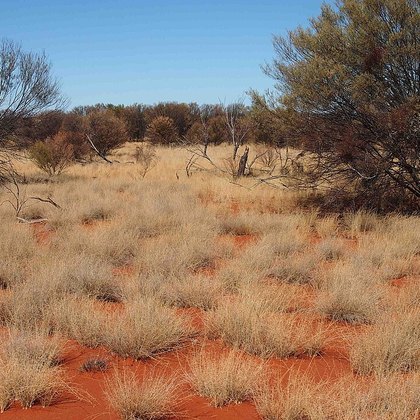
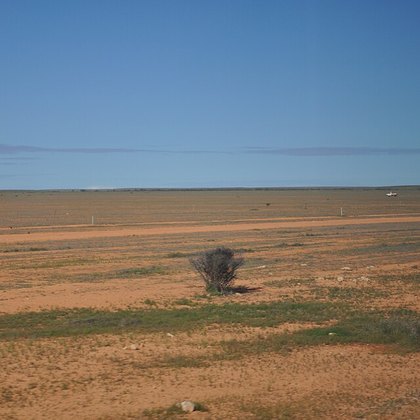
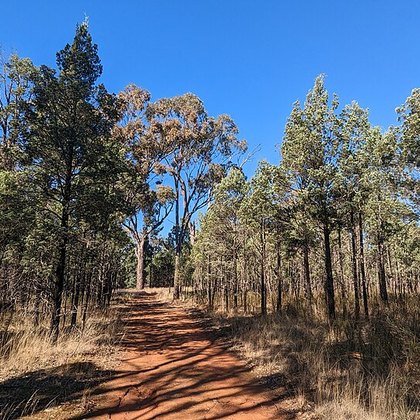
Arid and semi-arid shrubland and lightly timbered grassland: mulga and other acacia scrub, mallee, saltbush and bluebush plains, groves of callitris and casuarina, and the tree line along dry creeks. It nests in tree hollows, often low in a dead trunk, and forages on the ground for the seeds of grasses, shrubs and trees, with flowers and fruit besides. In the south the breeding season runs July to December, but in the north of the range it simply breeds after good rain, whenever that falls.
Where the bird is most often found, arranged by main group and formation.

Range and movements
The interior of southern Australia, from central-southern Queensland and western New South Wales — with places such as Collarenebri, West Wyalong and Griffith on the eastern edge — through north-western Victoria and nearly all of South Australia into Western Australia south of about 23°S, taking in the Wheatbelt and reaching north to the edge of the Pilbara. It is absent from the humid east coast, from Tasmania, from New Zealand and from Norfolk Island.
- Resident
- dark = core range, pale = thinly spread
Where and when to look
Drive a dirt road through mulga or mallee slowly in the early morning and watch the verges: nearly every record starts with a pair lifting off the bare ground and shooting away low. Brace yourself for a soft whistle repeated three or four times, because loud it never gets. A stock trough or a farm dam in dry country is the most reliable place in the heat of the day, and there you also have time to confirm the yellow frontal band and the red nape patch.
Conservation
Least Concern (LC) and rated secure in every Australian state where it occurs. Its range is vast and lies largely in thinly settled interior, and it gains rather than loses from artificial stock water. Locally there is pressure: shrubland has been cleared on a large scale in the wheat districts of Western Australia and New South Wales, heavy grazing by sheep, goats and rabbits strips the seeding herb layer, and old hollow trees — its nest sites — grow scarcer as dead timber is tidied away. Because it feeds on the ground and along verges it is also a regular traffic casualty. It is widely bred in aviculture, so wild-taken birds hardly matter any more.
Scientific name
Psephotellus varius | (Clark, 1910)
The naming history is unusual: the bird was described in the nineteenth century, but the name then used proved already taken, so the American zoologist Austin Hobart Clark introduced the replacement name Psephotus varius in 1910. Mathews moved the species to Psephotellus in 1913, which is why author and year stand in parentheses. Latin varius means 'varied, many-coloured' and refers to the male — the same thought as the Dutch guide name regenboogparkiet and the Spanish perico variado, while the English name points instead to mulga scrub. The type locality is the Eyre Peninsula in South Australia, from a specimen Robert Brown collected there.