All species › Parrots › Old World parrots › Red-rumped Parrot
Red-rumped Parrot | Psephotus haematonotus
Roodrugparkiet | Perico dorsirrojo
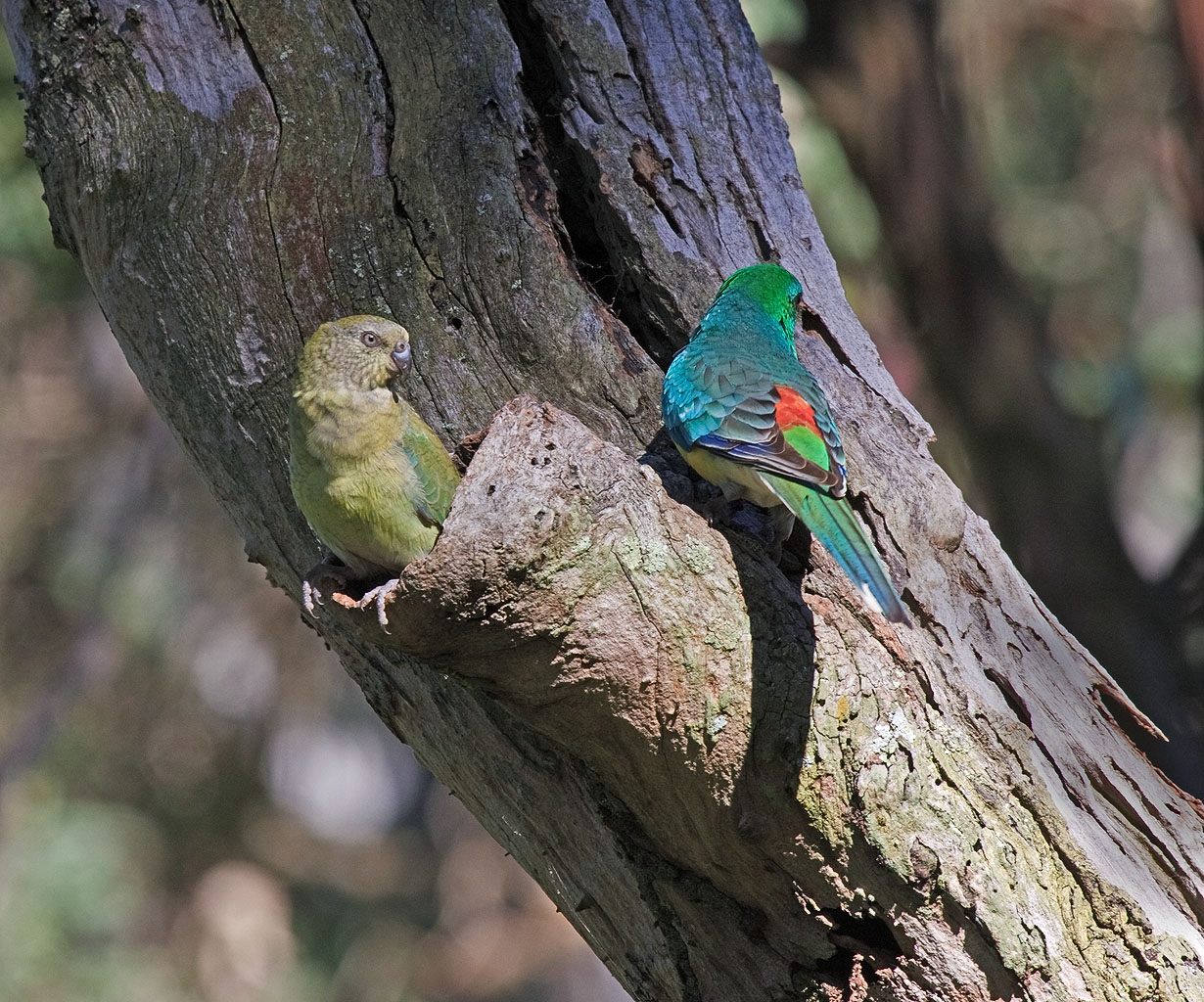
The Red-rumped Parrot is the parrot south-eastern Australia shows you most easily: a slim, bright green bird that forages on foot in pairs or small parties on a roadside verge, a sports field or a park lawn. The male carries a blue-green head and a small, burning scarlet panel on the rump that shows only as it takes off — and only he has it.
Voice
A friendly two-note whistle gives the species away at once: suweet-weet, with a questioning upward lift, repeated in flight and from a wire or post. A party on the grass keeps up a soft, pleasant chatter, without the sharp screeching notes of many other parrots. The whole effect is cheerful and muted — one of the most musical voices among Australian parrots.
No freely licensed recording has been found for this species yet; what to listen for is described below.
Identification
A slim parrot of twenty-six or twenty-seven centimetres with a long narrow tail. The male is bright grass-green, with a distinctly blue-green head and neck, yellow-green shoulders standing out as a pale patch on the wing, a yellow belly and undertail-coverts, and on the rump a small but vivid red panel that flares like a spark as it lifts off and often stays hidden on a perched bird. The bill is dark grey. The female is paler and plainer: olive-green to grey-green, with a green — not red — rump, a pale underwing stripe and faint yellow or light green scalloping on the belly. Juveniles resemble the female.
Confusion species
The Mulga Parrot (Psephotellus varius) is the one that matters; they share the interior of New South Wales and Victoria. The male Mulga Parrot carries a yellow frontal band and a red patch on the hindcrown — both absent in the Red-rumped Parrot — and has an orange-red rather than yellow belly. The red behind differs too: in the Red-rumped Parrot it is a vivid scarlet rump panel, in the Mulga Parrot a smaller, darker patch set lower, with a light green band above it. Females are the hard part: the female Mulga Parrot still shows a faded yellow frontal band and red nape patch, while the female Red-rumped Parrot carries no red anywhere. The Eastern Bluebonnet (Northiella haematogaster) is larger and olive-grey with a blue face, and the Swift Parrot (Lathamus discolor) is red-faced with red underwing-coverts and a far faster, scythe-winged flight.
Habitat
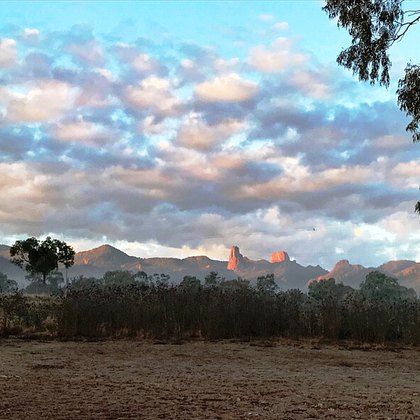
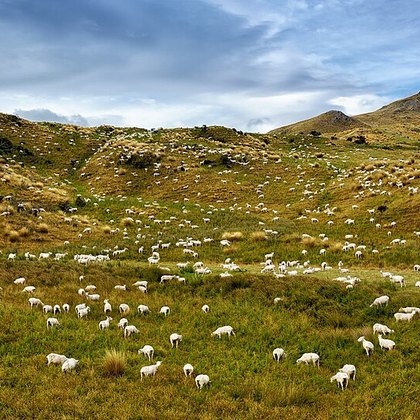
Open grassy eucalypt woodland and lightly timbered plains, and above all their edges: river red gum along creeks and rivers, mallee farmland, paddocks with scattered trees, road verges, golf courses, sports fields and town parks. It is one of the few Australian parrots that does better rather than worse in a landscape reworked by people, as long as open water and hollow trees are near. It forages almost always walking on the ground, on the seeds and leaves of grasses, and also in trees on seed, fruit and flower. The pair bonds for life; the female chooses and cleans the hollow in a eucalypt, incubates for twenty-one days, and the young fledge after thirty.
Where the bird is most often found, arranged by main group and formation.


Range and movements
South-eastern Australia: nearly all of New South Wales — less so on the coast — and all of Victoria, plus south-eastern South Australia including the Adelaide district, and besides that an isolated population in north-eastern South Australia and south-western Queensland. In a number of areas numbers have been topped up by escaped cage birds. It does not occur in Western Australia, in Tasmania, in New Zealand or on Norfolk Island.
- Resident
- dark = core range, pale = thinly spread
Where and when to look
You need not hunt for it, only let it come: sit on a lawn with scattered eucalypts — a park in Adelaide or Melbourne, a golf course, a country cemetery — and wait for a pair to work across the grass on foot. Hold your verdict on the rump until the bird flies, because perched is exactly when the red stays hidden. The cheerful suweet-weet is the most reliable field mark and separates it by ear from the far quieter Mulga Parrot.
Conservation
Least Concern (LC) and one of the few parrots to have gained from the reworking of the landscape: the clearing of dense forest into open pasture and the building of dams and troughs have enlarged its ground, and in urban green space it is a common breeder. Where it struggles, the issue is nest hollows: old trees are disappearing from paddock and cropland, and Common Starlings and Common Mynas occupy what hollows remain. Traffic takes a toll besides, since it feeds on verges, and locally whole verge strips are kept bare with herbicide. It is bred on a large scale for aviculture, so wild-taken birds no longer signify.
Scientific name
Psephotus haematonotus | (Gould, 1838)
Gould described the species in 1838 as Platycercus haematonotus, from South Australian material; because it later changed genus, author and year stand in parentheses. The epithet is from Greek haima 'blood' and nōton 'back' — 'blood-back', for the red panel on the male's rump, and that is the source of the Dutch, English and Spanish guide names alike. The genus Psephotus was introduced by Gould himself in 1845, from Greek psēphōtos 'inlaid with pebbles, mosaic-work', for the many-coloured plumage. Since the other species moved to Psephotellus, the Red-rumped Parrot is the only one left in Psephotus.