All species › Passerines › Snowfinches and Old World sparrows › House Sparrow
House Sparrow | Passer domesticus
Huismus | Gorrión
The House Sparrow is the most successful and the most regretted of all the birds released in this part of the world. It reached New Zealand in 1859 and Melbourne in 1863, brought in to pick caterpillars out of the crops, and within twenty years had been declared a pest itself. Today it sits on every verandah, railway station and grain shed from Cape York to Campbell Island.
Voice
The male's song is not a song but a repeated, unmusical cheep from a gutter or a wire, given all year and loudest in spring. Both sexes use the same note at the communal roost, where towards sunset dozens of birds chirp at once and the sound runs together into one rattling mass. At a cat or a falcon comes a sharp, hard cher-r-r, on which the whole party drops into cover.
Recording: Philippe Grange — CC0 · La Loge (near La Roche-sur-Yon), Vendée, Pays de la Loire, France · xeno-canto
Identification
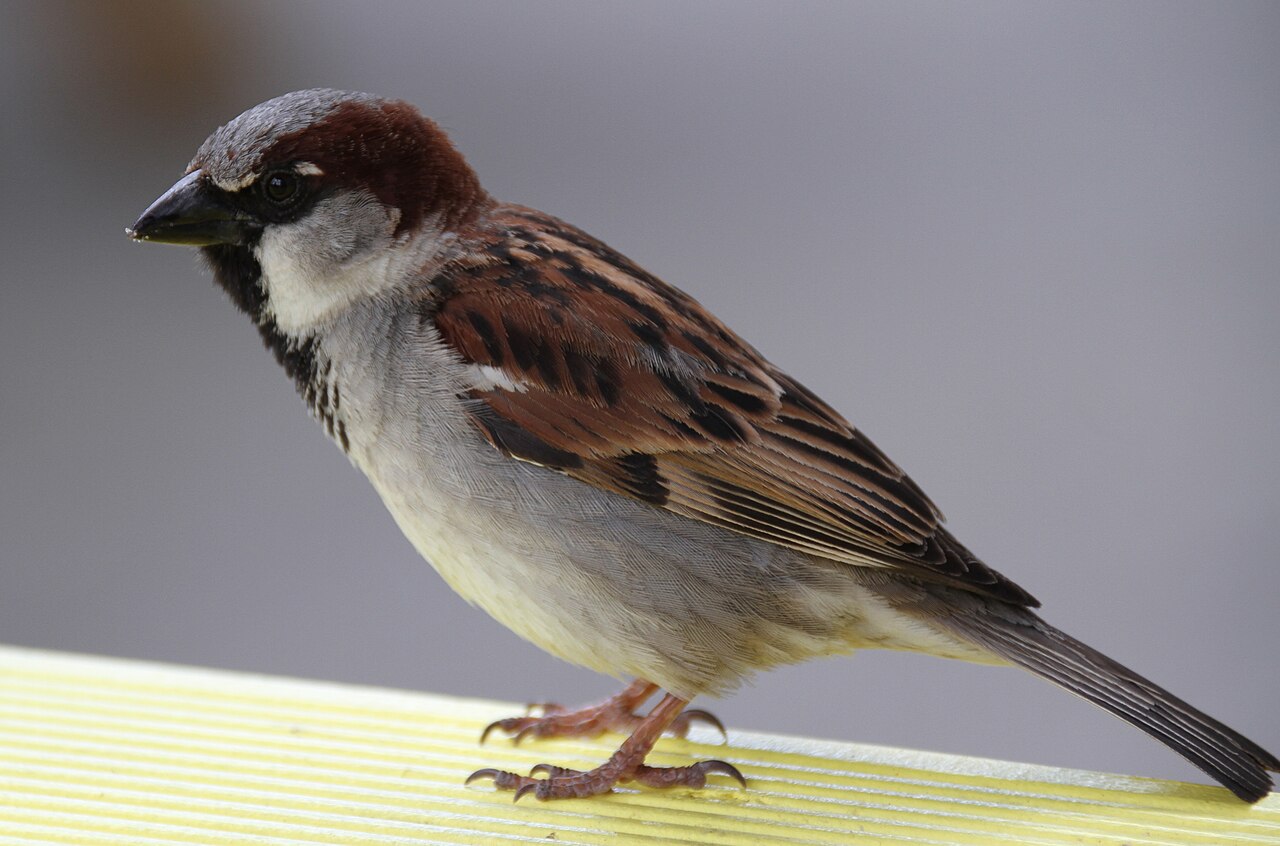
A stocky, short-legged bird of fourteen to sixteen centimetres with a heavy conical bill. The male has a grey crown, chestnut nape, white cheeks and a black bib from chin to breast, largest and blackest in summer; outside the breeding season pale feather fringes veil that bib and the bill is horn rather than black. The female has none of it: grey-brown, with a pale stripe behind the eye, a streaked brown back and a pale wing bar. Young birds resemble the female.
Confusion species
Eurasian Tree Sparrow (Passer montanus), in Australia confined to Victoria and the Riverina, has an entirely chestnut crown, a black spot in the middle of the white cheek, and identical sexes. Dunnock (Prunella modularis) of the New Zealand garden is slimmer, with a thin pointed bill and a grey head. A female Chaffinch (Fringilla coelebs) shows two clean white wing bars and white outer tail feathers.
Habitat
Towns and villages, gardens, parks, grain paddocks, stockyards, silos, sewage ponds and tips — anywhere people spill food. It nests under roof tiles, behind downpipes and in wall cavities, and where there is no building, in a hollow tree or an old nest of another bird. In New Zealand it goes a step beyond its home habits: it drinks nectar from kowhai and harakeke and carries pollen while doing so.
Where the bird is most often found, arranged by main group and formation.



Range and movements
In Australia across virtually the whole eastern half, from Tasmania and Victoria to Cape York and west into the Northern Territory and South Australia. Western Australia has kept it out: every bird that turns up there is destroyed, and that has been sustained for more than a century. In New Zealand everywhere but the high mountains and closed forest, most numerous in the north and the dry east, and beyond that on Norfolk, the Chathams and as scattered records out to the subantarctic islands.
- Resident
- dark = core range, pale = thinly spread
Where and when to look
In summer, December to February, look at the bib of every singing male: the blacker and broader it is, the older the bird. At sunset stand by the dense hedge or creeper the noise is coming from; that is the communal roost, and it shows at a glance how many sparrows a street really holds.
Conservation
Least Concern (LC) and one of the most successful invasive birds on earth. The damage is real: in New Zealand it costs wheat and barley about five per cent of the yield on average, it strips fruit buds and sown seed, fouls sheds and stock feed, and takes nest cavities that native hole-nesters need. Eradication is out of reach in eastern Australia and New Zealand; the Western Australian border is the only thing that has worked.
Scientific name
Passer domesticus | (Linnaeus, 1758)
Linnaeus described the bird in 1758 as Fringilla domestica, among the finches; because it later moved to another genus, author and year stand in parentheses. The genus Passer was introduced by Brisson in 1760; it is the ordinary Latin word for sparrow, traceable to a root for speed and quickness. domesticus means 'of the house', after the tie to human building. The type locality is Sweden.