All species › Waders, gulls and terns › Skimmers, noddies, terns and gulls › Kelp Gull
Kelp Gull | Larus dominicanus
Kelpmeeuw | Gaviota dominicana
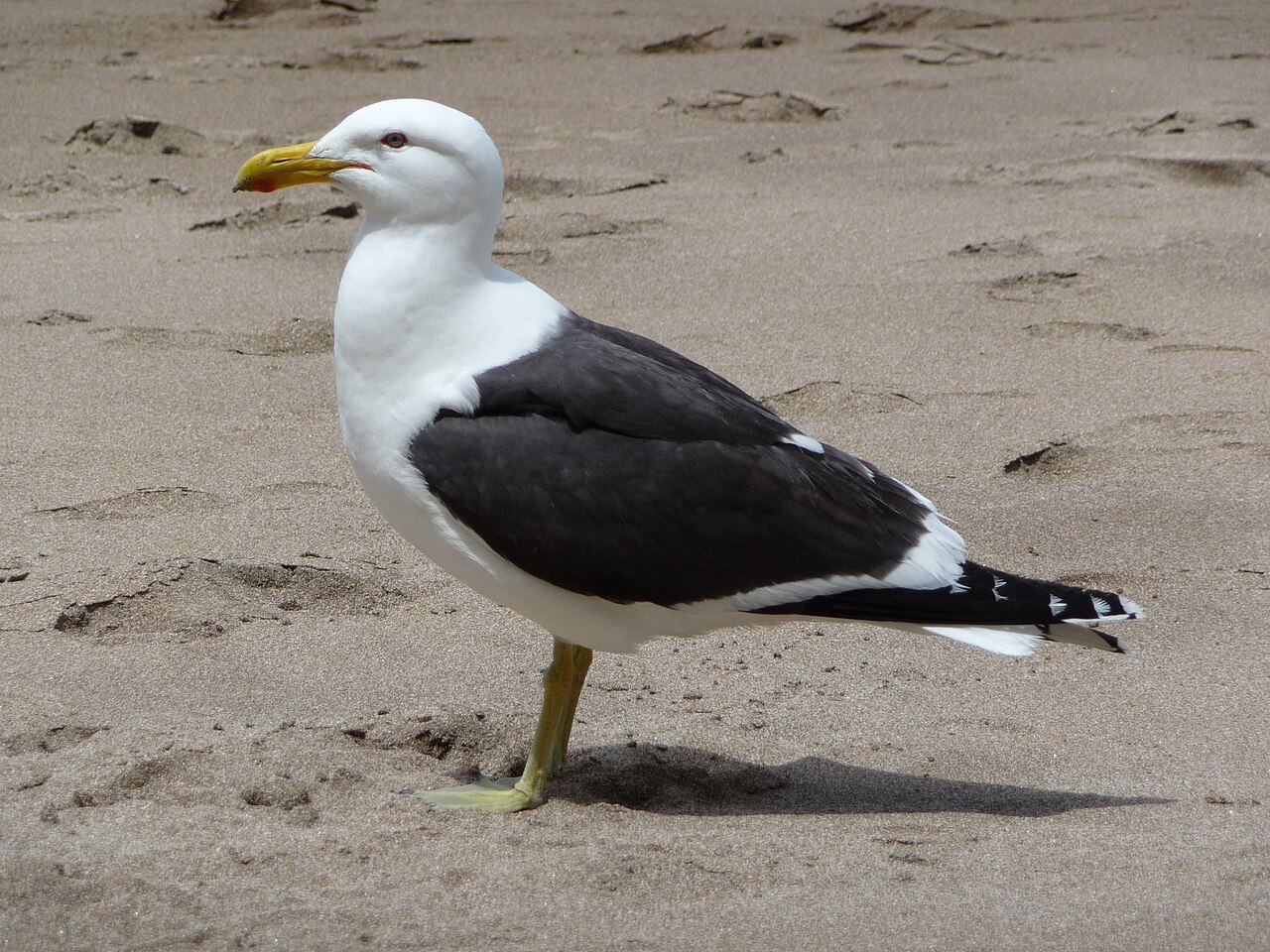
The Kelp Gull is the large black-backed gull of the southern hemisphere, and in New Zealand, where it is the Karoro, the only large gull there is: snow white with a slate-black mantle, a heavy yellow bill with a red spot on the lower mandible, and olive-green legs. It stands at every harbour, every tidal flat and every landfill. In Australia it is instead a newcomer, established along the southern coast only since the middle of the last century.
Voice
Loud and far-carrying. The signature series is a ringing, swelling ee-ah-ha-ha-ha, thrown up with the head raised in territorial defence and in squabbles over food. There is also a short hard alarm that lifts a whole colony at once, and a low throaty moan between partners at the nest. Young birds beg with a persistent squealing whine that hangs over a breeding island.
Recording: African Bioacoustics Community — CC BY-NC-SA 4.0 · Cape Town, Cape Town, Western Cape, South Africa · xeno-canto
Identification
A large gull of about sixty centimetres. Head, neck, underparts and tail stay entirely white; the mantle and upperwing are black to slate-black, with a narrow white trailing edge and white mirrors in the wingtip. The bill is heavy and yellow with a red spot at the gonys angle, and the legs are olive to yellow-green, never pink. The deciding point is the tail: in the adult it is wholly white, with no terminal band. Young birds are dark mottled brown with a black bill and black legs and reach adult plumage only in their third year, the mantle blackening from the inside outwards.
Confusion species
Pacific Gull (Larus pacificus) is the only real confusion and overlaps with it along the southern Australian coast. It is bulkier, with an enormous deep bill that is yellow with red on both upper and lower mandible, and it has — decisively — a broad black band across the end of the otherwise white tail, which Kelp Gull lacks. Look at tail and bill, not at the mantle, which is black in both; the legs help too, yellow-green in Kelp Gull, yellow to orange-yellow in Pacific Gull. Silver Gull (Chroicocephalus novaehollandiae) is far smaller, pale grey above and red throughout. A juvenile Kelp Gull, all dark brown, is taken at sea for a Brown Skua (Stercorarius antarcticus); the skua has a white primary flash and a much heavier hooked bill.
Habitat
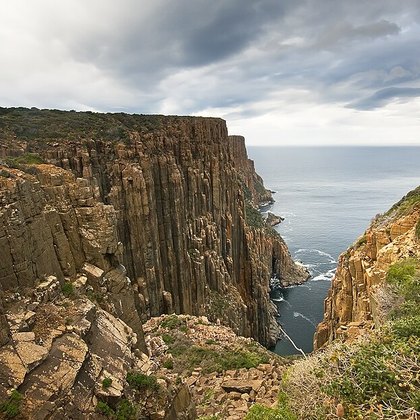
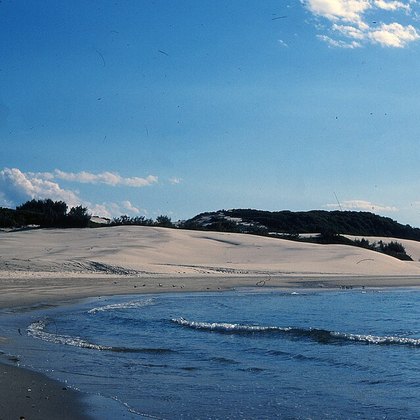
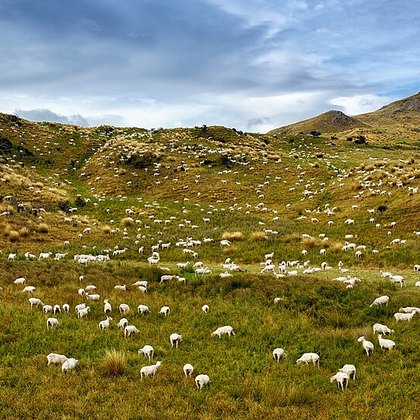
Everything but closed forest. Tidal flats and estuaries, rocky and sandy shores, the shingle banks of braided rivers, pasture far inland and, in the mountains, the high-country sheep stations. It nests colonially or as a lone pair on islets, steep headlands, sand and shingle spits and river islands. Around harbours, fish-processing plants, sewage ponds and landfills it gathers in its greatest numbers all year round, because that is where the easiest food lies.
Where the bird is most often found, arranged by main group and formation.




Range and movements
In New Zealand everywhere outside forest, from Northland to Stewart Island and on to the Chathams, the Kermadecs and the subantarctic islands; GBIF data for 2015–2024 hold more than six times as many records from New Zealand as from Australia. In Australia it is a recent coloniser: the first breeding dates from the 1950s in Tasmania, after which it spread across Bass Strait to Victoria and Port Phillip Bay and now breeds along the southeastern coast from South Australia to New South Wales. In the west and the tropical north it stays scarce. On Norfolk it appears only exceptionally — nine records in ten years.
- Resident
- dark = core range, pale = thinly spread
Where and when to look
No searching needed: stand at a fishing harbour, an estuary at low tide or a landfill and it is the biggest bird in view. The test that always works is the tail, so let a large dark gull show you its tail first: white with no band means Kelp Gull. Pay particular attention in Victoria and Tasmania, where both large gulls stand on the same pier.
Conservation
Least Concern (LC), and in this region more too numerous than too few. Fish waste, landfills, sewage and the opening up of grassland have fed it year-round, and its numbers grew strongly through the twentieth century. That makes it a problem for others: it takes the eggs and chicks of terns, waders and small gulls, and at colonies of threatened species — Black-billed Gull on the South Island rivers, terns and plovers on coastal spits — it is actively deterred or culled. In Australia its advance is suspected of coming at the expense of the native Pacific Gull.
Scientific name
Larus dominicanus | Lichtenstein, 1823
Lichtenstein described the species in 1823 as Larus dominicanus, and it remains in that genus, so author and year carry no parentheses. Larus is the classical Latin name for a gull or seabird. dominicanus refers to the Dominicans: the bird's sharp black and white reminded the describer of the white habit and black mantle of that order. The type locality is on the coast of Brazil. In New Zealand the Maori name Karoro is in general use, in English as well.