All species › Waders, gulls and terns › Skimmers, noddies, terns and gulls › Pacific Gull
Pacific Gull | Larus pacificus
Diksnavelmeeuw | Gaviota de Tasmania
The Pacific Gull is the largest gull in Australia and occurs nowhere else on earth. It is heavily built, black above, with a white tail crossed by a broad black band, and above all with that colossal yellow red-tipped bill. It is a bird of the southern rocky coasts and the islets off them, and far less a bird of the town than the other gulls of the region.

Voice
Heavier and slower than any other gull here: a deep barking owk or kyah-ook, given singly and repeated from a rock, a post or a pier, and in excitement a series that builds into a raw croaking. At the nest there is a short growling throat note. Anyone with the high screeching cry of the Silver Gull in their ears will hear at once that this is a far lower voice — close to an octave apart.
No freely licensed recording has been found for this species yet; what to listen for is described below.
Identification
A very large gull of over sixty centimetres, white on head, neck and underparts, with a black mantle and upperwing and a narrow white trailing edge. The bill is the mark: exceptionally deep and heavy, yellow, with a pronounced angle below and a red tip on both upper and lower mandible. The tail is white with a broad black band across the end. The legs are yellow to orange-yellow, the eye pale with a red ring. Young birds are uniformly dark brown with a dull pink, dark-tipped bill already as massive, and take four years to reach adult plumage. Two subspecies exist, pacificus in the southeast and georgii in the southwest; the differences are slight and rarely usable in the field.
Confusion species
Kelp Gull (Larus dominicanus) is the species it is confused with, and it has stood on the same southern Australian coast since the 1950s. Two points decide it. The bill: in Kelp Gull merely heavy and yellow with a red spot on the lower mandible alone, in Pacific Gull outsized and red on both mandibles. And the tail: in Kelp Gull wholly white, in Pacific Gull white with a broad black terminal band — on a bird flying over, the fastest test there is. The mantle is black in both and so does not help; the legs do, yellow to orange-yellow against olive-green. Silver Gull (Chroicocephalus novaehollandiae) is half the size, pale grey and red-fitted, and is no serious problem. A dark young Pacific Gull does suggest a Brown Skua (Stercorarius antarcticus) at sea, but the skua has white wing flashes and a quite different, buoyant flight.
Habitat
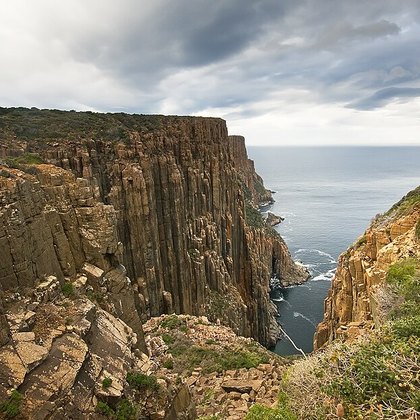
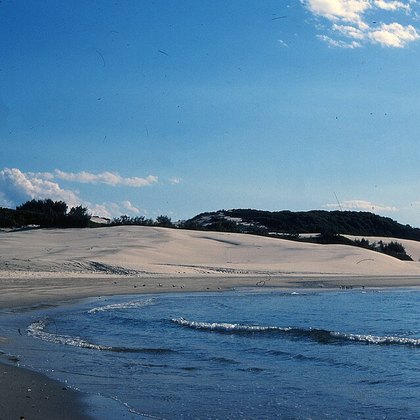
Rocky coasts and sea cliffs, and above all the rocky islets offshore, where it nests in loose groups or as a single pair. Beyond that it uses sandy beaches, estuaries and the shallow sea over the continental shelf, where it follows fishing boats. It shows itself at harbours and fish markets, but it follows people far less than Kelp Gull and Silver Gull do: at an inland landfill you will hardly ever find it.
Where the bird is most often found, arranged by main group and formation.



Range and movements
Endemic to Australia and tied to the southern coast: from about Shark Bay in Western Australia along the Great Australian Bight and South Australia to Victoria, Tasmania and the Bass Strait islands, thinning eastwards along New South Wales to southern Queensland. Tasmania and the Bass Strait islands are the stronghold; north of Sydney it is a rarity. In New Zealand it is an exceptional vagrant — this guide's counts hold a single record in ten years, against nearly a hundred thousand from Australia — and on Norfolk it is absent altogether.
- Resident
- dark = core range, pale = thinly spread
Where and when to look
Stand on a headland or a pier on the southern coast and look at the bill before you look at anything else: no other Australian gull carries such a block in front of its face. It flies heavily and slowly, on deliberate beats, and drops shellfish, crabs and sea urchins from height onto the rocks to break them — a habit that gives it away before you have properly seen it. Tasmania is the best place: there it is still everywhere, and there it often stands alone on a beach rather than in a gull flock.
Conservation
Not threatened (LC) and broadly stable, but the picture is not the same everywhere. On the southeastern mainland it has declined since Kelp Gull established itself there from the 1950s: that species is more numerous, nests far more densely and takes over breeding islets, and the fall in Pacific Gull numbers around Victoria and Bass Strait is put down to it. Beyond that, visitors and loose dogs disturb the breeding islets, birds drown in fishing gear, and individuals die from swallowed plastic and fish hooks. In Tasmania and in Western Australia it continues to do well.
Scientific name
Larus pacificus | Latham, 1801
Latham described the species in 1802 as Larus pacificus, and it has stayed in that genus, so author and year carry no parentheses. Larus is the classical Latin name for a gull. pacificus means 'of the Pacific' — a generous label for a bird tied to the southern coast of Australia that barely reaches the Pacific proper. The type locality is on the coast of New South Wales, where the material of the early British settlement came from. The Spanish guide name, Gaviota de Tasmania, points at the species' stronghold.