All species › Waders, gulls and terns › Skimmers, noddies, terns and gulls › Laughing Gull
Laughing Gull | Leucophaeus atricilla
Amerikaanse lachmeeuw | Gaviota guanaguanare
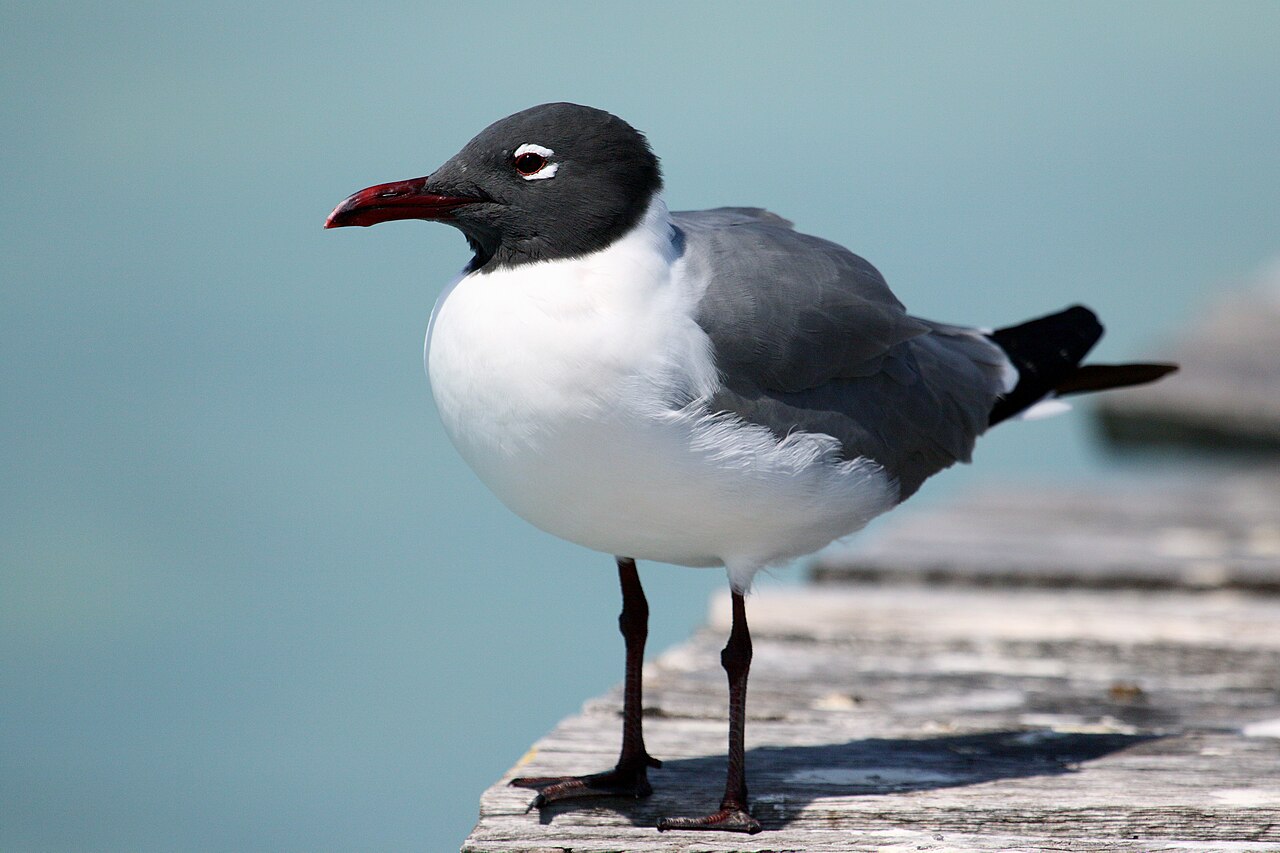
The Laughing Gull is the gull of the North American Atlantic coasts that owes its name to a cackling call, and in this map window a rare but persistent vagrant: the GBIF data for 2015–2024 hold twenty-eight records, shared between Australia, New Zealand and Norfolk Island. It is medium-sized, dark slate-grey above, with a jet-black hood in breeding plumage and a long, slightly drooping dark red bill.
Voice
The call is the trademark: a loud descending series of laughs, ha-ha-ha-haah-haah-haah, that fills whole harbours on the American coasts and gives the species its name. There is also a drawn-out plaintive kaaah and a short kuk when uneasy. A lone vagrant here rarely calls, but anyone who hears it once knows at once this is no Silver Gull — it is fuller, lower and far more rhythmic.
Recording: David Darrell-Lambert — CC BY-NC-SA 4.0 · Sizewell, Suffolk, England, United Kingdom · xeno-canto
Identification
A medium-sized gull of nearly forty centimetres, slim and long-winged, with a slate-grey mantle that, apart from Kelp and Pacific Gull, is darker than that of any other gull here. The bill is long, fairly heavy and slightly drooping, dark red to almost black; the legs are dark red to black. In breeding plumage it carries a jet-black hood with narrow, broken white crescents above and below the eye. The wingtip is an even black wedge, with no white mirrors and no white division between black and grey, at most a narrow white edge to the feather tips. In non-breeding plumage the head is white with a vague, diffuse grey wash over the rear crown and nape. First-year birds are brownish grey with a broad black tail band and a dark shadow of the hood.
Confusion species
Franklin's Gull (Leucophaeus pipixcan) is the direct counterpart — the other American vagrant with a black hood — and is smaller and more compact, with a short straight bill, shorter legs, a paler grey mantle and, decisively, a white stripe separating the black of the wingtip from the grey. Where Laughing Gull keeps only a vague grey wash on the rear crown in non-breeding plumage, Franklin's keeps a sharply bounded dark half-hood. Against the native gulls it stands out mainly by its dark mantle: Silver Gull (Chroicocephalus novaehollandiae) and Black-billed Gull (Chroicocephalus bulleri) are light to pale grey and never take a black hood, while Kelp Gull (Larus dominicanus) is far larger, truly black above and carries a heavy yellow bill.
Habitat
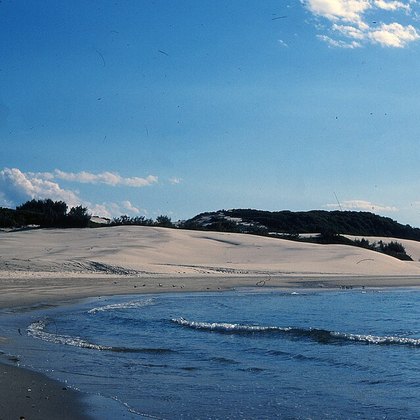
Coast and near-coastal water: estuaries and mudflats, sandy beaches, harbours and piers, sewage ponds and fish markets. In its own range it is above all the gull of busy port cities and bathing beaches, and here it behaves the same way. A vagrant almost always stands among the Silver Gulls on a beach, a jetty or a seafront car park, and not out on the open ocean.
Where the bird is most often found, arranged by main group and formation.



Range and movements
Breeds outside the map window, along the Atlantic and Gulf coasts of North America and through the Caribbean to northern South America. Within this map window it is a rare vagrant with a certain regularity: over 2015–2024 twenty-eight records and nearly two hundred observations, with Australia in four of the ten years and both New Zealand and Norfolk Island in one; most Australian reports come from the east coast. Vagrants often stay put — a bird that joins a settled gull flock can remain for months or return over successive seasons, so part of the record total refers to the same individuals.
- Resident
- dark = core range, pale = thinly spread
Where and when to look
Work the same beach flocks as for Franklin's Gull, but now look for a larger, longer-lined bird: dark mantle, long dark bill with a slight downward kink, and in flight an entirely black wingtip with no white. A non-breeding bird gives itself away by the combination of dark mantle and dark bill on a gull that otherwise looks like a Silver Gull. On a long-staying bird, check the legs too: dark red to black, never the bright orange-red of a Silver Gull.
Conservation
Least Concern (LC). The world population runs into the hundreds of thousands and has recovered strongly in North America since protection early in the twentieth century — the species had by then been all but shot out of the northern coasts by the feather trade. The pressure points today lie in the breeding habitat: salt marsh and low sand islands lost to coastal development, sea-level rise and storm surge, and locally displacement by larger gulls. None of that bears on this map window; here it is and remains a chance visitor with no management question of its own.
Scientific name
Leucophaeus atricilla | (Linnaeus, 1758)
Linnaeus described the species in 1758 as Larus atricilla; because it was later moved to Leucophaeus, author and year stand in parentheses. Leucophaeus comes from Greek leukos, 'white', and phaios, 'dark grey'. atricilla is compounded from Latin ater, 'black', and -cilla, a suffix prised out of motacilla and wrongly taken to mean 'tail' — 'black-tail', then, after the black tail band of the young bird. The described specimen came from the Bahamas. The Dutch guide name adds 'amerikaanse' because the word lachmeeuw is also in circulation in Europe for other gulls.