All species › Passerines › Honeyeaters › Kimberley Honeyeater
Kimberley Honeyeater | Meliphaga fordiana
Kimberleyhoningeter | Mielero de Kimberley
The Kimberley Honeyeater is the sandstone honeyeater of the west: a grey-green bird with a blue eye and a thin pale mark beneath it, occurring only in the gorges and escarpments of the north-western Kimberley. Until 2014 it was treated as a subspecies of the White-lined Honeyeater of Arnhem Land; work on genes, voice and foraging behaviour brought the separation. Its range covers less than forty-five thousand square kilometres, which makes it one of the most narrowly confined birds in Australia.

Voice
Loud, short whistled phrases, rounded off and clearly divisible into units. That is the character on which the 2014 split chiefly rested: the White-lined Honeyeater of Arnhem Land gives long, wavering and slurred notes with sliding pitch instead. Beside these come hard contact calls from the gorge vegetation.
No freely licensed recording has been found for this species yet; what to listen for is described below.
Identification
About eighteen centimetres: uniformly grey-green to dark olive-grey above, paler grey below with vague grey streaking on the breast and a milky-white belly. The underwing coverts are pale creamy-buff. The dark face is broken by a thin pale mark from the gape, running back and up to below the eye. The iris is blue and the bill dark grey and slightly decurved. Male and female are alike.
Confusion species
The White-lined Honeyeater (Meliphaga albilineata) of Arnhem Land is all but identical and was the same species until 2014. The only plumage differences on record are this species' paler, creamy-buff underwing coverts and milkier white belly, and both are hardly usable in the field; the honest answer is that the two cannot reliably be separated on appearance. In practice this need be no obstacle, since the ranges lie sixteen hundred kilometres apart, divided by the whole width of the Northern Territory: in the Kimberley only this species can occur. That leaves voice, which does differ: short and rounded here, long and wavering there. From the Tawny-breasted Honeyeater (Xanthotis flaviventer) and the Yellow-tinted Honeyeater (Ptilotula flavescens) the blue iris and the thin pale mark below the eye separate it clearly. The six brown Meliphaga of the east coast and Cape York do not occur in Western Australia.
Habitat
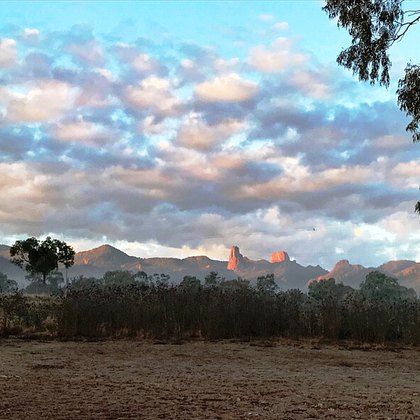
The sandstone of the western Kimberley: gorges, walls and scree of the escarpment, with the rainforest pockets and patches of monsoon forest that hold on in the sheltered gorges. It also uses adjoining eucalypt woodland and melaleuca stands, but remains tied to the rock and the gorge forest.
Where the bird is most often found, arranged by main group and formation.



Range and movements
Endemic to north-western Australia and confined to the north-western Kimberley in Western Australia, including the Charnley River–Artesian Range Wildlife Sanctuary. The total range is put at about forty-three thousand square kilometres, between roughly 13.7 and 16.4 degrees south. Resident, with no demonstrable movement.
- Winter
- dark = core range, pale = thinly spread
Where and when to look
In the Kimberley the identification is done as soon as the bird is seen: a grey-green honeyeater with a blue eye in gorge country is this species here and no other. Look for it at the foot of the walls and in the rainforest pockets, and listen for the short, rounded whistled phrases; those are the difference that matters in any comparison with Arnhem Land. Records from before 2014 often still stand under the name of the White-lined Honeyeater.
Conservation
Not threatened; although the range is small it lies almost entirely in very thinly settled and partly protected country, and the sandstone environment is little exposed to the clearing that operates elsewhere. The species is common within its bounds. No figures were found on the effect of altered fire regimes on the gorge forest it needs, and no statement is made about it here.
Scientific name
Meliphaga fordiana | Schodde, 1989
Richard Schodde described the bird in 1989 in Canberra Bird Notes as Meliphaga fordiana. The specific name honours Julian Ralph Ford (1932–1987), an Australian chemist and ornithologist who published much on the birds of Western Australia. The English, Dutch and Spanish names all three point to the Kimberley, the only country where it occurs. For the genus Meliphaga, from Greek meli (honey) and phagos (eating), see Lewin's Honeyeater; the species has also stood in the genera Territornis and Microptilotis. Because it was described within Meliphaga and has remained there, author and year stand without parentheses.