All species › Passerines › Honeyeaters › White-lined Honeyeater
White-lined Honeyeater | Meliphaga albilineata
Witbaardhoningeter | Mielero listado
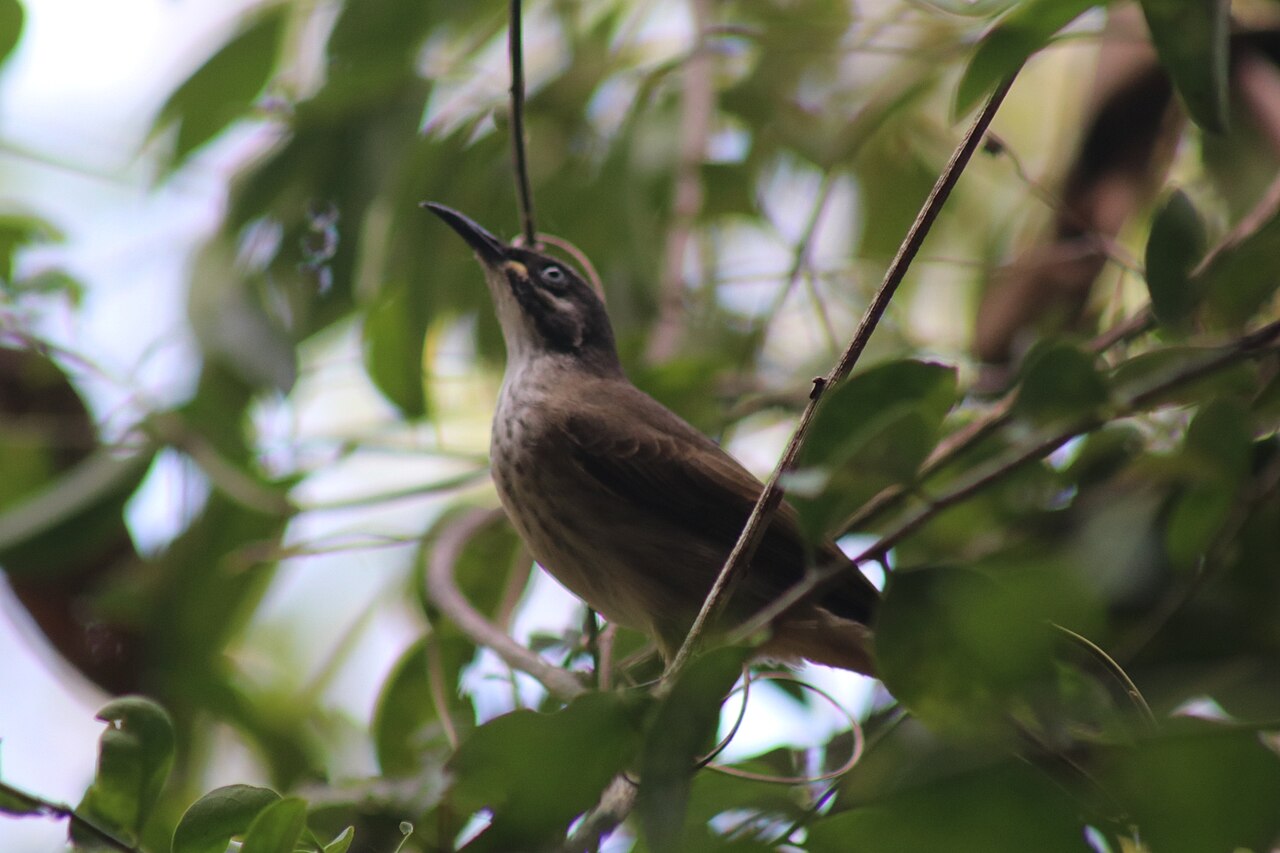
The White-lined Honeyeater is the honeyeater of the Arnhem Land sandstone: a grey-green bird with a thin pale line under the blue eye, which spends its whole life in the gorges and at the foot of the escarpment. It is one of the few birds tied to that rock, and it gives itself away above all by its loud, wavering whistles echoing between the walls. Until 2014 the Kimberley Honeyeater, sixteen hundred kilometres to the west, counted as its subspecies.
Voice
Loud, wavering and slurred whistles with sliding pitch, from between the rock walls and out of the gorge forest. Voice is the character on which the 2014 split from the Kimberley Honeyeater chiefly rested: that species gives short, rounded whistled phrases, where this bird strings long, drawn-out notes together. Beside these come hard contact calls.
No freely licensed recording has been found for this species yet; what to listen for is described below.
Identification
Seventeen to twenty centimetres: uniformly grey-green to dark olive-grey above, grey-brown below with vague grey streaking on the breast. The face is dark and is broken by a thin pale gape mark running back and up to below the eye — the 'line' of the name — joining a yellow fringe along the rear edge of the ear coverts. The iris is blue, the bill dark grey and decurved, the legs grey. Male and female are alike.
Confusion species
The Kimberley Honeyeater (Meliphaga fordiana) is all but identical and counted as a subspecies until 2014: it has slightly paler, creamy-buff underwing coverts and a milky-white belly, but that difference is hardly usable in the field. Confusion is nonetheless impossible in practice, because the whole width of the Northern Territory lies between the two ranges: one sits in the Arnhem Land sandstone, the other in the Kimberley sandstone, with hundreds of kilometres of unsuitable country in between. The real field problem in Arnhem Land lies in other genera: the Tawny-breasted Honeyeater (Xanthotis flaviventer) and the Yellow-tinted Honeyeater (Ptilotula flavescens) are yellower and lack both the thin pale line under the eye and the blue iris. The six brown Meliphaga of the east coast and Cape York are all absent here, so that the genus is represented in this country by this one species.
Habitat
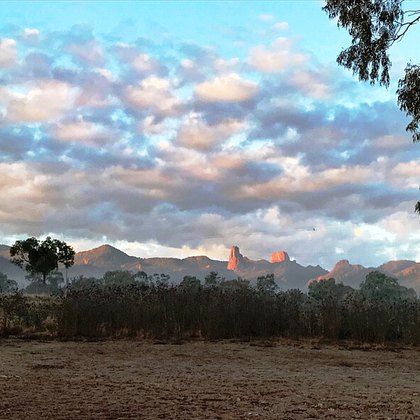
The sandstone: gorges, walls and scree of the escarpment, with the moist rainforest pockets and monsoon-forest patches that hold on in the sheltered gorges, and the gallery forest along the creeks running off the plateau. It also occurs in adjoining eucalypt woodland and in melaleuca stands, but always returns to the rock.
Where the bird is most often found, arranged by main group and formation.


Range and movements
Endemic to north-central Australia and confined to the sandstone of western Arnhem Land in the north of the Northern Territory: from the northern coast south through Kakadu National Park to Katherine and Nitmiluk National Park, which forms the southern limit. The type locality is the King River. Resident and territorial; usually alone or in pairs, with no demonstrable seasonal movement.
- Resident
- dark = core range, pale = thinly spread
Where and when to look
Look for it at the foot of the escarpment and in the gorges, not out on the open plateau, and let the ear do the work: the long wavering whistle carries far between the walls and in Arnhem Land comes from no other bird. With a bird in view, look at the eye — blue — and at the thin pale mark running back from the gape to below the eye.
Conservation
Not threatened; the range is small but lies almost entirely in protected or thinly settled country, including Kakadu and Nitmiluk, and the species is common within it. The sandstone environment is moreover little exposed to the clearing that operates elsewhere in the north. No figures were found on the effect of altered fire regimes on the gorge forest it needs, and no statement is made about it here.
Scientific name
Meliphaga albilineata | (White, 1917)
Henry Luke White described the bird in 1917 in The Emu as Ptilotis albilineata, from material from the King River in the Northern Territory; because the species was later placed in Meliphaga, author and year stand in parentheses. albilineata is Latin for 'white-lined', from albus (white) and linea (line), after the thin pale mark running from the gape to below the eye, and the English name follows that word, where the Dutch name calls the same mark a 'beard'. For the genus Meliphaga, from Greek meli (honey) and phagos (eating), see Lewin's Honeyeater; over time the species has also stood in the genera Ptilotis, Territornis and Microptilotis.