All species › Tubenoses › Albatrosses › Light-mantled Albatross
Light-mantled Albatross | Phoebetria palpebrata
Roetkopalbatros | Albatros manto claro
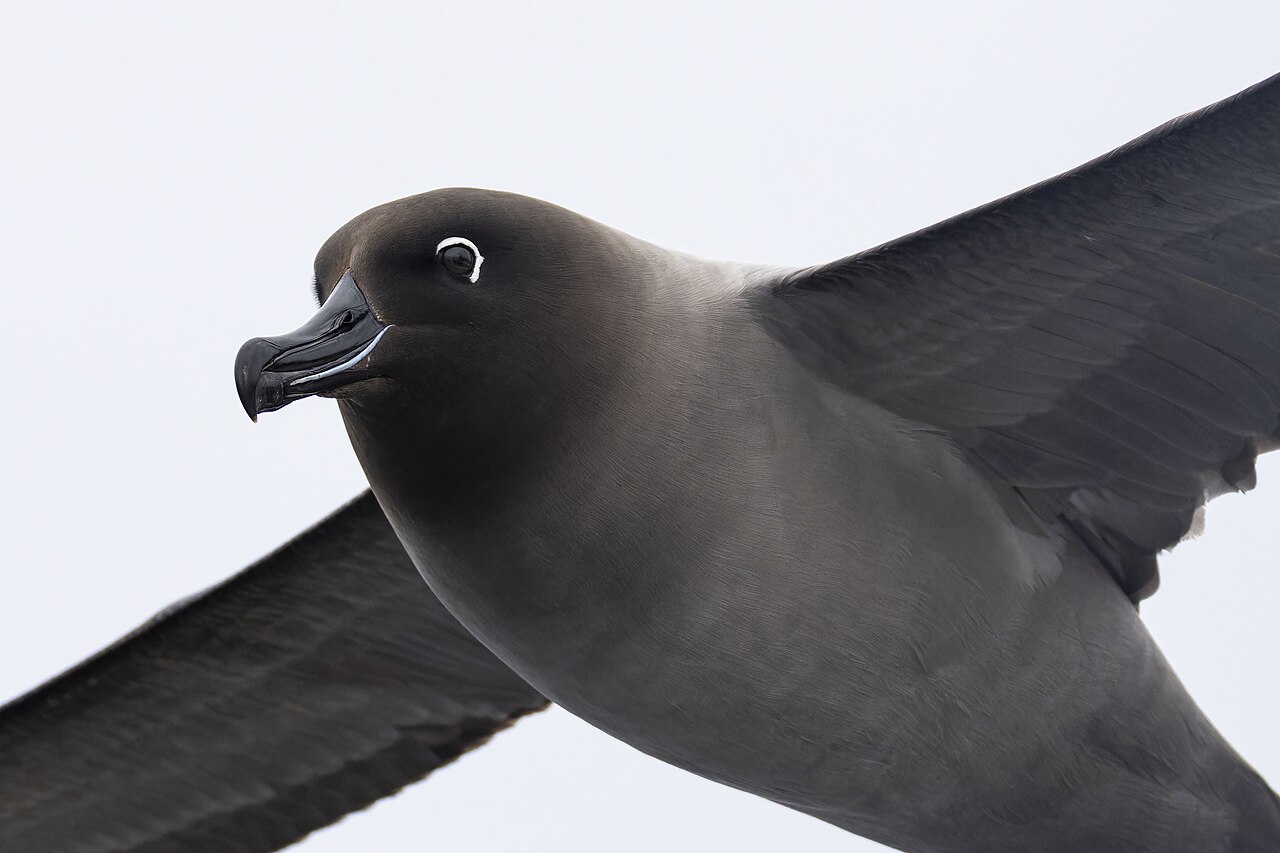
The Light-mantled Albatross is an albatross of the southern seas: a dark bird with narrow pointed wings and a long wedge-shaped tail, its sooty-brown head giving way to an ash-grey mantle and back. Over the cliffs of the subantarctic islands, pairs fly a courtship display in formation, each bird mirroring the other beat for beat.
Voice
At sea it is silent. At the colony the two-note 'sky call' is the hallmark: a far-carrying pee-aahh given with the head angled up, often during the paired flight along the cliff edge. There are braying threat calls at the nest and a dry snapping of the bill.
Recording: Kevin Guille — CC BY-NC-SA 4.0 · Sourcil Noir, France · xeno-canto
Identification
80 to 90 cm long, span 1.8 to 2.3 m and about 3 kg — a mollymawk (an albatross of the genus Thalassarche) by length, but quite different in outline: the wings are strikingly narrow and pointed and the tail runs out into a long wedge. Head and neck are sooty brown and stand out clearly against the pale ash-grey mantle, back and underparts, a contrast sometimes likened to the markings of a Siamese cat. A thin white crescent sits behind the eye. The bill is black with a pale blue stripe along the lower mandible. Flight is exceptionally light and sweeping, in long glides along the wave crests.
Confusion species
Sooty Albatross (Phoebetria fusca) is the only real confusion and the margin is narrow: it is evenly dark chocolate brown over the whole body, without the pale mantle, and the stripe on the lower mandible is cream to orange-yellow rather than pale blue. On a dark bird against the light the mantle contrast may not show, and then the bill stripe is the only hard mark; distribution helps, since in this region Light-mantled is the expected one of the two. Giant petrels (Macronectes) are heavier built, with a thick pale bill carrying a prominent nasal tube, and a short tail. Young Antipodean Albatross (Diomedea antipodensis) and Snowy Albatross (Diomedea exulans) are chocolate brown too but far larger, with a white face mask, a largely white underwing and a pink bill. All the Thalassarche mollymawks have a white body.
Habitat
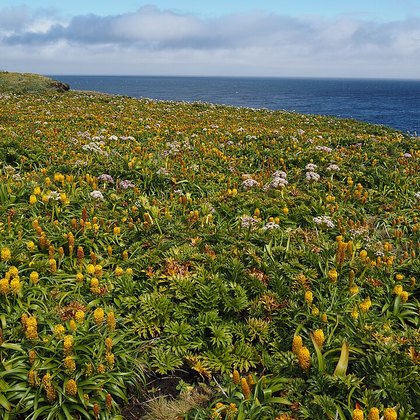
Subantarctic and Antarctic seas, right to the pack ice; outside the breeding season chiefly in cold water far from land. To breed it chooses narrow ledges on sea cliffs and steep tussock (grassland of loose, tall clump-forming grasses, especially in New Zealand) slopes on subantarctic islands, where the nest is a cone of mud and plant matter, often half under overhanging vegetation.
Where the bird is most often found, arranged by main group and formation.


Range and movements
Within this map window it breeds on the Auckland Islands (about 5,000 pairs), Campbell Island (about 1,600 pairs), the Antipodes Islands (about 250 pairs) and Macquarie Island. At sea expect it in subantarctic water south of New Zealand and in the southern Tasman Sea, and in small numbers on deep-water trips off Tasmania and South Australia, mainly in winter. It is absent from the subtropical water off Queensland.
- Breeding (summer)
- dark = core range, pale = thinly spread
Where and when to look
Take a deep-water trip out of Eaglehawk Neck in Tasmania in winter, or head for the southern New Zealand waters; on a visit to the Auckland Islands or Campbell the pairs can be watched along the cliff edge. Learn the outline first: narrow pointed wings plus a long wedge tail mean Phoebetria before any colour shows — no other albatross here has that tail. Only then go to the mantle contrast and the bill stripe.
Conservation
Near Threatened (NT), with some 58,000 breeding pairs worldwide but a decline of twenty to thirty per cent over the past century. Bycatch on high-seas longliners is the best-documented cause, although precise figures for the numbers caught are lacking. Plastic in the food and, on some breeding islands, feral cats and predation by giant petrels play their part. The species breeds only every second year, so losses are slow to be made up.
Scientific name
Phoebetria palpebrata | (Forster, 1785)
Johann Reinhold Forster described the bird in 1785 as Diomedea palpebrata; because the species now sits in Phoebetria, author and year go in parentheses. palpebrata means 'provided with eyelids' and refers to the short white crescent of feathers behind the eye. The type locality lies in open water south of the Prince Edward and Marion Islands: Forster recorded only a band of latitude, and Mathews fixed it there in 1934. The genus Phoebetria was introduced by Reichenbach in 1853, from the Greek phoibētria, 'prophetess'.