All species › Waders, gulls and terns › Buttonquails › Little Buttonquail
Little Buttonquail | Turnix velox
Kleine vechtkwartel | Torillo veloz
The Little Buttonquail is the palest and the most numerous buttonquail in Australia, a sandy ball of the dry interior that appears everywhere at once after a good wet season and is just as completely gone again in dry years. As in all buttonquails the female is the larger and the brighter marked, and it is she who calls and who fights over the males; the male incubates and raises the young. Anyone hoping to see one usually gets no more than a pale, whirring shape bursting from the grass at a metre's range.

Voice
The calling sex is the female, and her voice is a low, dull booming oo-ah or coo-oo, mostly at night and at dusk, repeated at intervals of a few seconds and with a carrying quality that makes it impossible to say whether the bird sits ten metres off or a hundred. A startled bird gives a high squeaky chip chip-chip as it flies. The male is all but silent.
No freely licensed recording has been found for this species yet; what to listen for is described below.
Identification
The smallest buttonquail of the interior, twelve to sixteen centimetres, round in shape, with a small blue-grey bill, pink to yellowish legs and three toes: the hind toe is missing, which separates all buttonquails from the true quails. The plumage is pale reddish-brown to sandy, with fine white streaks across the upperparts and a conspicuous white stripe along the flank dividing the pale breast from the white belly; the eye is pale, whitish to cream. The sexual difference runs the other way round: the female is clearly larger and warmer in colour than the duller male, and this reversed sexual dimorphism is unique among Australian birds to the buttonquails. In flight it is strikingly pale: light sandy wing coverts against dark primaries, low and whirring across the grass, and gone again after fifty metres.
Confusion species
Red-chested Buttonquail (Turnix pyrrhothorax) is the main confusion and locally shares the grassland: it is darker and has an orange-rufous breast and belly without the white flank stripe, and prefers taller, denser and damper grass. Red-backed Buttonquail (T. maculosus) is as small but has a yellow bill and yellow legs, a grey face and black spots on the flanks, and sits in the wet grass of the tropical north. Painted Buttonquail (T. varius) is larger, greyer, with pearl-white drop spots and an orange-red eye, and belongs in litter-floored forest. Chestnut-backed Buttonquail (T. castanotus) is larger and chestnut-backed and sits on stony savanna slopes in the north-west. More important still is Plains-wanderer (Pedionomus torquatus), which lives in the same sparse grassland but is longer in leg and neck, has a hind toe, and on flushing goes off with dangling legs instead of whirring away low. Stubble Quail (Coturnix pectoralis) is a true quail: larger, heavily streaked, with a hind toe and a quite different, loud call.
Habitat
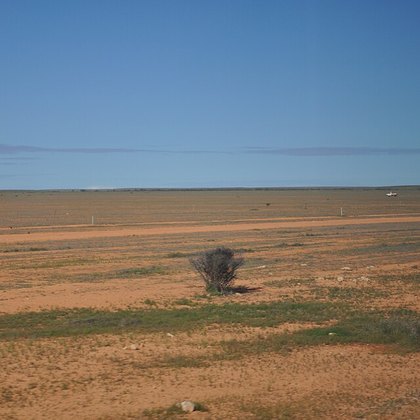
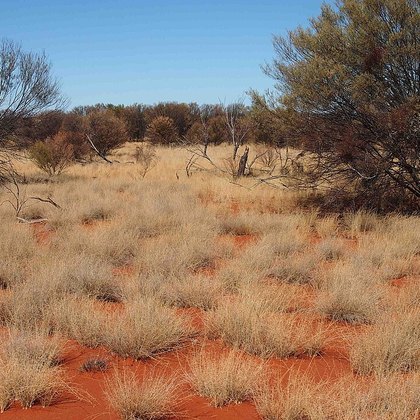
Open, dry grassland and herbfield of the arid and semi-arid interior: Mitchell grass, spinifex, saltbush and bluebush plains, the grassy understorey of mulga and mallee, and every temporary herbfield that springs up after rain. Also stubble, fallow paddocks and roadsides, provided there is low grass with bare ground between the tussocks. It avoids closed forest, dense reedbed and long-wet soils.
Where the bird is most often found, arranged by main group and formation.




Range and movements
Nearly the whole Australian mainland, centred on the arid and semi-arid interior and on the south and west; it is absent from Tasmania and scarce or missing in the wettest tropical corners — the Kimberley, Arnhem Land and Cape York Peninsula. Its occurrence is utterly unpredictable: after a good wet season it breeds in enormous numbers inland and turns up in coastal districts where it has not been recorded for years, only to vanish from whole states again in drought. It does not reach New Zealand.
- Resident
- Breeding (summer)
- dark = core range, pale = thinly spread
Where and when to look
A year or two after good inland rain, drive slowly along a sand track through Mitchell grass or stubble at first light and watch for the pale shapes that burst from the grass ahead of the car; that is by far the commonest way the species is recorded. On such a bird, look at the flank: a sharp white stripe along the side and an overall sandy-pale flight picture are the key. At an inland camp, listen at night for the female's low booming.
Conservation
Least Concern (LC), with a range covering almost the whole continent and a population that in wet years can run into the millions. Numbers swing so hard with the rainfall that a trend is barely measurable, though data from the south point to a gradual decline as native grassland is turned to cropland and as heavy grazing removes the tussocks and the bare ground between them. Feral cats and foxes press on a bird that does everything at ground level. Its enormous range and its ability to breed quickly keep the species well clear of danger for now.
Scientific name
Turnix velox | (Gould, 1841)
Gould described the bird in 1841 as Hemipodius velox; because it was later placed in another genus, author and year stand in parentheses. The genus Turnix was introduced by Bonnaterre in 1791 and is a shortening of Latin coturnix, 'quail'. velox means 'swift', after the headlong, low whirring flight with which the bird disappears from the grass. The type locality lies in the interior of New South Wales.