All species › Passerines › Honeyeaters › Macleay's Honeyeater
Macleay's Honeyeater | Xanthotis macleayanus
Bruinkaphoningeter | Mielero de Macleay
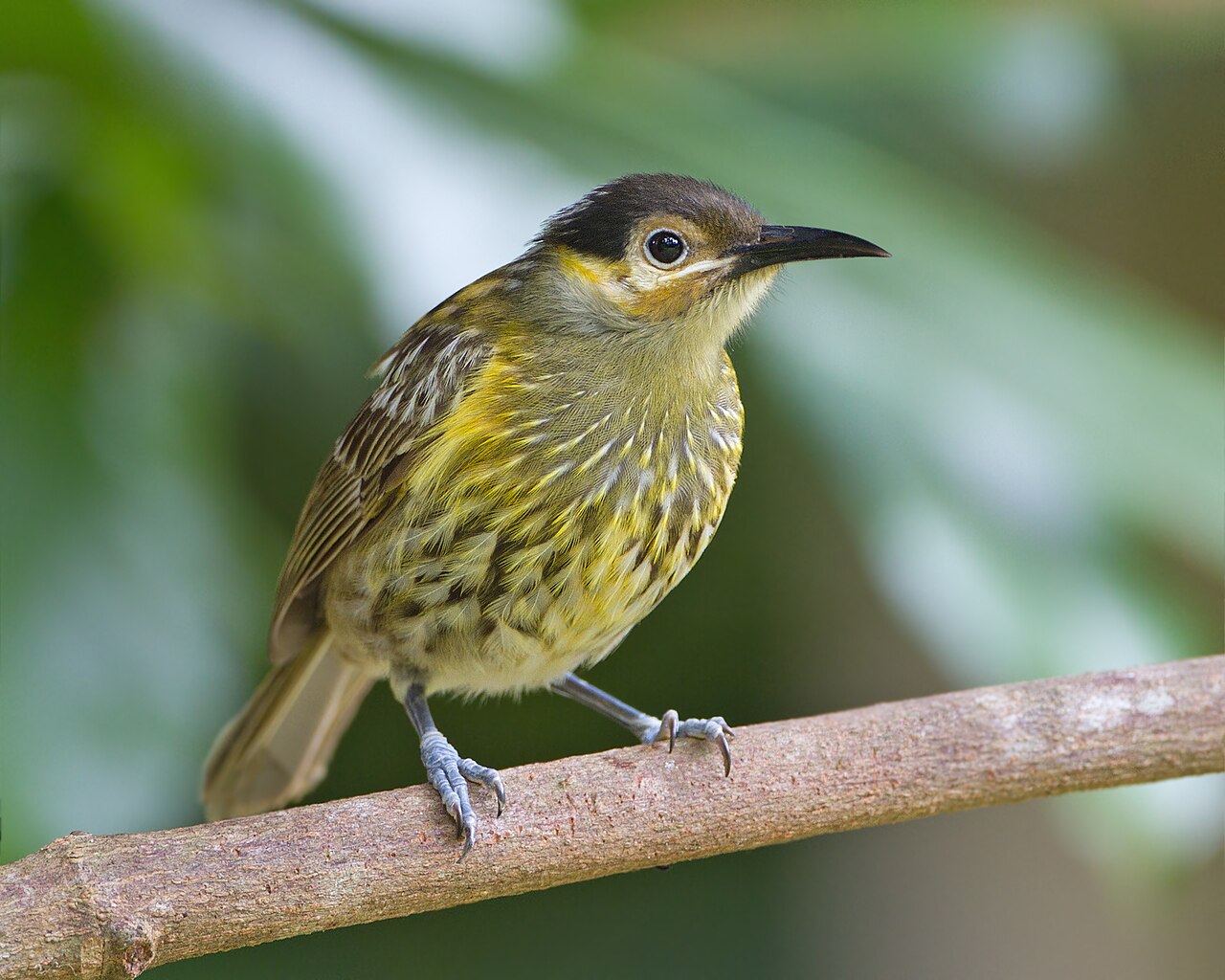
Macleay's Honeyeater is the honeyeater of the Wet Tropics rainforest and occurs nowhere else: a coastal strip in north Queensland from Cooktown to the Paluma Range. It is known by its near-black cap and the broad white-scalloped nape behind it — as though snow had settled on its shoulders.
Voice
A rich, shrill and rather unmusical repertoire: short sharp calls and a rattling chattering run delivered from dense cover. It calls a great deal and at all hours, including the middle of the day when the rest of the rainforest falls quiet, which makes it one of the most dependable voices in the forest above Cairns.
Recording: Arnoud B van den Berg — CC BY-NC-SA 4.0 · Mount Carbine, Mareeba Shire, Queensland, Australia · xeno-canto
Identification
A fairly large honeyeater of nineteen to twenty-one centimetres and thirty to forty grams. The head is dark brown-black with a brown eye-ring, and from the hind crown a bold, broad white scalloping runs over the nape and on down the back — the diagnostic mark. The underparts are olive-greenish brown with heavy pale grey streaking; the vent is dark olive-brown and the tail dark brown. The gape is pale, the eye dark, and bill, legs and feet are dark grey. It forages by climbing and probing along trunks and epiphytes, more like a treecreeper than a typical nectar-seeker.
Confusion species
The same rainforest holds three Meliphaga species — Lewin's Honeyeater (Meliphaga lewinii), Yellow-spotted Honeyeater (Meliphaga notata) and Graceful Honeyeater (Meliphaga gracilis) — all of which carry a pale, often yellowish ear patch and a plain brown head; none has the dark cap with the white-scalloped nape. The other Xanthotis, Tawny-breasted Honeyeater (Xanthotis flaviventer), lies further north on Cape York, is larger, has a plain tawny breast without streaking and a grey-blue bare patch around the eye; the ranges barely meet. Varied Honeyeater (Gavicalis versicolor) is yellower and carries a yellow neck-plume instead of the white nape scalloping.
Habitat
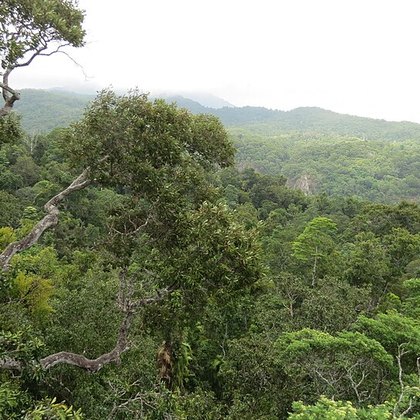
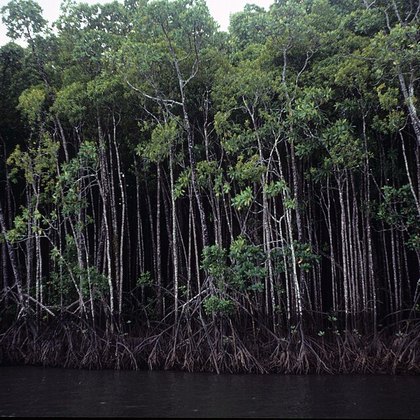
Tropical rainforest of the lowlands and lower ranges, and its margins; also mangrove and, where forest meets settlement, gardens and banana plantations. It stays in the same place year round and is not nomadic. Much of the diet is invertebrates, supplemented with nectar and fruit.
Where the bird is most often found, arranged by main group and formation.

Range and movements
Endemic to the Australian Wet Tropics: a narrow, more or less coastal strip along the Queensland east coast, from Black Mountain National Park just south of Cape Melville and Cooktown in the north to the hills in the hinterland of Townsville and the Paluma Range in the south. The whole range covers under thirty thousand square kilometres.
- Resident
- dark = core range, pale = thinly spread
Where and when to look
In the forest around Kuranda, Julatten or the Atherton Tablelands, do not look for it in the flowers but against the trunks: watch for medium-sized birds working their way up mossy branches and epiphytes. When the bird turns, the white-scalloped nape is immediately clear even in poor light — far more visible than the streaked pattern on the breast.
Conservation
Least Concern (LC). The species is common within its small range, and most of that range lies in the Wet Tropics of Queensland World Heritage Area, which is well protected. The restricted and strongly altitude-bound distribution does make it vulnerable in the longer term to climate change, which shifts suitable rainforest upslope.
Scientific name
Xanthotis macleayanus | (Ramsay, 1875)
Edward Pierson Ramsay described the species in 1875, originally as Ptilotis macleayana, naming it for William John Macleay, the Australian naturalist and collector; as it was later moved to another genus, author and year stand in parentheses. The genus Xanthotis is formed from Greek xanthos 'yellow' and ōtis 'eared' — after the small yellow ear feathering the species of this genus carry. The Dutch name names the dark brown cap; the English name keeps the dedication.