All species › Passerines › Honeyeaters › Tawny-breasted Honeyeater
Tawny-breasted Honeyeater | Xanthotis flaviventer
Geelborsthoningeter | Mielero ventrihabano
In Australia the Tawny-breasted Honeyeater is found only on Cape York Peninsula, at the southern edge of a range that otherwise covers the whole of New Guinea. It is a bulky, drab honeyeater with a tawny breast, a dark cap and a grey-blue bare patch around the eye, working slowly and quietly through the upper layers of the forest.
Voice
Both short sharp calls and a longer whistled song, with considerable variation across its large range. In Australia it is notably quiet compared with the other honeyeaters of Cape York; in New Guinea it is heard more often, giving clear whistled runs from the canopy.
No freely licensed recording has been found for this species yet; what to listen for is described below.
Identification
A fairly large honeyeater of eighteen to twenty-one centimetres and about forty grams — heavy for a honeyeater. The upperparts are dull olive-brown, the breast and belly tawny to pale buff-yellow, without streaking. The head is darker with a dark cap, and around the eye lies a bare grey-blue patch with a small yellow ear feathering behind it — the feature that gives the genus its name. The gape is pale, bill and legs dark. It moves slowly and methodically, searching leaf clusters and vine tangles, and rarely comes into the open.
Confusion species
The other Australian Xanthotis, Xanthotis macleayanus, sits further south in the Wet Tropics, is smaller and has a near-black cap with a strikingly white-scalloped nape and heavily streaked underparts; the ranges barely meet, so distribution settles most cases by itself. On Cape York the comparison worth making is with the Meliphaga species: Meliphaga notata and Meliphaga gracilis are smaller, show a clear yellow ear patch and lack the blue-grey eye patch. Trichodere cockerelli, on the same peninsula, is grey with a golden-yellow moustachial stripe and a white-streaked breast.
Habitat
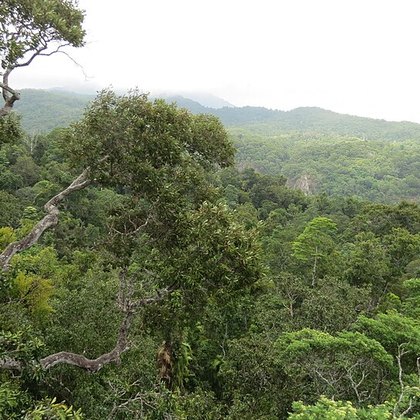
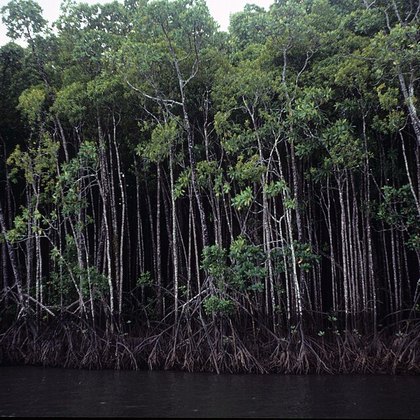
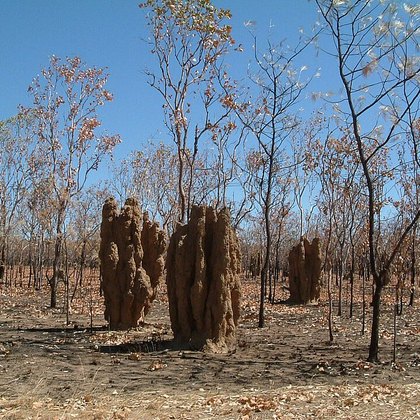
Rainforest, monsoon forest and vine thicket, forest edge and second growth, mangrove and savanna woodland with a closed canopy; in New Guinea from the lowlands to about fifteen hundred metres. It takes mainly invertebrates gleaned from leaves and bark, supplemented with nectar and fruit. The clutch is usually two eggs.
Where the bird is most often found, arranged by main group and formation.

Range and movements
New Guinea and its surrounding islands — so both Papua New Guinea and the Indonesian side — plus the northern part of Cape York Peninsula in Australia, where the subspecies filiger reaches south to about the Pascoe and Rocky rivers. In Australia it is the only honeyeater whose centre of gravity lies far off the continent. Resident, with no significant movements.
- Resident
- dark = core range, pale = thinly spread
Where and when to look
On Cape York look for it in the vine thickets and rainforest patches of Iron Range and its surroundings, and look high: it works slowly through the middle and upper layers of the forest and prefers dense foliage. In good light from below the pale blue patch around the eye is the first thing to register; the tawny breast and the complete absence of streaking confirm it.
Conservation
Least Concern (LC). The species has a very large range across New Guinea and northern Cape York and is common in suitable forest. The Australian population is small and confined to the rainforest patches of Cape York, which makes it locally sensitive to fire and clearing, but that has no measurable effect on the species as a whole.
Scientific name
Xanthotis flaviventer | (Lesson, 1828)
René Primevère Lesson described the species in 1828. The genus Xanthotis is formed from Greek xanthos 'yellow' and ōtis 'eared', after the yellow ear feathering. flaviventer is Latin: flavus 'yellow' and venter 'belly'. The name is generous — the underparts are tawny to pale buff rather than truly yellow — but the Dutch name Geelborsthoningeter follows the scientific name, while the English Tawny-breasted Honeyeater stays closer to the actual colour.