All species › Passerines › Honeyeaters › White-streaked Honeyeater
White-streaked Honeyeater | Trichodere cockerelli
Cape-yorkhoningeter | Mielero de cockerell
The White-streaked Honeyeater occurs nowhere but Cape York Peninsula, north of about Cooktown. It is a grey honeyeater with a golden-yellow moustachial stripe and ear tuft, a blue gape and a breast full of narrow, almost bristly white feather streaks — a combination no other Australian honeyeater carries.

Voice
Its voice consists mainly of short, clear contact notes repeated as it works from flower to flower; little is known of any developed song. In a flowering heath on Cape York it is therefore found by movement rather than by voice, although a party working through flowering grevilleas gives itself away with a continuous thin piping.
No freely licensed recording has been found for this species yet; what to listen for is described below.
Identification
A medium-sized honeyeater of sixteen to eighteen centimetres, with a dark grey head set off by a golden-yellow moustachial stripe below the eye and a golden-yellow ear tuft, and with a blue bare gape. Chin, throat and breast carry narrow, pointed, almost bristle-like white feathers that run as fine streaks over the light grey underparts and take on a yellow cast in the centre — hence the English name. Wing and tail have yellow feather edges. Males are noticeably larger than females, unusual among Australian honeyeaters. Young birds lack the blue gape but already show the bristly breast feathering.
Confusion species
The genus Trichodere holds one species, and the combination of golden moustache, yellow ear tuft and white-streaked breast is unique. Genetic work published in 2017 nevertheless places the species inside the Phylidonyris clade, and that shows in the field too: Phylidonyris species and Gliciphila melanops have the same restless build and the same streaked underparts, but lack the yellow moustache and do not occur on Cape York. The Meliphaga species of the same area are brown with a pale ear patch and unstreaked, and Xanthotis flaviventer, which does overlap on Cape York, is larger, unstreaked and carries a grey-blue bare patch around the eye.
Habitat
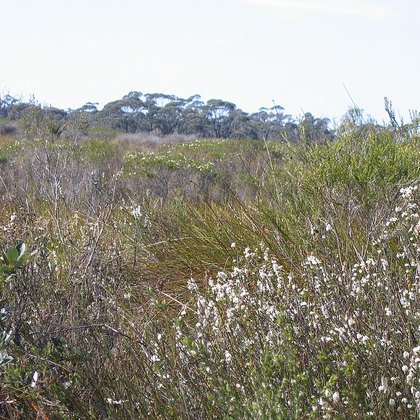
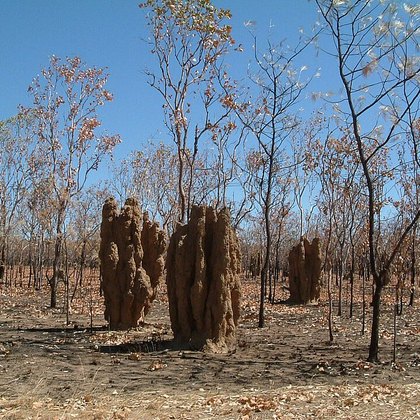
Heathland, open woodland and riverine forest; rainforest is avoided. It follows the flowering of paperbarks, bottlebrushes and grevilleas and therefore shifts through the year between heath and river belts. The species is nomadic: a site that held dozens last season may be empty now.
Where the bird is most often found, arranged by main group and formation.


Range and movements
Cape York Peninsula in far northern Queensland only, north of about Cooktown, with an extension south-east to the Cape Melville and Muundhi area and occasionally to the country around Port Douglas. Within that restricted range it is locally numerous but unpredictable.
- Resident
- dark = core range, pale = thinly spread
Where and when to look
The classic sites are the heath at Tozer's Gap and river crossings such as the Wenlock, in the dry season. But the birds follow the blossom, not the guidebook: watch which shrubs are in flower as you travel, and stop there. Once you have one in view, check the gape — on adults the blue is surprisingly obvious at close range.
Conservation
Least Concern (LC). The range is small and lies entirely within Australia, but Cape York is thinly settled and the heath and woodland habitat is largely intact. Changing fire regimes and the spread of grazing on the peninsula are the main longer-term concerns.
Scientific name
Trichodere cockerelli | (Gould, 1869)
Gould described the species in 1869 as Ptilotis cockerelli, naming it for a Mr Cockerell, who shot the type specimen. Alfred North erected the genus Trichodere in 1912, from Ancient Greek thrix, trichos 'hair' and derē 'throat' — after the hair-like throat feathers that no other honeyeater has in this form. The Dutch name Cape-yorkhoningeter refers to the range; the English name to the white breast streaking.