All species › Passerines › Honeyeaters › Black Honeyeater
Black Honeyeater | Sugomel nigrum
Rouwhoningeter | Mielero blanquinegro
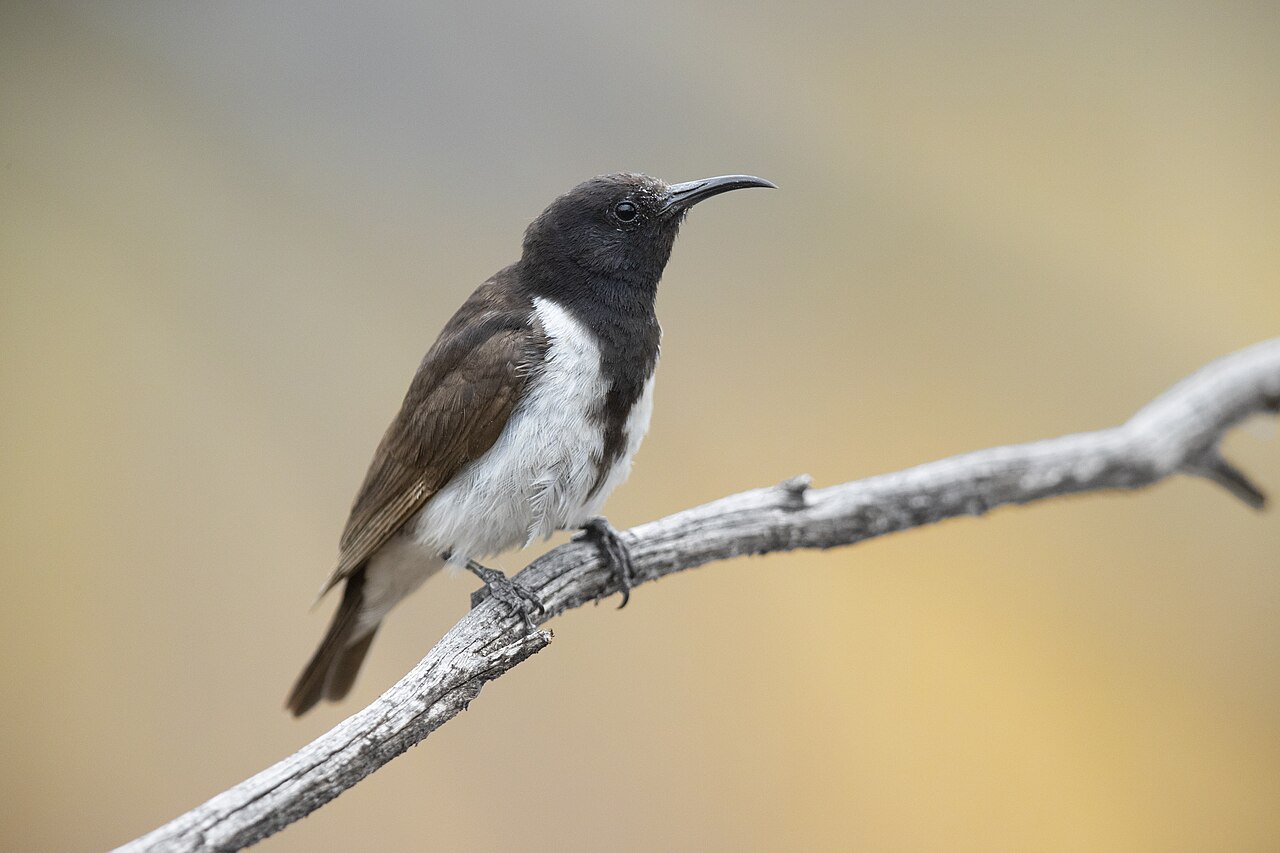
The Black Honeyeater is one of Australia's smallest honeyeaters and the only black-and-white one: the male has a black head, neck and upperparts with a black stripe running down over the white underparts like a tie. It is a bird of the dry interior, tied to flowering emu-bush, appearing and vanishing with the rain.
Voice
A soft metallic 'chwit, chwit' as a contact note and a louder, evenly held 'tieee'. In the breeding season the male gives a thin, high 'peeee' during a zigzagging song flight above the shrubs, a sound that hardly registers as a bird. After the chicks hatch both parents scold softly when disturbed.
No freely licensed recording has been found for this species yet; what to listen for is described below.
Identification
A very small honeyeater of ten to thirteen centimetres and about ten grams, with a long, slender, strongly down-curved bill, a plump body, long pointed wings and a short tail. The male is black on head, neck, back and wings and white on belly and flanks, with a black central stripe carrying down from the black breast onto the belly — the decisive mark. The female is inconspicuous, buff-brown on crown and upperparts, with a pale eye-stripe and a speckled grey-brown breast grading into a dull white belly. Immatures resemble the female.
Confusion species
The one real confusion species is Certhionyx variegatus, also black and white and living in the same dry scrub. It is clearly larger, with a longer tail and a thicker bill, a blue crescent of bare skin below the eye and a white wing patch, and the male lacks precisely that black central stripe on the white underparts. The females are the harder pair: that of Certhionyx variegatus has a more obviously streaked throat, is bulkier and also shows the blue mark below the eye. Male Myzomela species can look superficially similar, but are red on head or breast rather than black and white.
Habitat
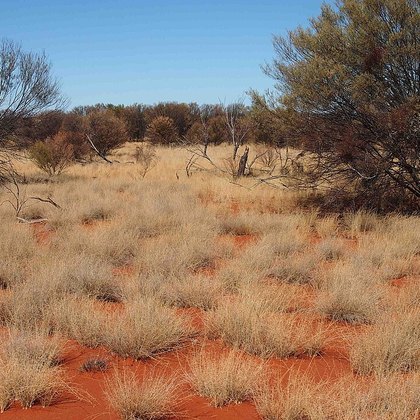
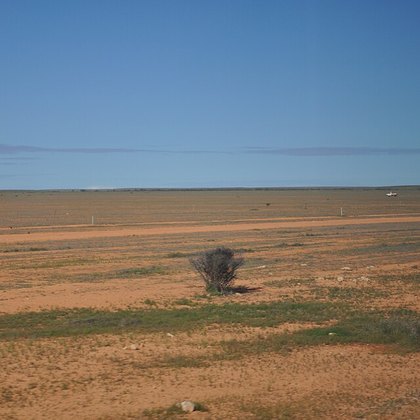
Open woodland and shrubland of the arid and semi-arid zone, above all where emu-bush (Eremophila) is in flower, and also mulga, mallee and spinifex savanna with flowering grevilleas and paperbarks. The nest is a small cup of twigs and grass, low in a shrub, with two or three eggs; the breeding season runs July to December, peaking August to November, but also opportunistically after rain.
Where the bird is most often found, arranged by main group and formation.


Range and movements
Endemic to inland Australia: western Queensland and western New South Wales, scattered through South Australia to central and northern Western Australia, and around Alice Springs in the Northern Territory. It appears occasionally in the Victorian mallee. The species is strongly nomadic with a seasonal pattern — south in spring and summer, north in autumn and winter — and drought triggers irruptions far beyond the usual range.
- Resident
- Breeding (summer)
- Winter
- dark = core range, pale = thinly spread
Where and when to look
After good rain, drive an inland road and stop at every flowering emu-bush: Black Honeyeaters come in small numbers to such shrubs, and the black-and-white male is visible from a distance. Breeding females regularly visit old campfire sites to take wood ash — most likely for the calcium that goes into eggshell — so an abandoned fireplace in flowering scrub is worth a few minutes.
Conservation
Least Concern (LC), although the population trend is downward. The huge range and nomadic habits make the species resilient, but it depends closely on flowering shrubs of the dry zone, and that vegetation is under pressure from stock grazing, clearing and changing fire regimes inland.
Scientific name
Sugomel nigrum | (Gould, 1838)
Gould described the species in 1838, originally in Myzomela. The genus Sugomel holds this species alone and is built from Latin sugo 'to suck' and mel 'honey', after the nectar-feeding habit. nigrum is Latin for 'black'. Note the spelling: many older sources write Sugomel niger, with the adjective in the masculine form; the combination now in general use is Sugomel nigrum. The Dutch name Rouwhoningeter ('mourning honeyeater') refers to the black-and-white plumage of the male.