All species › Passerines › Honeyeaters › White-gaped Honeyeater
White-gaped Honeyeater | Stomiopera unicolor
Witsnavelhoningeter | Mielero unicolor
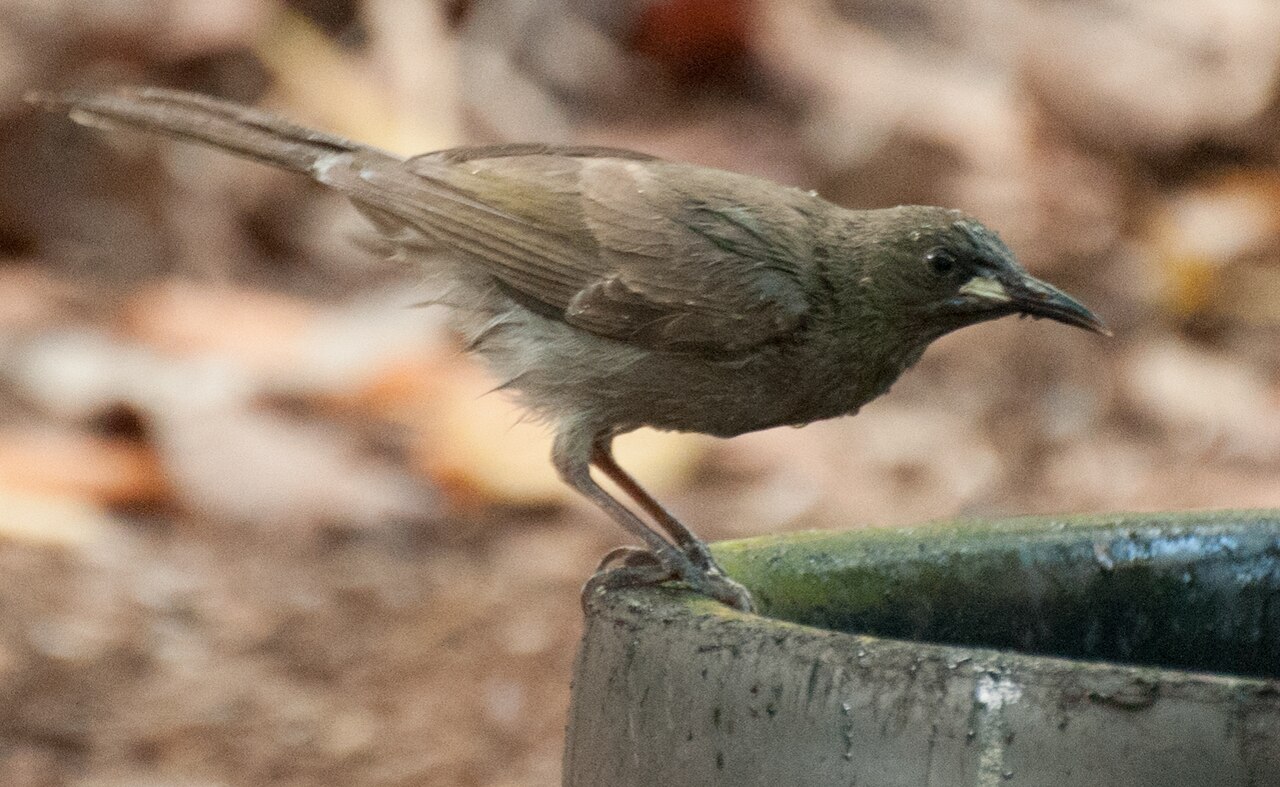
The White-gaped Honeyeater is the loud, drab honeyeater of northern riverside forest: a fairly large, plain olive-grey bird whose only real mark is a white streak at the gape. Along any creek with pandanus and paperbark in the Top End and the Kimberley it is heard long before it is seen.
Voice
One of the fixed sounds of tropical northern Australia: loud, raucous and persistent, with clattering chattering runs and rolling whistles that dominate everything in the first hour after sunrise. It calls a great deal and carries far, which is just as well, because the plumage offers no help.
No freely licensed recording has been found for this species yet; what to listen for is described below.
Identification
A fairly large honeyeater — males nineteen to twenty-two centimetres, females seventeen to twenty — almost entirely plain dark olive-grey to grey-brown, slightly paler below, without streaking, mask or plume. The only contrast is at the gape: a conspicuous white to cream streak running back from the base of the bill, showing at range as a small white fleck. The bill itself is dark, not white. The species is monotypic, so there is no geographic variation to allow for.
Confusion species
The other Stomiopera, Stomiopera flava, is smaller and wholly lemon-yellow and replaces it in eastern Queensland; where the ranges approach, confusion is impossible once colour is clear. Harder are the Gavicalis species from the same ex-Lichenostomus cluster: Gavicalis fasciogularis has a streaked throat and lives in south-east Queensland mangrove, Gavicalis versicolor has a dark crown and a yellow neck-plume. The same forest also holds Lichmera indistincta and Myzomela obscura, both far smaller and finer-built, and the Meliphaga species with their pale ear patch. If every mark is missing and the bird is large, grey-brown and loud, this is it.
Habitat
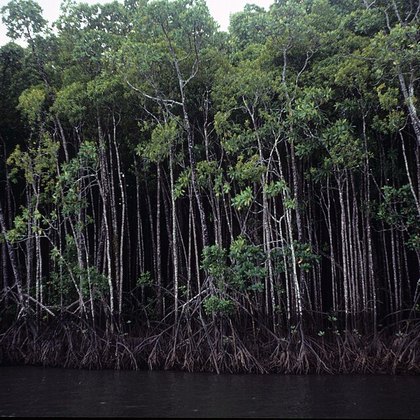
Forest and woodland close to water: riparian forest along creeks and rivers, paperbark swamp, monsoon forest and vine thicket, pandanus belts and mangrove. It moves readily into gardens and the edges of towns, where it behaves conspicuously as a bully towards other honeyeaters and defends flowering trees. It takes nectar, fruit and seed, along with insects and spiders.
Where the bird is most often found, arranged by main group and formation.



Range and movements
Northern Australia, from the Kimberley in Western Australia through the Top End of the Northern Territory and the Gulf of Carpentaria, east and south along the Queensland coast to about Sarina. Resident; within that range it is one of the commonest honeyeaters of riverside forest.
- Resident
- dark = core range, pale = thinly spread
Where and when to look
Stand by a creek with pandanus or paperbark just after sunrise and follow the loudest sound — nine times out of ten it is this species. Once the bird is in view, look for the white streak exactly at the gape; it shows much better when the bird is in the open than half-hidden in foliage. Note that the Dutch name means 'white-billed': the bill is in fact dark, and it is the gape that is white.
Conservation
Least Concern (LC). The species is numerous across its whole northern range, tolerates disturbed and urbanised places well and profits from plantings in towns and cities. Loss of riparian forest to stock trampling and altered water regimes is locally adverse but has no visible effect on the overall population.
Scientific name
Stomiopera unicolor | (Gould, 1843)
Gould described the species in 1843 as Ptilotis unicolor; it is the type species of Stomiopera, which Ludwig Reichenbach erected in 1852 from Greek stomion 'mouth' and pēra 'pouch, wallet' — after that very gape. The genus was brought back into use in 2011 when Lichenostomus proved polyphyletic. unicolor is Latin for 'of one colour'. The English name White-gaped Honeyeater names the white gape streak correctly; the Dutch name Witsnavelhoningeter points at the bill, which is in fact dark — it is kept here unchanged because it is established.