All species › Passerines › Honeyeaters › Yellow Honeyeater
Yellow Honeyeater | Stomiopera flava
Citroenhoningeter | Mielero amarillo
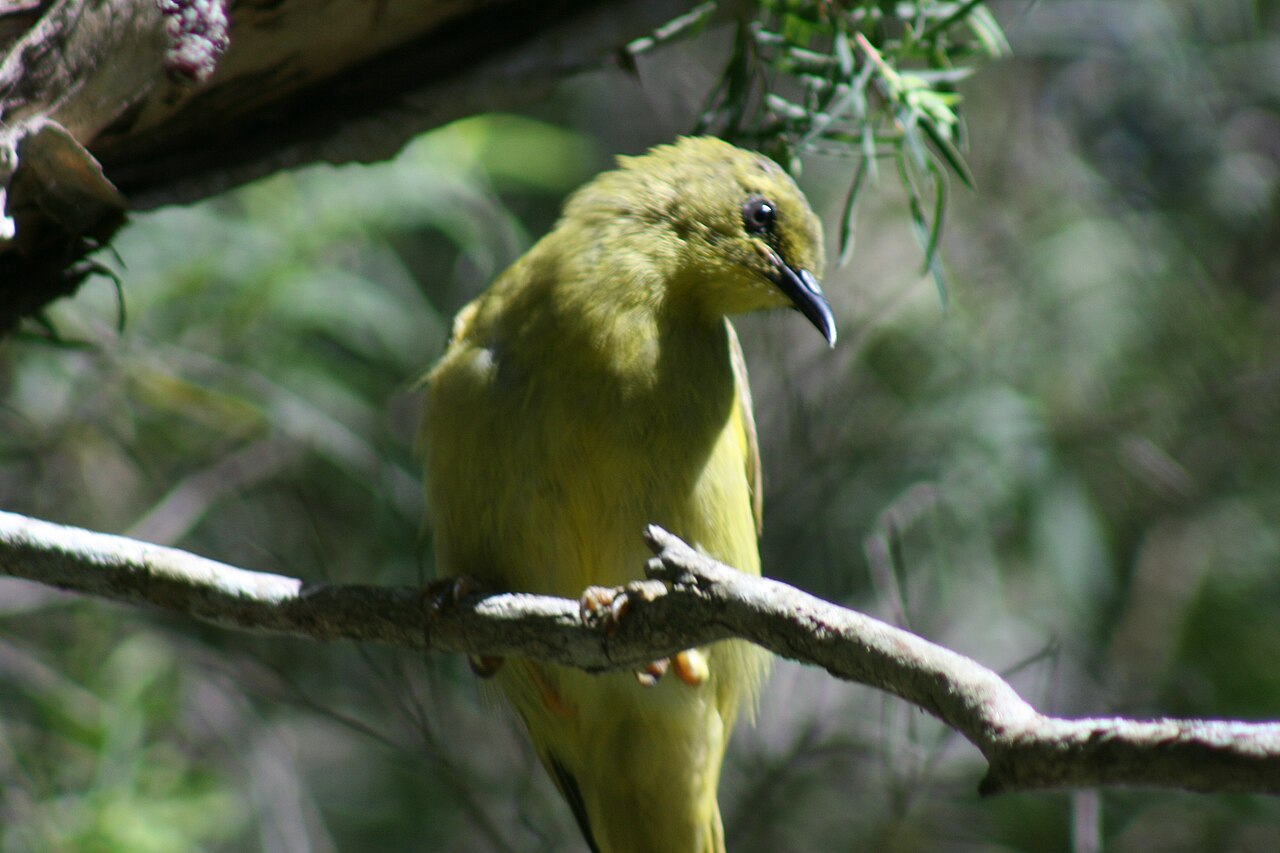
The Yellow Honeyeater is the only honeyeater in tropical Queensland that is yellow from head to tail: a medium-sized, plain lemon-yellow bird with no streaking, no mask and no plume. It lives in the gardens and parks of Townsville and Cairns as readily as in monsoon forest, and sings from an open branch all year round.
Voice
A loud, clear run of whistled notes, usually given from an exposed branch or a roof edge and carrying a long way. The voice is strikingly powerful for so unremarkable a bird; anyone in a North Queensland garden hearing a sustained musical whistling they cannot place is usually looking straight past a yellow bird sitting in full view.
No freely licensed recording has been found for this species yet; what to listen for is described below.
Identification
A medium-sized honeyeater of seventeen to eighteen centimetres, wholly yellow below and on the head and yellow washed with olive-green above. The patterning is minimal: a thin, inconspicuous grey line through the eye and grey-edged wing coverts, with grey showing through the underparts when the feathers are ruffled. The bill is dark grey and slightly down-curved, the eye brown, the legs grey. There is no throat or breast streaking, no ear patch and no neck-plume — that bare simplicity is itself the mark.
Confusion species
Nothing else in its range is so uniformly yellow, but the family resemblance runs through the ex-Lichenostomus cluster. The second Stomiopera, Stomiopera unicolor, is larger and dull olive-grey with a white gape stripe, and largely replaces it to the north and west. Of the Gavicalis species, Gavicalis versicolor is the trickiest: bulkier, with a dark crown, a yellow neck-plume and fine breast streaking. Gavicalis fasciogularis has a streaked throat and sits further south in mangrove, and Gavicalis virescens is a grey-brown bird of the dry interior. The Meliphaga species sharing the same forest are brown with a pale ear patch and never plain yellow.
Habitat
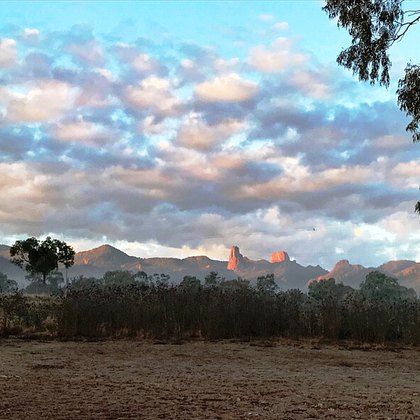
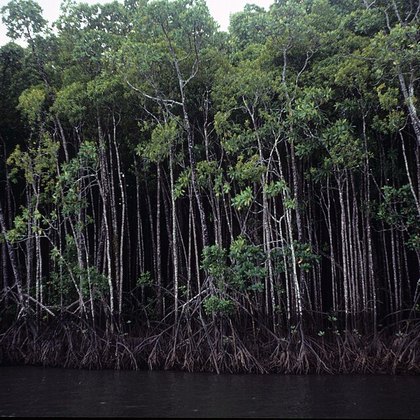
Tropical woodland and open forest, riparian forest along creeks, mangrove and monsoon forest, and also, successfully, town parks, street trees and gardens. It is chiefly a coastal and lowland bird and does not reach far inland.
Where the bird is most often found, arranged by main group and formation.


Range and movements
Endemic to north-eastern Queensland, with two subspecies: nominate flava on Cape York Peninsula and west to the mouth of the Norman River, and addendus along the south-eastern coastal strip from about Kewarra Beach near Cairns south to Cape Palmerston National Park near Mackay. Resident, with no significant movements.
- Resident
- dark = core range, pale = thinly spread
Where and when to look
In Townsville or Cairns you need not leave town: walk into a park or a street with flowering trees and wait for the clear whistling. The bird often sits high and fully exposed, but yellow plumage against sunlit foliage disappears completely — so find it by sound first and by colour second.
Conservation
Least Concern (LC). The species has a restricted but well-occupied range, is common in north-east Queensland and has settled readily into urban greenery, which makes it less vulnerable than many other rainforest birds of the region. There is no evidence of decline.
Scientific name
Stomiopera flava | (Gould, 1843)
Gould described the species in 1843 as Ptilotis flava. It long sat in Lichenostomus but was moved to Stomiopera in 2011 when molecular work showed Lichenostomus to be polyphyletic. Stomiopera was erected in 1852 by Ludwig Reichenbach, from Greek stomion 'mouth' and pēra 'pouch, wallet', after the conspicuous gape of the genus. flava is Latin for 'yellow' — the feature behind the English, Dutch and Spanish names alike.