All species › Parrots › Old World parrots › Malherbe's Parakeet
Malherbe's Parakeet | Cyanoramphus malherbi
Oranjevoorhoofdkakariki | Perico maorí montano
Malherbe's Parakeet, kakariki karaka, is the smallest and rarest of the kakariki and one of New Zealand's most threatened parrots. It is a close copy of the Yellow-crowned Parakeet, but the band above the bill is orange rather than red — a difference argued over for more than a century.

Voice
The call is a loud chatter of varying length and intensity, close in pitch to the Yellow-crowned Parakeet and not reliably separable from it in the field. Between members of a pair come soft contact notes, and in courtship a series of deliberate, separately delivered single notes. In a quiet beech valley the chatter carries far, but it only points you to a kakariki, not to the species.
No freely licensed recording has been found for this species yet; what to listen for is described below.
Identification
At nineteen to twenty-two centimetres and thirty to fifty-two grams the smallest kakariki, strikingly pale and blue-green in tone, with a blue-green wash over the underparts. The frontal band is orange, the crown lemon-yellow, and an orange patch sits on each side of the rump as well. The primary coverts are azure blue. Juveniles lack the orange and yellow on the head and are then indistinguishable from a young Yellow-crowned Parakeet.
Confusion species
Yellow-crowned Parakeet (Cyanoramphus auriceps) is the only real confusion: brighter grass-green, slightly larger, with a crimson rather than orange band above the cere and red rather than orange rump patches. Against the light or at range crimson often reads as orange, so trust only a bird seen close and in good light. Red-crowned Parakeet (Cyanoramphus novaezelandiae) is much larger and carries red back beyond the eye.
Habitat
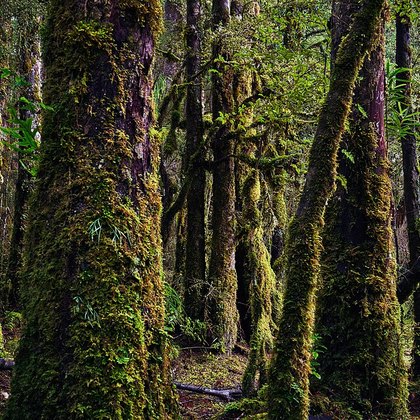
Almost entirely beech forest: red, silver and mountain beech on the valley sides and terraces of the mountain valleys, where it feeds high in the canopy but also comes low into the understorey and onto the forest floor. It uses every layer of the forest, including the creeks for drinking and bathing, and nests in cavities in old beeches. On the islands it has been released to it lives in podocarp-broadleaf forest and scrub.
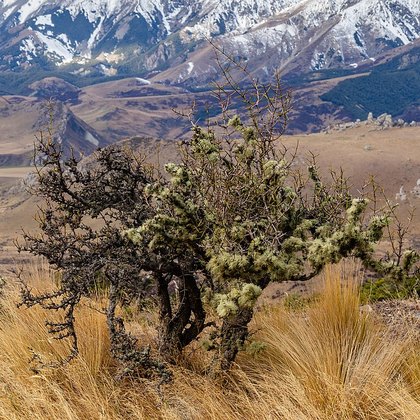
Where the bird is most often found, arranged by main group and formation.

Range and movements
Naturally down to four South Island valleys: the Hawdon, the Andrews and the Poulter in Arthur's Pass National Park, and the south branch of the Hurunui in Lake Sumner Forest Park. Beyond those it has been released on the predator-free islands of Maud, Blumine, Chalky and Tuhua, and into the fenced Brook Waimarama Sanctuary near Nelson, which now holds the strongest mainland population.
- Resident
- dark = core range, pale = thinly spread
Where and when to look
In the Hawdon Valley or the Andrews, stand at first light by the creek where the beech forest meets the riverbed: the birds come in to drink and bathe, and it is the one place you get them settled, close and at eye level. Check the band above the bill, and judge it only in side light — in shade orange cannot be told from crimson. The Brook Waimarama Sanctuary offers the best odds of all.
Conservation
Critically Endangered (CR). The mainland probably holds fewer than one hundred mature birds, with perhaps two to three hundred more on the islands it has been moved to. Numbers fell from five to seven hundred birds around 2000 to one or two hundred by 2004; ship rats and stoats are the main cause, above all in beech mast years, with psittacine beak and feather disease on top. Recovery rests on predator control, metal collars around nest trees and captive breeding at the Isaac Conservation and Wildlife Trust: forty-five birds were released on Chalky Island between 2005 and 2007, sixty-eight on Maud Island between 2007 and 2009, and a hundred and twenty-five went to the Brook Waimarama Sanctuary.
Scientific name
Cyanoramphus malherbi | de Souancé, 1857
De Souance described the species in 1857 as Cyanoramphus Malherbi, and as it has stayed in that genus author and year carry no parentheses. The epithet honours Alfred Malherbe, the French ornithologist and magistrate best known for his work on woodpeckers. No type locality was given; it is now taken as the South Island of New Zealand. That this is a species in its own right rather than a colour form of the Yellow-crowned Parakeet was only settled by molecular work in 2000; kakariki karaka is the Maori name, in which karaka means 'orange'.