All species › Parrots › Old World parrots › Chatham Islands Parakeet
Chatham Islands Parakeet | Cyanoramphus forbesi
Chathamkakariki | Perico de las Chatham
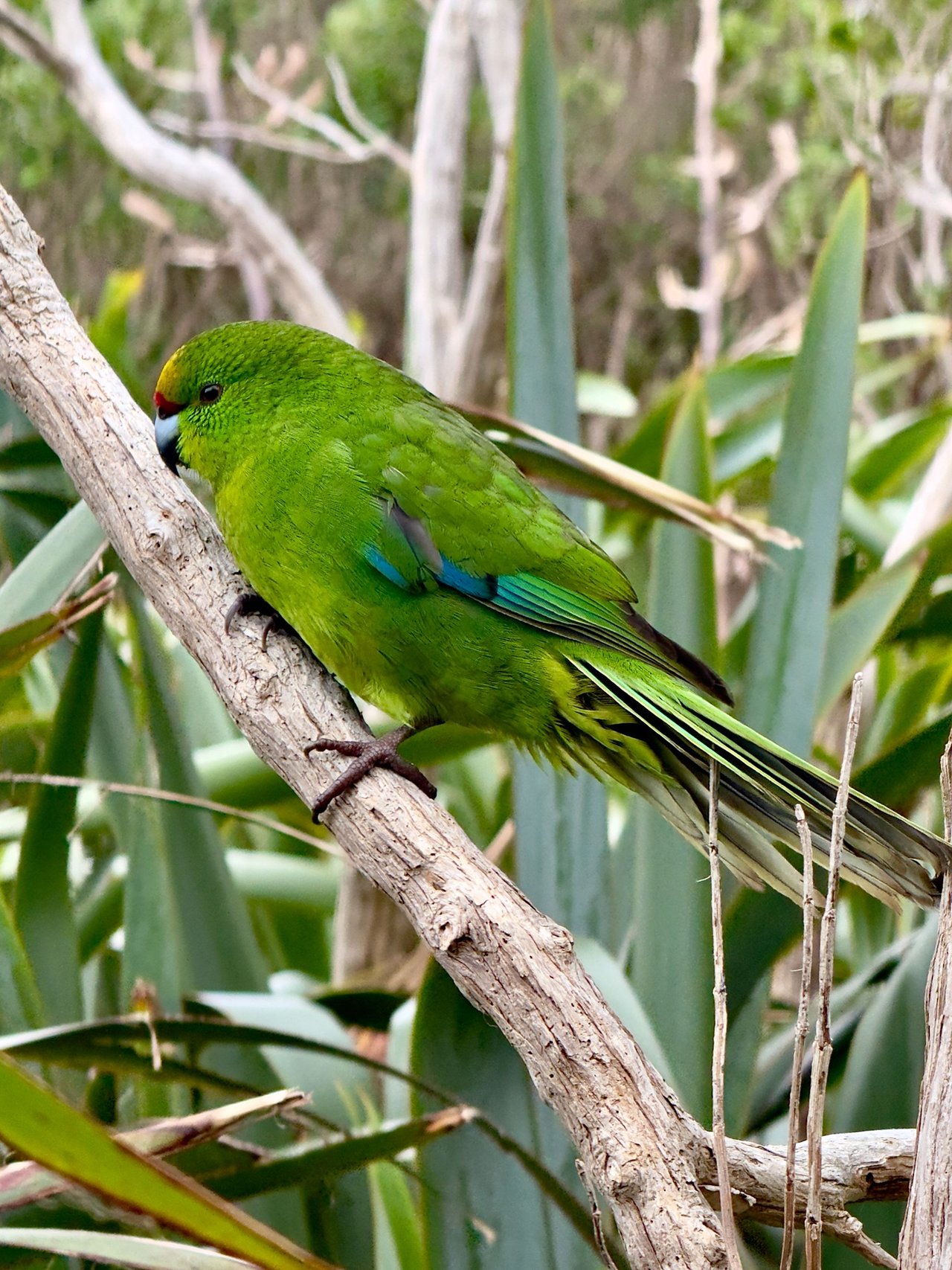
The Chatham Islands Parakeet is the kakariki of the Chatham Islands: emerald green, long-tailed, with a golden-yellow fore-crown and a crimson frontal band that stops short of the eye. It has been pushed back to two small islands, and its greatest threat is not a predator but a relative.
Voice
The voice is the usual kakariki chatter, with softer tur-tur-tur contact notes between members of a pair. It cannot be reliably separated from the call of the Chatham Island Red-crowned Parakeet, with which it shares Mangere, so voice is no help with identification here. In the dense scrub you hear it far more often than you see it.
Recording: David Boyle — CC BY-NC-SA 4.0 · Little Mangere, Chatham Islands Territory, New Zealand · xeno-canto
Identification
A solid kakariki of twenty-eight centimetres and some eighty grams, with broad rounded wings and a notably long tail. The fore-crown is bright golden-yellow, the narrow frontal band crimson, and that band halts in front of the eye. The eye itself is orange-red, the primary coverts violet-blue, and some red sits on each side of the rump. The female is clearly smaller and shorter-billed.
Confusion species
The Chatham subspecies of Red-crowned Parakeet (Cyanoramphus novaezelandiae) shares the same islets and is the only real problem: there the red of the forehead runs on behind the eye, and the fore-crown is red rather than golden-yellow. Harder still are the hybrids between the two, in which the red reaches halfway to the eye and the yellow crown is shot through with red — a bird with that intermediate pattern cannot be placed in the field. Confusion with mainland Yellow-crowned Parakeet (Cyanoramphus auriceps) is ruled out on geography.
Habitat
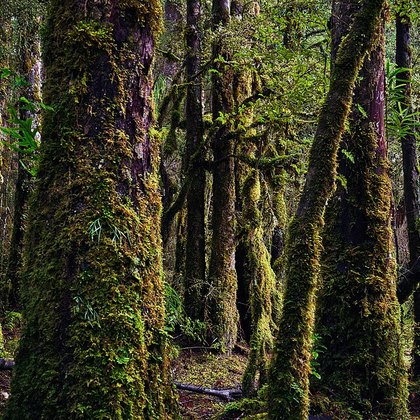
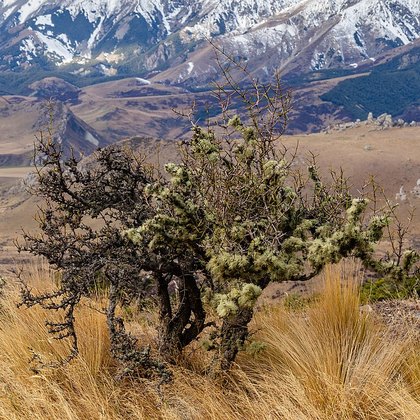
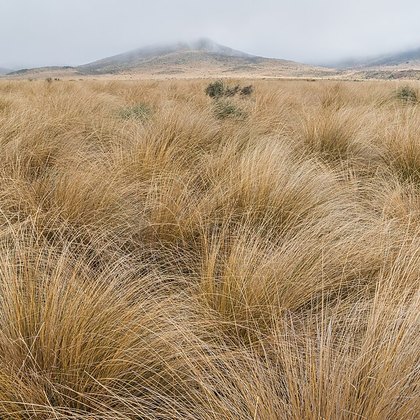
Densely vegetated ground: the regenerating forest and scrub of akeake, ribbonwood and muehlenbeckia on Mangere, with clearings and thick edges between. Unlike the Red-crowned Parakeet, which prefers the open grassy part of the island, it keeps largely inside closed vegetation, taking seed, buds and leaves. It nests in cavities and crevices.
Where the bird is most often found, arranged by main group and formation.
Range and movements
The Chatham Islands only, and within them only Mangere and Little Mangere (Tapuaenuku) — under three hundred hectares between them. In the nineteenth century it also held Pitt Island and southern Chatham Island, but it has gone from both; what turns up there now are stray wanderers. Rangatira (South East Island), the group's third predator-free reserve, holds not this species but the Chatham Island Red-crowned Parakeet.
- Passage
- dark = core range, pale = thinly spread
Where and when to look
Mangere and Little Mangere are closed nature reserves requiring a permit, so in practice you see the bird only on management or research work. If you get there, watch the edge of dense scrub and judge every bird on one point: how far back does the red reach. If it passes the front of the eye, you have a Red-crowned Parakeet or a hybrid.
Conservation
Vulnerable (VU), and nationally listed as endangered. Numbers once fell to twenty or thirty birds on Little Mangere; about a thousand now live on Mangere, where they make up more than ninety per cent of all parakeets. The great threat is genetic: hybridisation with the Chatham Island Red-crowned Parakeet, with both mitochondrial DNA and microsatellites showing how far the mixing has gone. Since 1976 hybrids have been culled and the island replanted at some six thousand trees a year, precisely to rebuild the closed forest in which this species outcompetes the Red-crowned, which prefers open ground.
Scientific name
Cyanoramphus forbesi | Rothschild, 1893
Rothschild described the species in 1893 as Cyanorhamphus forbesi, with the Chatham Islands as type locality; it has stayed in the genus, so author and year carry no parentheses. The epithet honours Henry Ogg Forbes, the Scottish explorer and naturalist who collected in the Chathams. For a long time the bird was treated as a subspecies of the Red-crowned Parakeet; molecular and morphological work has restored it as a species in its own right.