All species › Parrots › Old World parrots › Norfolk Parakeet
Norfolk Parakeet | Cyanoramphus cookii
Norfolkkakariki | Perico de Norfolk
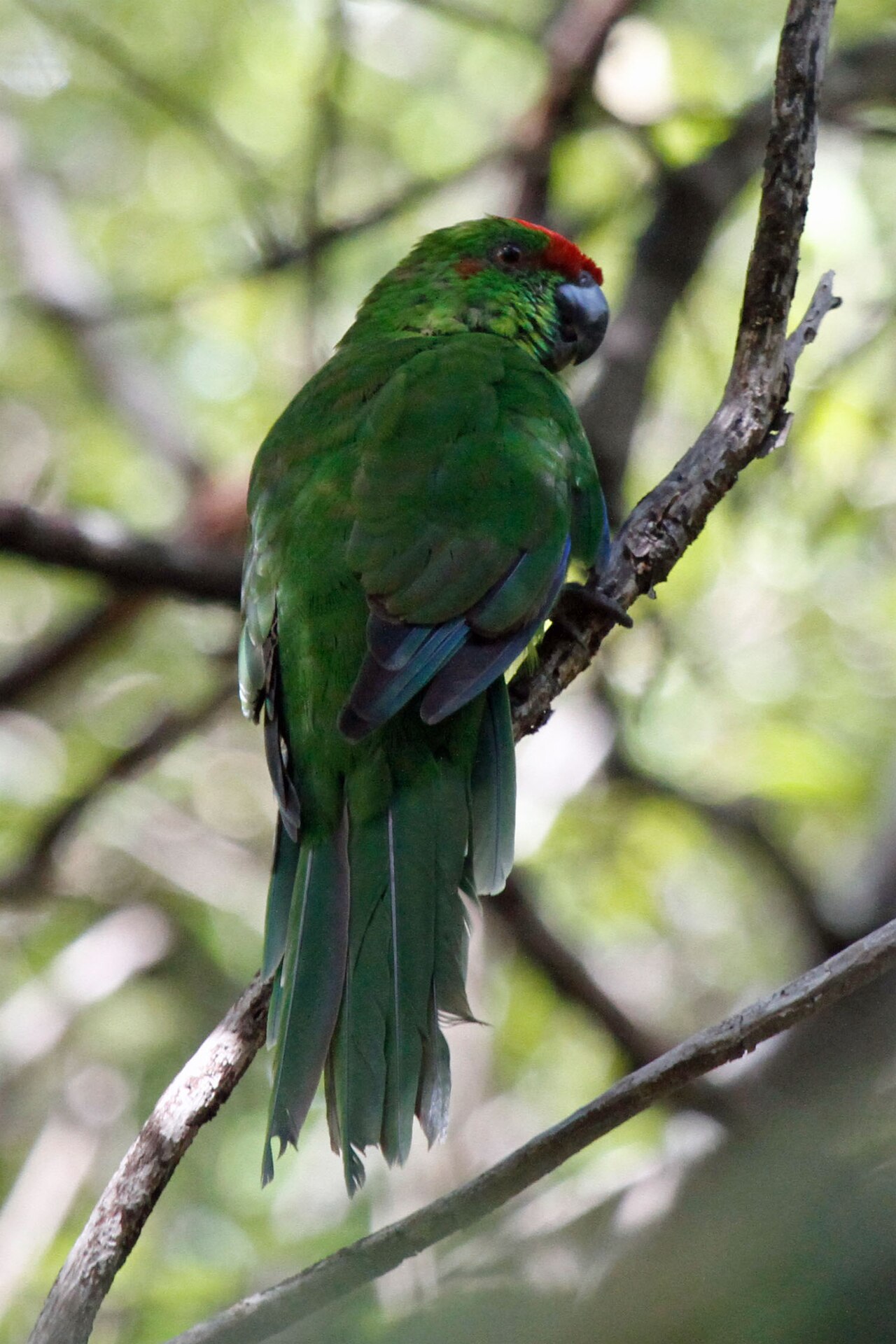
The Norfolk Parakeet, known on the island simply as the green parrot, is the only parrot native to Norfolk Island: a solid green parakeet with a red crown and a heavy pale bill. It has twice come close to extinction and twice been pulled back by hand.
Voice
The call is a loud, rattling kek-kek-kek, at times drawn out into a rapid kakakakaka, cutting through the Araucaria forest of Mount Pitt. Shorter, harder alarm and contact notes pass between members of a pair. It is heard far more often than seen: the green all but disappears in the canopy, and the call is usually the only trace.
No freely licensed recording has been found for this species yet; what to listen for is described below.
Identification
A stocky, short-winged parakeet of about thirty centimetres and some hundred grams, with a notably rounded head and a proportionally very large, pale bluish-grey bill. The plumage is green with a light yellow wash below. Red sits on the forehead, crown and lores and as a patch behind the eye, and again on each side of the rump. The primary coverts and outer primaries are violet-blue; the tail is dark green with yellow edges. The female shows less red and a smaller bill.
Confusion species
On Norfolk Island the only other green parrot is the introduced Crimson Rosella (Platycercus elegans): adults are crimson and blue, but young birds are largely green and are regularly taken for this species — then note the rosella's blue cheeks and much longer, narrower tail. From its New Zealand counterpart, the Red-crowned Parakeet (Cyanoramphus novaezelandiae), it is barely separable in the field; it is larger and heavier-billed, and there is no geographical overlap.
Habitat
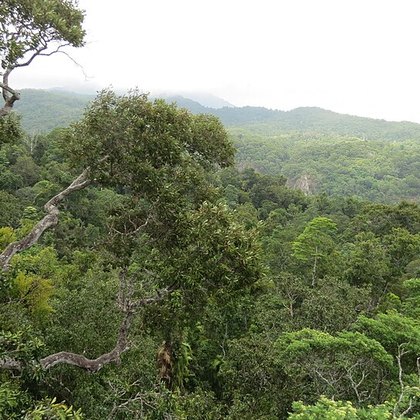
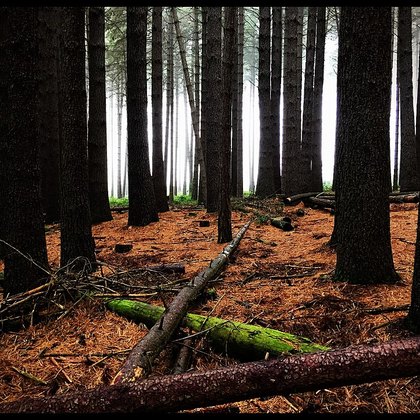
Tall dense remnant forest of Norfolk Island pine (Araucaria heterophylla) with native understorey in the national park on Mount Pitt and Mount Bates, under three hundred hectares in all. From there it moves out into adjoining eucalypt plantation, orchards and gardens to feed on seed, fruit, buds and flowers. It nests in cavities in old thick-trunked trees, and it is precisely those that have grown scarce on the island.
Where the bird is most often found, arranged by main group and formation.


Range and movements
Norfolk Island only, and within it essentially the Norfolk Island National Park and the forest and gardens immediately around it. It does not migrate and does not leave the island. The related bird of Lord Howe Island was wiped out in the nineteenth century, leaving the Norfolk bird the last of this group in Australian territory.
- Resident
- dark = core range, pale = thinly spread
Where and when to look
Go early to the lookout deck at the Botanic Gardens, the start of the Mount Bates track or the valley at Palm Glen, and stand and listen: the hard kek-kek-kek gives the bird away before anything moves. Follow the sound and then look for movement in the crowns of the pines, or watch for a bird crossing between two forest edges. Orchards on the park boundary are the best chance when fruit is on.
Conservation
The Red List still places this bird within the widespread Red-crowned Parakeet and so formally gives Least Concern (LC), but that does not describe the reality: Australia protects it as a threatened species and its entire world population lives on one island. By the late 1970s fewer than fifty birds were left; predator control and nest boxes from 1987 raised more than two hundred and fifty chicks to fledging by 2000, and a 2009 count put the population at about two hundred and forty. Then it fell again: a 2013 survey estimated just forty-two to ninety-six birds, with only ten confirmed adult females in some three hundred hectares of remnant forest. In 2014 seventy-eight rat- and cat-proof nest sites were built within twelve months, with a smooth cement rim around the entrance; breeding pairs rose from ten to about twenty-two, by 2015 the population stood at roughly two hundred and twenty, and in 2016 seventy per cent of nests produced young against a historical rate rarely above forty per cent. Black rats, feral cats and competition for hollows with Crimson Rosellas and Common Starlings remain the core of the problem.
Scientific name
Cyanoramphus cookii | (Gray, 1859)
George Robert Gray described the species in 1859 as Platycercus Cookii; because of its placement in Cyanoramphus, author and year stand in parentheses. The epithet honours James Cook, who reported the bird when he landed on Norfolk Island in 1774. The type locality was given in error as New Zealand and has been corrected to Norfolk Island. For a long time the bird was treated as a subspecies of the Red-crowned Parakeet; it is now handled as a species of its own, and also appears in the literature as Tasman Parakeet.