All species › Parrots › Old World parrots › Red-crowned Parakeet
Red-crowned Parakeet | Cyanoramphus novaezelandiae
Roodvoorhoofdkakariki | Perico maorí cabecirrojo
The Red-crowned Parakeet is the best known of the six kakariki: an emerald-green, long-tailed parakeet with a crimson forehead and a red stripe running through and behind the eye. It is the largest and loudest of the small kakariki, and today mainly a bird of predator-free islands.

Voice
The flight call is the characteristic kakariki chatter, a rapid clattering ke-ke-ke-ke-ke that carries out over the water from an island. Beneath it runs a range of softer contact notes, including a murmured tur-tur-tur between members of a pair. The voice is clearly lower and fuller than that of the Yellow-crowned Parakeet, which in mixed flocks is often the first difference noticed.
No freely licensed recording has been found for this species yet; what to listen for is described below.
Identification
A parakeet of twenty-five to twenty-eight centimetres, more than half of it tail, weighing seventy to eighty grams. The plumage is plain emerald green, yellower below. Red sits on the forehead and fore-crown, in the lores, as a band continuing behind the eye, and as a patch on each side of the rump. The leading edge of the primaries is bright cyan blue and flares the moment the wing opens. The bill is pale bluish-grey with a black tip; the male is larger and heavier-billed than the female.
Confusion species
Yellow-crowned Parakeet (Cyanoramphus auriceps) is smaller, with a yellow crown and only a narrow red band just above the cere, and lacks red behind the eye — the most reliable mark, but one that needs a good view of the head. Malherbe's Parakeet (Cyanoramphus malherbi) is smaller again and paler, with an orange rather than red frontal band. Chatham Islands Parakeet (Cyanoramphus forbesi) has a yellow fore-crown and a red band that stops short of the eye. Antipodes Parakeet (Cyanoramphus unicolor) is far larger and has no red or yellow on the head at all.
Habitat
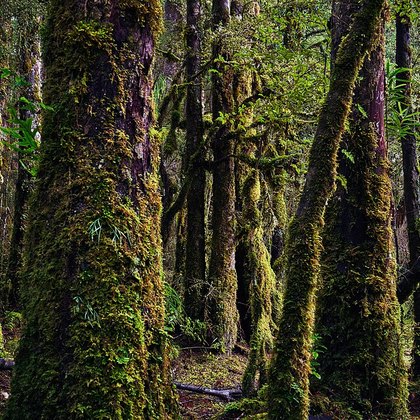
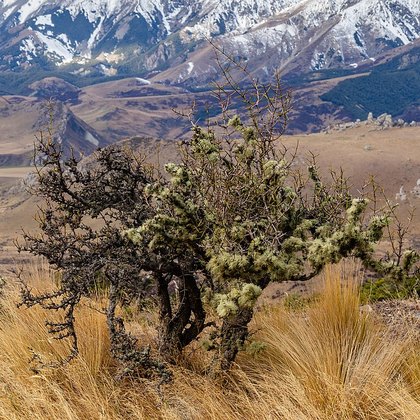
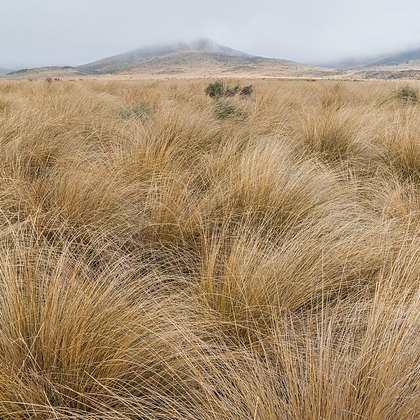
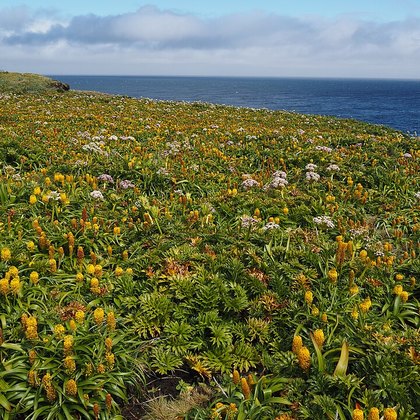
From podocarp-broadleaf and beech forest through low manuka scrub to tussock fields and even bare grassy islets: on predator-free islands it uses anything that yields seed, buds and berries, and forages on the ground as readily as in the canopy. It nests in tree cavities and rock crevices, and on treeless islands in burrows under tussock pedestals. In Wellington it visits gardens and parks around the fenced sanctuary.
Where the bird is most often found, arranged by main group and formation.

Range and movements
Now largely confined to pest-free offshore and outlying islands, from the Kermadec Islands in the north east to the Chathams and south to the Auckland Islands, with strongholds on Little Barrier, Tiritiri Matangi, the Mercury Islands, Kapiti, Codfish and Stewart Island. On the North and South Island mainland it has become rare; the one place it is seen regularly is Wellington, where it has spread into the city from the fenced sanctuary at Zealandia.
- Resident
- Breeding (summer)
- dark = core range, pale = thinly spread
Where and when to look
Look for it on a predator-free island along the forest edge and above the scrub: parties almost always call in flight, so wait for the chatter and then check the blue on the leading edge of the wing. On the ground, among fallen litter and seeding grass, it is surprisingly inconspicuous — listen for the clicking of the bill. At Zealandia in Wellington a bench at the sanctuary edge will do the job.
Conservation
Least Concern (LC) globally, but in New Zealand it is classed as a relict: it has all but gone from the mainland to stoats, rats and possums, which rob the nest cavities. On islands where those predators have been removed it recovers fast, and reintroductions to Tiritiri Matangi, Motuihe and Zealandia have shown that the species returns as soon as the predators are gone. That makes it one of the clearest gauges of New Zealand island restoration.
Scientific name
Cyanoramphus novaezelandiae | (Sparrman, 1787)
Sparrman described the species in 1787 as Psittacus Novae Zelandiae, from material taken at Dusky Sound on the South Island; because it was later moved to another genus, author and year stand in parentheses. The genus Cyanoramphus was introduced by Bonaparte in 1854 and is formed from Greek kuanos 'blue' and rhamphos 'bill', for the bluish-grey bill. The epithet simply means 'of New Zealand'. Kakariki is Maori and means 'small green'.