All species › Parrots › Old World parrots › Antipodes Parakeet
Antipodes Parakeet | Cyanoramphus unicolor
Groene kakariki | Perico de las antípodas
The Antipodes Parakeet is the largest of its genus and the only one with no red or yellow on the head at all: plain green from crown to tail, with a heavy pale grey bill. It lives on one treeless subantarctic island, walks among the tussock pedestals there, and does not feed on plants alone.

Voice
The call is a deeper, louder kok-kok-kok-kok-kok than that of any other kakariki — heavy, slow and easily told apart. Alongside it comes a range of softer chattered notes between birds. On the Antipodes the deep call is decisive at once, because the island's other parakeet sounds much higher.
No freely licensed recording has been found for this species yet; what to listen for is described below.
Identification
At thirty-two centimetres in the male and twenty-nine in the female, and averaging a hundred and thirty grams, by far the largest kakariki — almost twice the weight of a Red-crowned Parakeet. The plumage is uniformly green with no red or yellow on head or rump. The bill is very large and pale grey, the wings broad and rounded, with a pale blue leading edge to the outer primaries. The male is clearly larger than the female.
Confusion species
On the Antipodes themselves only Reischek's Parakeet (Cyanoramphus hochstetteri) comes into it, which occurs there too: far smaller, with a red crown and a red eye-stripe, so separable without binoculars. All other kakariki, including Red-crowned Parakeet (Cyanoramphus novaezelandiae) and Yellow-crowned Parakeet (Cyanoramphus auriceps), carry red or yellow on the head and are smaller and slenderer-billed; and none of them occurs on this island.
Habitat
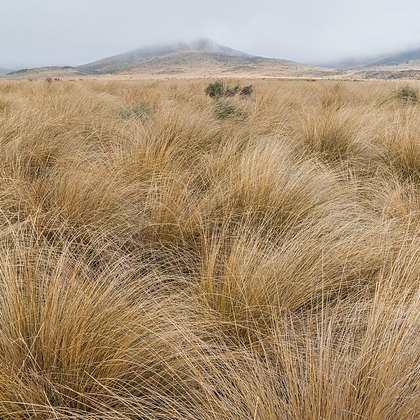
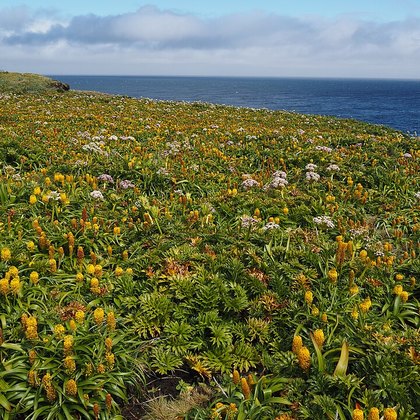
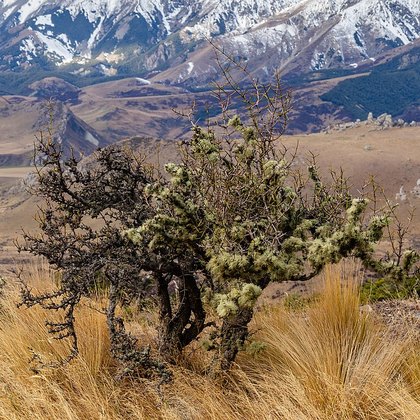
Tall dense tussock and sedge, above all where these stand on slopes and along streams; the island has no trees, so it forages largely on foot over the ground and among the pedestals. It nests in burrows under tussock and in rock crevices. Part of its food is animal: it takes flesh from the carcasses of seabirds and actively hunts nesting Grey-backed Storm Petrels.
Where the bird is most often found, arranged by main group and formation.
Range and movements
The Antipodes Islands alone, some seven hundred kilometres southeast of Stewart Island: common throughout the main Antipodes Island of just over two thousand hectares, and in smaller numbers on Bollons Island and the other satellites. It occurs nowhere else in the world, not even as a vagrant to New Zealand's other subantarctic islands.
- Resident
- dark = core range, pale = thinly spread
Where and when to look
The island is a closed nature reserve reachable only by permit, so in practice you see the species from an expedition ship or on management work. Then look down rather than up: the birds walk among the tussock and come out into clearings and around the huts. If you hear a parakeet, mind the pitch — deep and slow is this species, high and fast Reischek's Parakeet.
Conservation
Vulnerable (VU), with numbers put at one to two thousand birds and a New Zealand status of naturally uncommon. The entire range fits on one island, so a single predator incursion could sweep the species away. The largest intervention so far was the removal of the house mouse, which had held the island since the nineteenth century: the Million Dollar Mouse operation spread bait in 2016 and the island was declared mouse-free in 2018, with a reserve group of birds held in New Zealand zoos during the work. Strict quarantine at every landing is meant to keep another rodent from getting ashore.
Scientific name
Cyanoramphus unicolor | (Lear, 1831)
Lear described the species in 1831 as Platycercus unicolor, in his Illustrations of the family of Psittacidae; because of the move to Cyanoramphus, author and year stand in parentheses. The epithet is Latin for 'of one colour', for the plain green plumage without the red and yellow head pattern of its relatives. No locality was given; it is now taken as Antipodes Island.